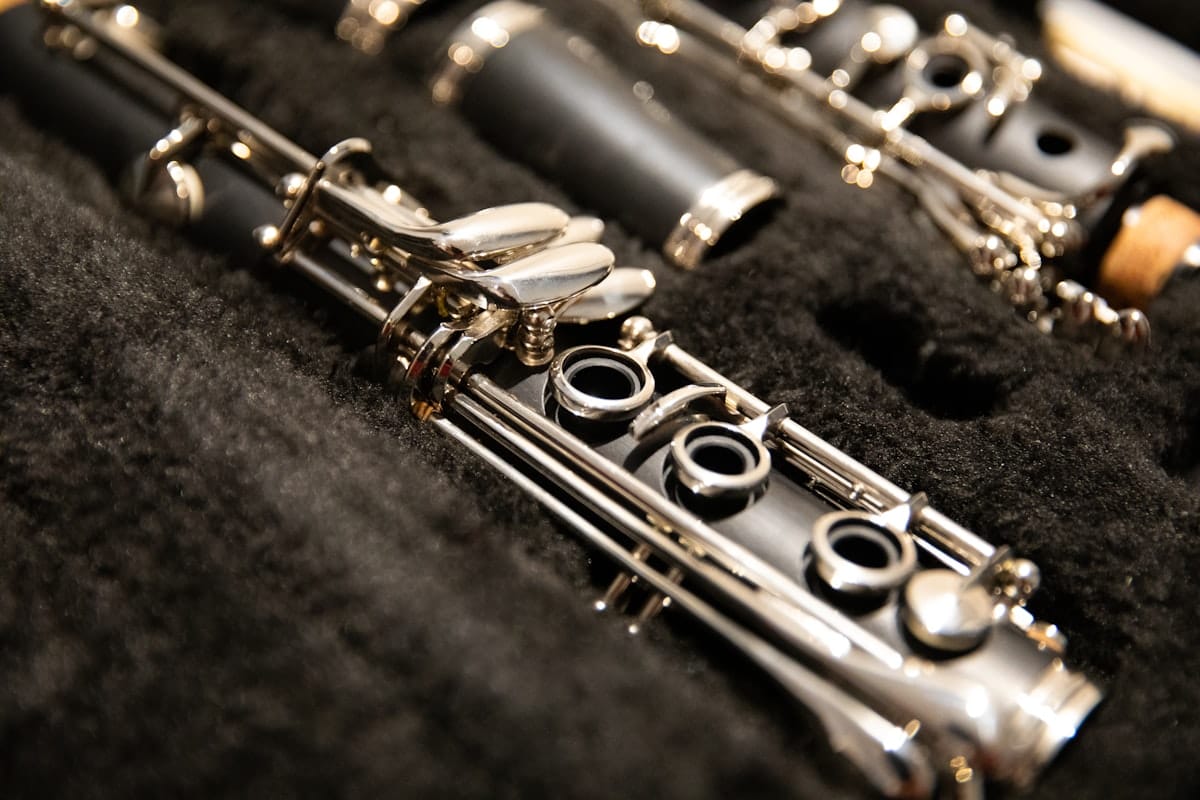
Clarinet parts are written a tone or a minor third above what actually sounds, and the transposition trips up anyone working from a concert-pitch sketch. A clarinet sheet music maker handles the transposition, the range, and the playback so you write the part the player reads. Flat runs in your browser with the transposition built into every clarinet you pick. This article walks through writing your first clarinet score, the clarinet-specific features that matter, and how to share or export what you've written.
Writing your first clarinet score in Flat
Open Flat, sign in, and start a new score. When you pick clarinet from the instrument list, Flat sets up a treble-clef staff with the correct transposition for the instrument you chose. Pick Clarinet in Bb and the staff is written a major second above concert pitch; pick Clarinet in A and it's a minor third above. Click any rest and either type the note name or click the staff position. The step-by-step tutorial covers the basics if you want a fuller walkthrough.
Clarinet-specific features that matter
A clarinet part isn't just notes in treble clef. Here's what Flat gives you for the things clarinetists actually need to write:
- Automatic Bb and A transposition. Pick Clarinet in Bb or Clarinet in A from the instrument list and Flat handles the transposition for you. Change your mind mid-piece and switch the instrument: Flat re-transposes the existing notes to keep them sounding the same.
💡 How transposition works in Flat. - Slurs for legato phrasing. Clarinet phrasing relies on slurs that tell the player which notes to take in one breath. Select the first note, press S, and Flat draws the slur. The playback respects the slur and connects the notes underneath it.
💡 How to slur notes. - Articulations for tonguing. Staccato, tenuto, accent, marcato, and detached legato cover the everyday tonguing markings clarinetists read. Each one is one click on the articulation toolbar.
💡 Articulations in Flat. - Trills and grace notes. Trills and ornaments are everywhere in clarinet repertoire from Mozart to klezmer. Flat puts trills, mordents, turns, and grace notes on the ornament toolbar so you don't have to draw them in by hand.
💡 How to add a trill. - Crescendos and dynamics that play back. Hairpins and dynamic letters (pp through ff) are on the dynamics toolbar, and the playback engine actually shapes the volume along the hairpin. A long crescendo into a forte sounds like one in your preview.
💡 Crescendo and diminuendo. - Key signature changes mid-piece. Many wind ensemble parts modulate. Flat lets you drop a new key signature on any measure and the engraving redraws the accidentals from that point on.
💡 Adding a new key signature.
Sharing and exporting your clarinet score
When the score is ready, click Share for a public link, invite collaborators by email for real-time editing, or open the export menu to download as PDF, MIDI, or MusicXML. PDF is what most clarinetists want on a stand or tablet, already transposed to the player's part. MIDI sends the line into a DAW. MusicXML lets another notation tool open the file with the transposition and articulations intact. A band director can send a transposed Bb clarinet part to a student while keeping the concert-pitch score for themselves.
Find inspiration in the Flat community
Flat hosts more than 100,000 user-published scores, including a lot of clarinet solos, duets, and ensemble parts. Browse the community scores to see how other composers handled the transposition, voiced an altissimo passage, or paced a slow line. You can clone any public score into your own account and start editing from there.
Why Flat for clarinet
Most clarinet notation tools require an install and a learning curve before you write a single note. Flat opens in your browser, the Bb or A transposition is set the moment you pick the instrument, and the playback uses recorded clarinet samples instead of a generic reed sound. Real-time collaboration lets a teacher, accompanist, or arranger work in the same score with you without sending files back and forth.
Ready to write your first clarinet piece? Try Flat for free!
FAQ
How do I write clarinet sheet music online for free?
Sign up for a free Flat account, create a new score, pick Clarinet in Bb or Clarinet in A, and start entering notes. The free tier covers personal use including PDF export and public sharing.
Does Flat transpose for clarinet automatically?
Yes. When you pick Clarinet in Bb the staff is written a major second above concert pitch, and Clarinet in A is a minor third above. Change instruments mid-piece and Flat re-transposes the existing notes.
Can I write a concert score and export a transposed clarinet part?
Yes. Flat lets you toggle the display between concert pitch and transposed pitch, and the PDF export uses whichever view you have set, so you can hand a player the correctly transposed part.
Can I export my clarinet score to PDF?
Yes. Open the score, click Export, and choose PDF. MIDI and MusicXML are also available so you can move the part into a DAW or another notation tool.
Can I collaborate with another musician on a clarinet score in real time?
Yes. Share the score with other Flat users and you can both edit and view it at the same time. Useful for teachers reviewing student parts or chamber duets working remotely.