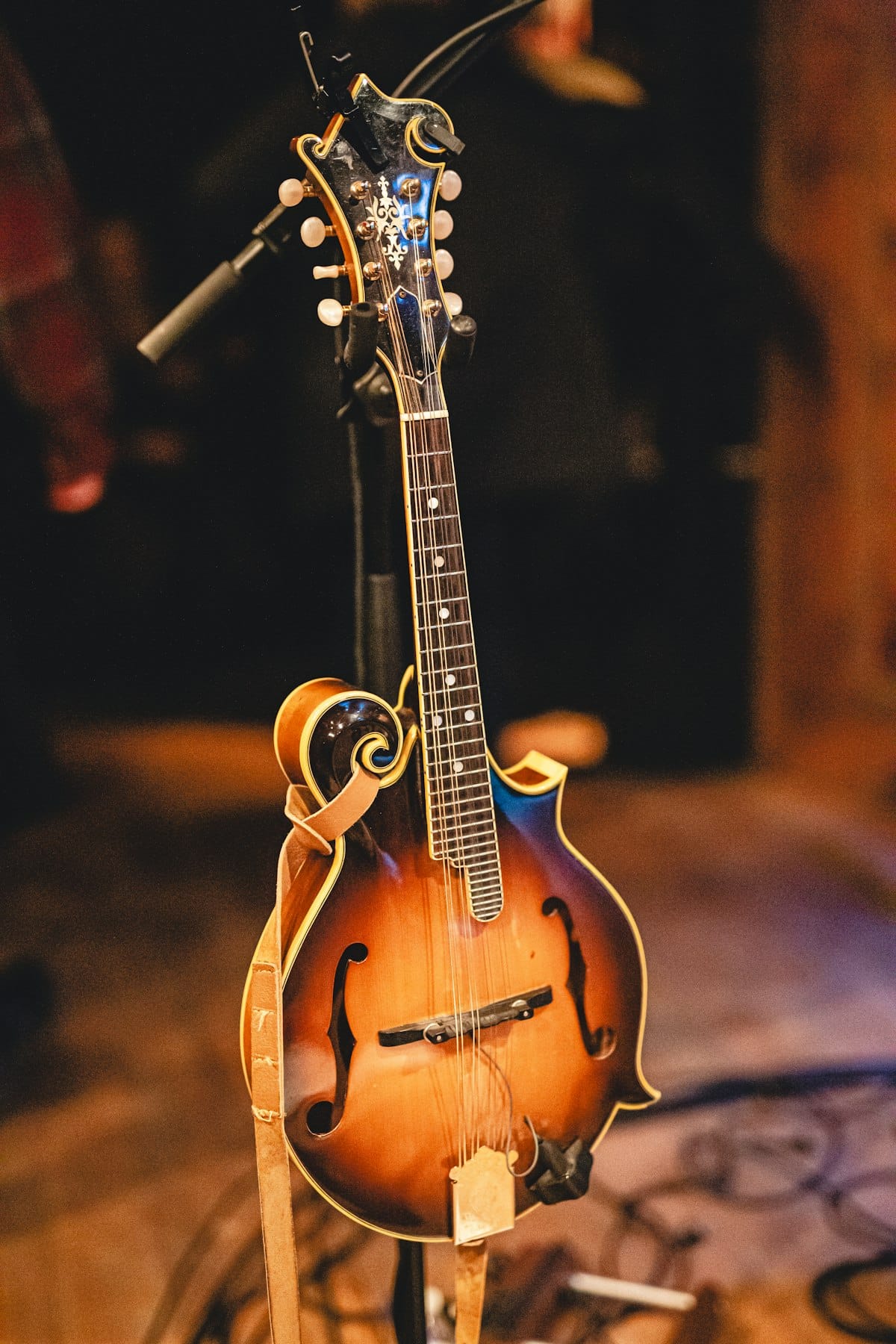
Mandolin tab lets you write a part by string and fret, which suits an instrument tuned in fifths where the same melody can fall under the fingers in very different ways. It also keeps the four courses clear, so a tremolo line or a pair of double stops reads cleanly. This article covers what mandolin tab is, how to write it in Flat, and the tuning and techniques that matter for mandolin.

What mandolin tab is
The mandolin has eight strings arranged in four courses, each course a pair tuned in unison, and the courses are tuned in fifths: G, D, A, E from low to high, the same as a violin. Mandolin tab represents the four courses, with a number telling you which fret to press.
Tuning in fifths means a scale or melody can be fingered several ways across the neck, and standard notation alone won't tell you which position to use. Tab names the string and fret, which is why it is handy for working out efficient fingerings on the mandolin.
Tab is weak on rhythm, so a standard notation staff above the tab keeps note values clear, useful for the fast, even subdivisions mandolin parts often use.
How to write mandolin tabs in Flat
Pick a mandolin in Flat and you get a tab staff paired with standard notation, both kept in sync.
- Create a new score and pick a mandolin. Flat adds a tab staff under the notation staff, tuned in fifths.
- Enter notes by fret or by pitch. Type fret numbers on the tab staff, or enter pitches on the notation staff. Arrow keys move a note to a different string.
- Confirm or customize the tuning. Standard mandolin is GDAE; set a custom tuning in instrument settings if you play in an alternate one.
- Add chords and articulations. Add chord grids for chop chords, and use slides, hammer-ons, and pull-offs for melodic passages.
- Share or export. Export to PDF or MusicXML, or share a link that others can clone and edit.
💡 Full reference: writing tab in Flat.
Mandolin techniques that matter in tab
Mandolin parts lean on tremolo, double stops, and chop chords, and the way you write them comes down to tuning and clear fingerings.
- Tune in fifths. Standard mandolin is GDAE, the same intervals as a violin. Set it as a custom tuning if you need an alternate one, so the fret numbers map to the right pitches.
💡 Tuning settings. - Use chord grids for chop chords. Mandolin rhythm playing often uses closed chord shapes moved up the neck, and a chord grid shows the shape above the staff.
💡 Chord grids in Flat. - Write double stops as stacked notes. Two notes on adjacent courses form the double stops common in fiddle-tune mandolin, entered by adding both pitches on the same beat.
- Notate slides and slurs. Slides, hammer-ons, and pull-offs capture the ornaments in bluegrass and folk mandolin lines.
💡 Tab tools. - Keep the notation staff for tremolo and fast passages. Tremolo and rapid runs are hard to read from fret numbers alone, so the standard staff above the tab keeps the rhythm clear.
- Import existing files. Flat opens MusicXML, MIDI, and Guitar Pro files (.gp, .gpx, .gp5, .gp4, .gp3) in the browser. Importing scores and tabs.
Try it yourself in Flat
Open a new score, pick Mandolin, and Flat adds the paired notation and tab staff. Enter a G major scale and watch it lay out across the fifth-tuned courses, then try the same notes a string higher to compare fingerings. The notation staff above keeps the rhythm clear when you add faster passages.
Create a free Flat account to write your first mandolin tab.
Find mandolin tab inspiration in the Flat community
The Flat community has over 100,000 public scores, including mandolin parts from bluegrass and folk to classical. Browse popular scores in Flat to see how others notate double stops and ornaments, then clone any public score to edit it yourself.
Ready to write your first mandolin tab? Try Flat for free.
FAQ
Do I need to read standard notation to write mandolin tab in Flat?
No. You can enter notes directly on the tab staff by selecting a string and typing the fret number. The standard notation staff updates automatically and can be hidden if you only want tab.
Can I set the mandolin's GDAE tuning in Flat?
Yes. Standard mandolin is GDAE, tuned in fifths like a violin. Set it as a custom tuning in instrument settings if you need an alternate one. Flat supports any string count from 3 to 14.
Can I add chord grids for chop chords?
Yes. Chord grids show a small fretboard diagram with finger positions above the staff, which helps with the closed chop-chord shapes mandolin players move up the neck.
Can I import Guitar Pro or MusicXML files?
Yes. Flat opens Guitar Pro files (.gp, .gpx, .gp5, .gp4, .gp3) as well as MusicXML and MIDI in the browser, with no desktop app required.
Can I export my mandolin tab as a PDF or MusicXML?
Yes. Both formats are supported, along with MIDI and audio. PDF is best for printing and MusicXML for moving the part into another notation tool.