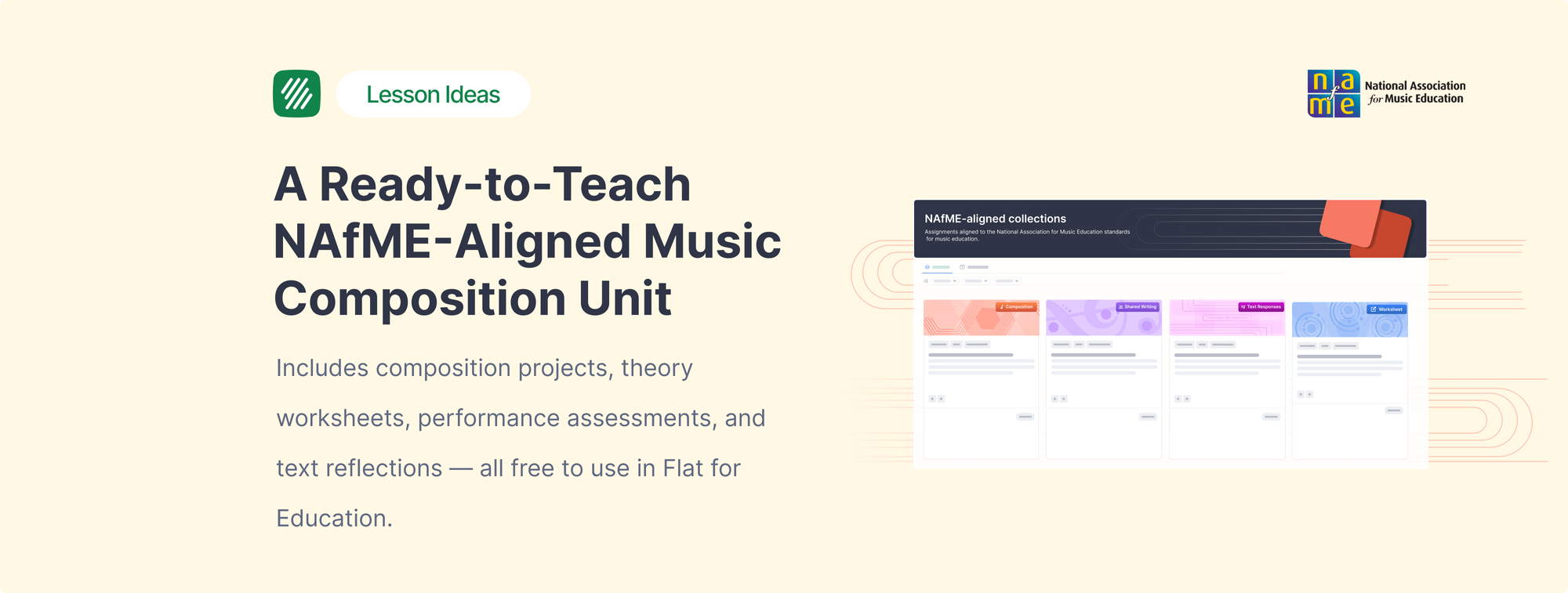
The Documentation Problem No One Warned You About
You became a music teacher to teach music.
But somewhere along the way, a significant part of the job became proving you're teaching music to administrators, to curriculum coordinators, to anyone who asks whether your program is aligned to the National Core Arts Standards.
Most digital tools make this harder, not easier. They give students a place to compose or record, but they leave the curriculum design, the standards mapping, and the assessment documentation entirely to you. You end up with a great student experience and a paperwork problem.
This unit is built differently. Every lesson does the musical work and documents it at the same time.
What This Unit Is (And What It Isn't)
This is a free, nine-lesson instructional unit for middle school general music, band, orchestra, or choir — grades 6, 7, and 8.
It is not a collection of standalone activities. It is a complete instructional arc: students compose a melody, develop it into a structured musical form, combine it with their classmates' work into an ensemble piece, rehearse it, record a final performance, and reflect critically on the result. The musical product grows across all nine lessons. So does student understanding.
Every lesson includes:
- Explicit NAfME National Core Arts Standards references (strand and standard code)
- A teacher implementation guide with timing, differentiation options, and common misconceptions
- A structured student task flow so students always know what they're doing and why
- A rubric-ready assessment framework: no reverse-engineering required
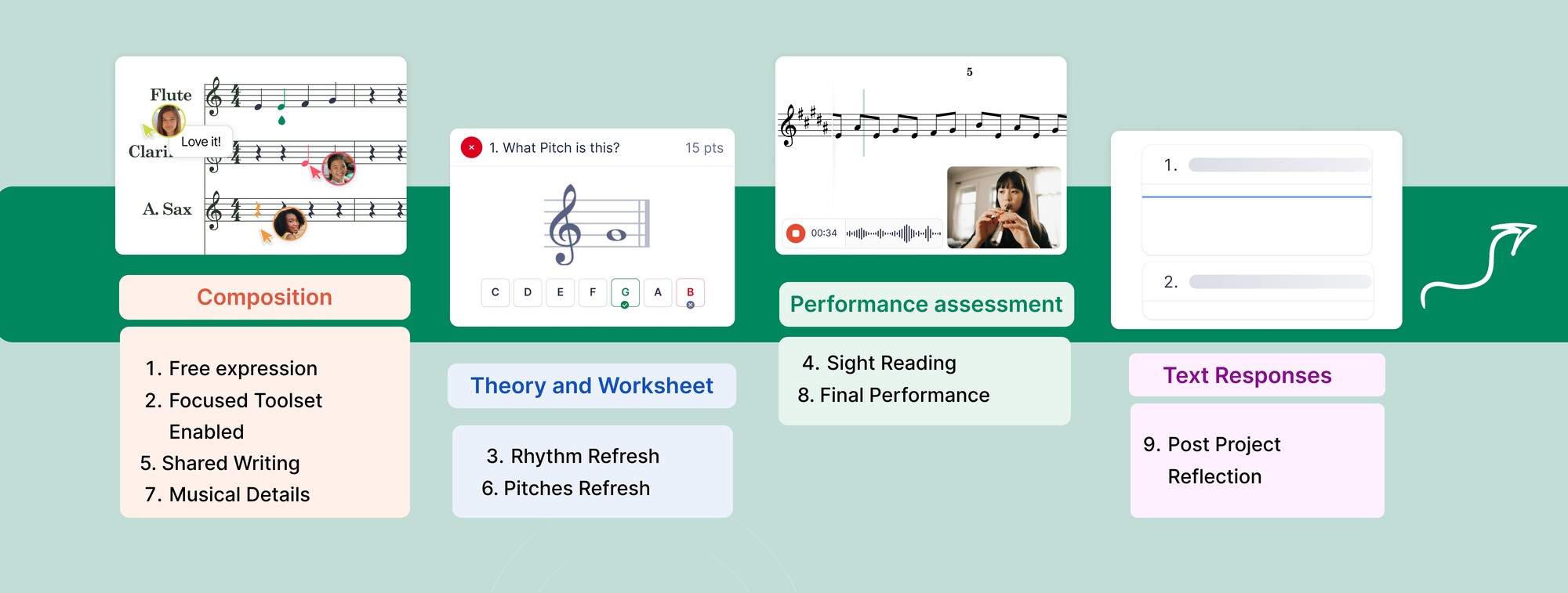
| Lesson | Title | Focus |
|---|---|---|
| 1 | The Sonic Sketchpad | Interface fluency, free composition |
| 2 | The ABA Sandwich | Ternary form, composition with constraints |
| 3 | Rhythm Boot Camp | Rhythmic literacy, auto-graded worksheet |
| 4 | The Harmonic Convergence | Shared writing, chord alignment |
| 5 | The Step-by-Step Sight-Reader | S.T.A.R. method, recorded performance |
| 6 | The Staff Navigator | Pitch literacy, auto-graded worksheet |
| 7 | Contrast & Texture | Dynamics, articulation, expressive form |
| 8 | The Studio Session | Final ensemble performance recording |
| 9 | The Critical Listener | Self and peer reflection, musical vocabulary |
How This Unit Covers the Standards You Actually Need to Document
The unit addresses all four NAfME artistic processes as an integrated sequence, not as a checklist.
Create. Students generate, develop, and refine melodic ideas within structured compositional constraints in lessons 1, 2, 4, and 7. Composition isn't a one-off project here; it's a thread that runs through the entire unit.
Perform. Students record a sight-reading performance in lesson 5 and a full ensemble recording in lesson 8, with explicit attention to balance, synchronization, and technical accuracy.
Respond. Lesson 9 is dedicated to evaluation. Students assess their own recorded performance and provide structured, vocabulary-driven written feedback to a peer ensemble.
Connect. The unit as a whole treats composition and performance as integrated, ongoing practices rather than isolated events separated by weeks of unrelated activities.
For curriculum mapping or administrator review, every lesson lists its NAfME strand and standard code in the teacher guide. You do not have to reverse-engineer the alignment. It is already documented.
👉 Watch the full playlist on YouTube
Why This Works in a Real Classroom
This unit was designed around the constraints that actually exist in middle school music programs:
40–50 minute class periods. Each lesson is self-contained and completeable in a single session. There are no lessons that require carrying half-finished work across two or three class meetings before students reach any conclusion.
Mixed ability levels. Every lesson includes a support pathway for students who need more scaffolding and an extension pathway for students who are ready to go further. You don't have to build those branches yourself.
Flexible instrumentation. The unit works in general music, band, orchestra, and choir settings. It does not assume a specific instrument or ensemble configuration.
Any device, no installation. Everything runs browser-based on Chromebooks, tablets, and laptops. Students open a score, annotate, record, and submit without downloading anything.
Built-in diagnostic data. Lessons 3 (Rhythm Boot Camp) and 6 (The Staff Navigator) include auto-graded worksheets that give you immediate data on rhythmic and pitch literacy before students move into the more complex ensemble and performance work. That data is useful for instruction and for any program evaluation process that asks you to demonstrate student growth over time.
How Flat for Education Makes This Possible
Every lesson runs inside Flat for Education, which means students and teachers share a single environment for composition, collaboration, performance, and assessment. No separate apps. No file management. No emailing recordings back and forth.
The platform features that power this unit:
- Browser-based notation editor accessible on any device, no download required
- Real-time shared writing so students collaborate on the ensemble composition in lessons 4 and 8 simultaneously, in the same score
- Version history so you can see exactly how student work evolved across every draft
- Built-in audio recording so students record and submit performances directly within the score
- Auto-graded worksheets with instant diagnostic results for lessons 3 and 6
- LMS integration with Google Classroom, Canvas, Schoology, and Moodle
Everything lives in one place: standards alignment, student work, assessment records, and revision history, all accessible without switching between tools.
Get the Full Unit
Already have a Flat for Education account?
Go to your Assignment Library, then Sample Assignments, then Collections, then Unit 1. 👉 Or click here to view the folder directly.
Want the complete Teacher Companion?
The full nine-lesson teacher guide, including all lesson plans, student task flows, differentiation notes, and assessment rubrics, is free to download. 👉 Download the Teacher Companion
Not yet using Flat for Education?
Start a free trial and have the first lesson running in your classroom today. No credit card required. 👉 Start your free trial
Want implementation support?
Our team works directly with music departments on unit rollout, pacing, and standards documentation. 👉 Book a call with our team
Flat for Education is used by music teachers across the US to deliver NAfME standards-aligned instruction in middle school general music, band, orchestra, and choir programs. Our curriculum is built on the National Core Arts Standards and designed for the realities of the middle school music classroom.