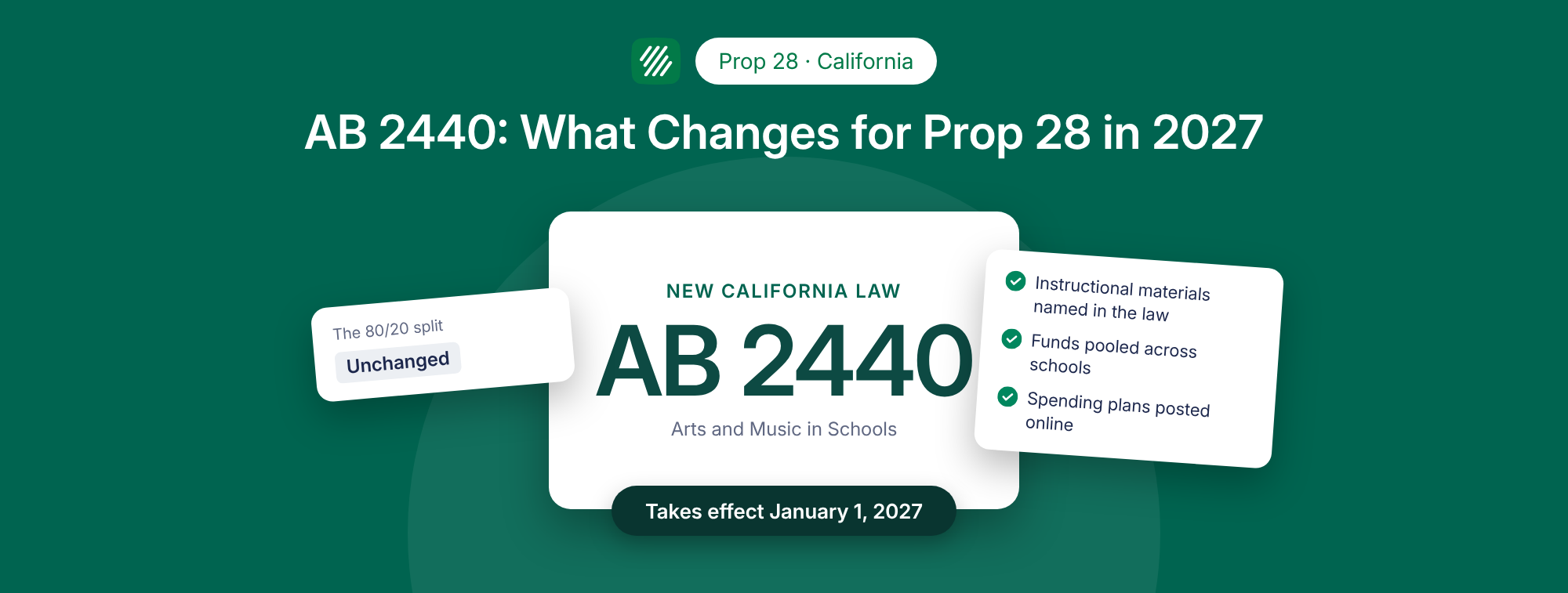
Prop 28 got its first real update this fall. Governor Newsom signed AB 2440 on September 27, 2026, and it takes effect January 1, 2027. If you plan arts spending in a California district, a few things you assumed about Prop 28 are about to change, and one thing everybody hoped would change didn't.
What is AB 2440?
AB 2440 (Chapter 606, Statutes of 2026) is a California law that amends the Arts and Music in Schools Act, the statute behind Prop 28. It widens what counts as an arts education program, lets districts pool funds across schools, and adds public posting, certification and audit requirements. It does not change the 80/20 split between arts staff and everything else.
What changes with AB 2440
Curriculum, instructional materials and professional development are named
The definition of an arts education program now explicitly includes curriculum, instructional materials and professional development. Programs must align with the California Arts Standards, the California Arts Education Framework, or the Preschool/Transitional Kindergarten Learning Foundations, as applicable. For music departments, that removes much of the guesswork around buying instructional software, method books or training with Prop 28 money.
Districts can pool funds across schools
Districts can now combine Prop 28 money from several schools, for example to share a music teacher between two sites or buy one license for all their music teachers, as long as each school's spending stays proportional to its allocation and follows its plan. Money still can't be moved away from the schools that generated it.
More public reporting
- Each school's expenditure plan, and any waivers, must be posted online.
- The annual board-approved report is due before September 30.
- The California Department of Education must post the 80% waivers it grants.
- From 2027–28, districts certify that the program was carried out correctly at each school site, and annual audits cover that certification.
Clearer rules on supplementing, not supplanting
The law spells out how districts show that Prop 28 adds to existing arts spending, including funds that expired or were one-time, so districts can compare against a fair baseline.
What AB 2440 doesn't change
| Rule | Before AB 2440 | From January 1, 2027 |
|---|---|---|
| 80/20 split (500+ students) | At least 80% on arts staff | Unchanged |
| Exemption under 500 students | Exempt from the 80% rule | Unchanged |
| Three-year spending window | Three fiscal years per allocation | Unchanged |
| Curriculum and instructional materials | Covered as supplies and materials | Named explicitly |
| Pooling across schools | Unclear | Allowed, proportional to each school's share |
| Expenditure plans posted online | Not required | Required |
So AB 2440 doesn't give districts more money for technology or materials. Those still come out of the share of up to 20%. What it does is make the case for instructional materials explicit, and make spending decisions more visible to parents and teachers.
What AB 2440 means for music teachers
- Asking for instructional software is easier to justify. "Instructional materials" is now in the law's definition, not just implied by "supplies."
- One district license gets simpler. Pooling lets a district buy a single agreement for every music teacher, instead of each school buying separately.
- You'll be able to see the plan. Once expenditure plans are posted, you can see what your school is spending Prop 28 on and ask about it.
How to prepare for 2027
- Read your school's current plan, or ask for it, before it's posted.
- Tie requests to the California Arts Standards and the framework, since programs must now align with them.
- Talk to colleagues at other schools. If several of you use the same tool, a pooled district agreement may now be the easiest route.
- Keep usage evidence for the certification and audit that start in 2027–28.
Flat for Education and the 2027 rules
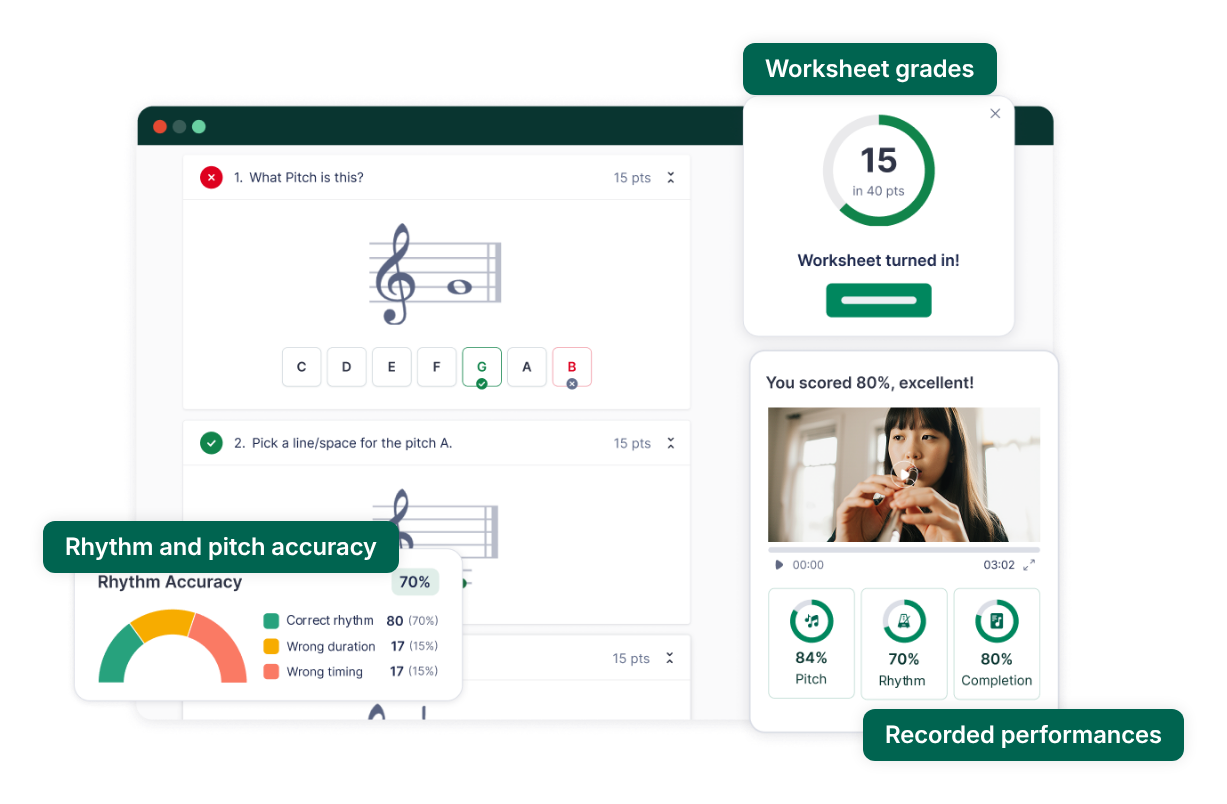
Flat for Education is music notation and assignment software that districts fund as supplies and materials today, and that counts as instructional materials from January 2027. It works for one school or as a single district agreement covering every music teacher, which is exactly what pooling now allows. Assignments, grades and recorded performances also give you evidence for the annual report. Read Prop 28 allowable expenses for the full rules, or request a quote for your district.

Sources: AB 2440 bill record, California Legislative Information, LACOE Prop 28 page. The CDE has said it will update its Prop 28 guidance for AB 2440; check its FAQ for the latest.
FAQ
What is AB 2440?
AB 2440 is a 2026 California law that amends the Arts and Music in Schools Act behind Prop 28. It was signed on September 27, 2026 and takes effect January 1, 2027.
Does AB 2440 change the Prop 28 80/20 rule?
No. Districts with 500 or more students must still spend at least 80% of Prop 28 funds on arts staff. Curriculum, materials and training still come from the share of up to 20%.
Can Prop 28 funds be pooled across schools after AB 2440?
Yes. From January 1, 2027, districts can pool Prop 28 funds across schools as long as each school's spending stays proportional to its allocation and follows its expenditure plan.
Do Prop 28 expenditure plans have to be public?
Under AB 2440, each school's Prop 28 expenditure plan and any waivers must be posted online, on the school's or the district's website.