Ask five people what Prop 28 can pay for and you'll get five answers. Some vendor pages say small schools get a "waiver." Some districts assume software isn't allowed. Neither is right. The rules are short, and once you see how the 80/20 split works, most questions about Prop 28 allowable expenses answer themselves.
This page is written for principals, VAPA coordinators and music leads who have to put a real plan together. Everything here comes from the California Department of Education's guidance, linked at the end.
What are Prop 28 allowable expenses?
Prop 28 allowable expenses are costs that directly support an arts education program for students: arts staff, instruction and training, supplies, materials and arts educational partnership programs. Music composition and ensembles are named among the eligible disciplines, alongside dance, media arts, theater, visual arts, folk art, coding, animation and film. Every purchase must add to what the school already spends on the arts, not replace it.
The Prop 28 80/20 rule, explained
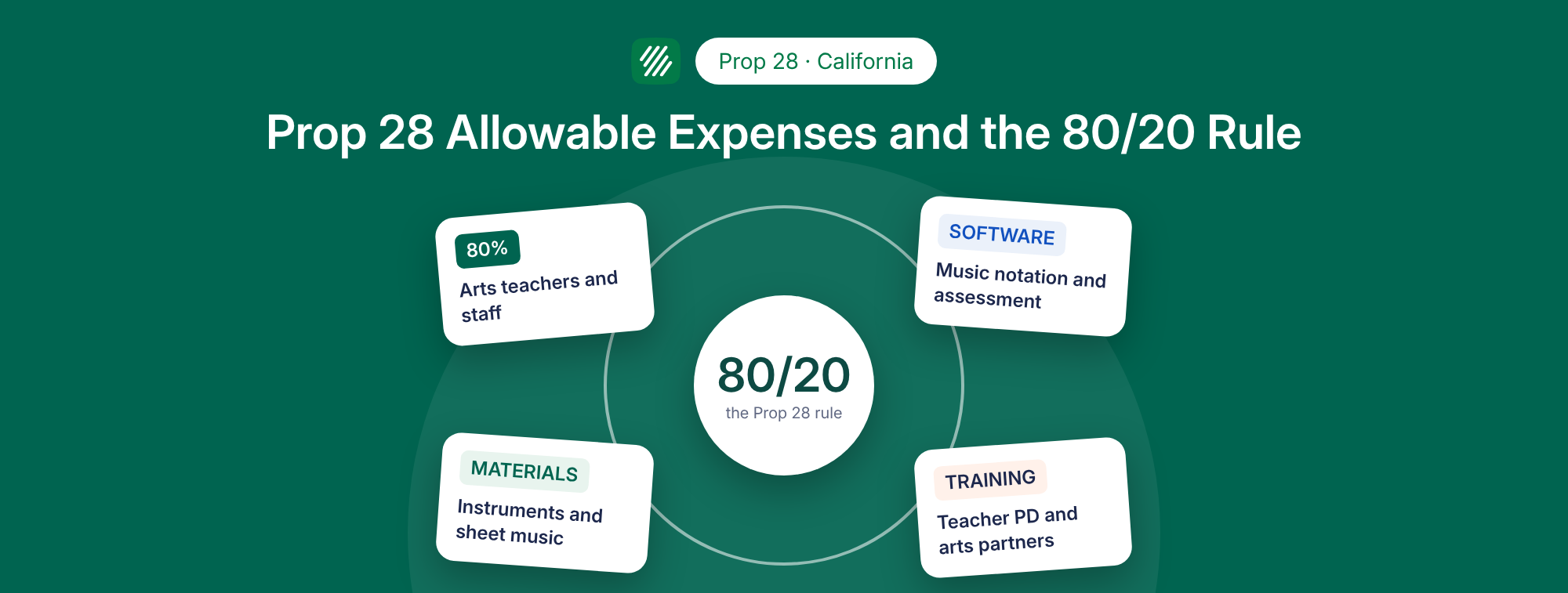
In districts and charters with 500 or more students, at least 80% of the Prop 28 money spent in a year must pay certificated or classified employees who provide arts instruction. The remaining share, up to 20%, can go to training, supplies, materials and arts partnerships.
Three details people miss:
- It's 80% of what's spent, not of what's allocated. The split applies to expended funds, so a school that spends a small amount on materials early in the year isn't out of compliance as long as the yearly totals balance.
- The 500-student threshold is about the district, not the school. It's based on the total enrollment of the local educational agency used to calculate its funding. A 300-student school in a 30,000-student district still follows the 80% rule.
- Districts under 500 students are exempt from the 80% rule. That's an exemption written into the law, not a waiver. Those districts must still follow every other requirement.
Where common purchases fit
| Expense | Which share | Notes |
|---|---|---|
| Music teacher salary (new position) | 80% (staff) | The main purpose of Prop 28 |
| Classified arts aide or accompanist | 80% (staff) | Classified employees count if they provide arts instruction |
| Music notation and assessment software | Up to 20% | Supplies and materials; AB 2440 names instructional materials explicitly from 2027 |
| Instruments, sheet music, recording gear | Up to 20% | Supplies and materials |
| Teacher training or PD | Up to 20% | Named in the law; AB 2440 adds professional development explicitly from 2027 |
| Contracted arts partner (teaching artists) | Up to 20% | Arts educational partnership programs; confirm structure with your business office |
| District administration | 1% cap | Including indirect costs |
Can Prop 28 pay for music software and other technology?
Yes, as supplies and materials, inside the 20% share. The California Department of Education doesn't list specific products, and there's no approved vendor list. The test is whether students use it for arts instruction and whether it adds to the program. A notation platform used for composition assignments passes easily. A general-purpose device that happens to sit in the music room is harder to defend.
Starting January 1, 2027, AB 2440 adds curriculum, instructional materials and professional development to the definition of an arts education program. It doesn't change the 80/20 split. More on that in AB 2440 and Prop 28: what changes in 2027.
What Prop 28 can't pay for
- Replacing existing spending. Moving a teacher or a software license your general fund already paid for onto Prop 28 is supplanting, which the law prohibits. AB 2440 tightens how districts document this.
- Costs without an instructional purpose. Assemblies, field trip buses or furniture with no clear link to arts teaching are hard to justify.
- Moving money between schools. Each site's allocation stays with that site. AB 2440 allows pooling across schools only if each school's spending stays proportional to its allocation.
The Prop 28 waiver: when it applies
The California Department of Education can waive the 80% staffing requirement for good cause, for example when a district can't hire qualified arts staff. A waiver covers the whole district and must be requested again for each allocation year. From 2027, waivers granted will be posted publicly. A waiver is the exception, so don't build a plan that depends on one.
How to check a purchase against the rules
- Confirm your district's enrollment bucket. Over or under 500 students decides whether the 80% rule applies.
- Check it's new or expanded. If the general fund paid for it last year, it probably can't move to Prop 28.
- Name the instructional use. Which students, which classes, which standards.
- Put it in the site expenditure plan. The principal writes it, and it gets posted publicly from 2027.
- Keep the evidence. Quotes, invoices and usage data make the annual report easy.
Where Flat for Education fits
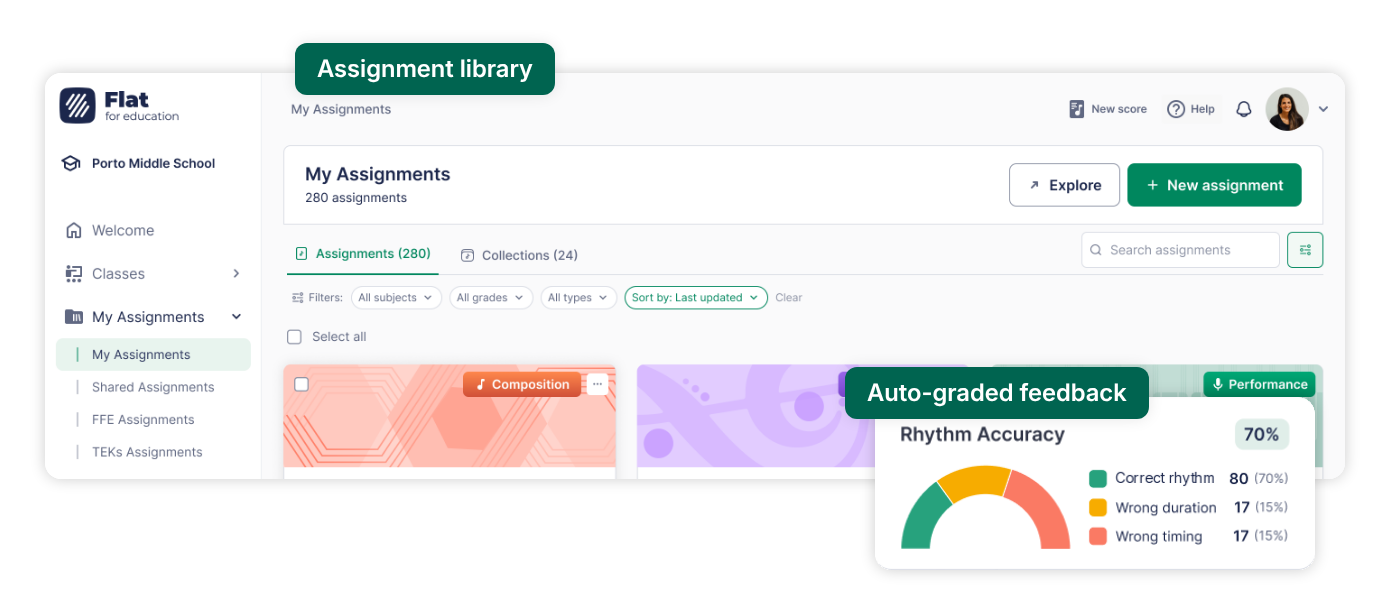
Flat for Education is a music notation and assignment platform that schools fund as supplies and materials, inside the 20% share. One license covers composition, theory, sight-reading, practice tools and performance assessment for every student in the music program, in the browser, with integrations for Google Classroom, Microsoft Teams, Canvas, Schoology and ClassLink. Teachers can use our Prop 28 request templates to ask for it, and districts can request a quote for their Prop 28 plan.
Sources: CDE Prop 28 FAQ (questions 9, 11, 13, 14, 17, 41–43), AB 2440 bill record. Reflects guidance as of November 2026; confirm details with your district business office.
FAQ
What is the Prop 28 80/20 rule?
In California districts with 500 or more students, at least 80% of the Prop 28 money spent each year must pay certificated or classified employees who teach arts. Up to 20% can go to training, supplies, materials and arts partnership programs.
Does the 500-student threshold apply to schools or districts?
To districts. It is based on the total enrollment of the local educational agency used to calculate its Prop 28 funding, so a small school in a large district still follows the 80% rule.
Are small districts exempt from the 80/20 rule?
Yes. Districts and charters with fewer than 500 students are exempt from the 80% staffing requirement by law, without needing a waiver. They must still meet all other Prop 28 requirements.
Can Prop 28 pay for instruments and music software?
Yes. Instruments, sheet music and music software count as supplies and materials, which fall in the share of up to 20% for districts with 500 or more students.
Can Prop 28 replace existing arts funding?
No. Prop 28 must supplement, not supplant, existing arts spending. Moving a cost the general fund already paid for onto Prop 28 is not allowed.