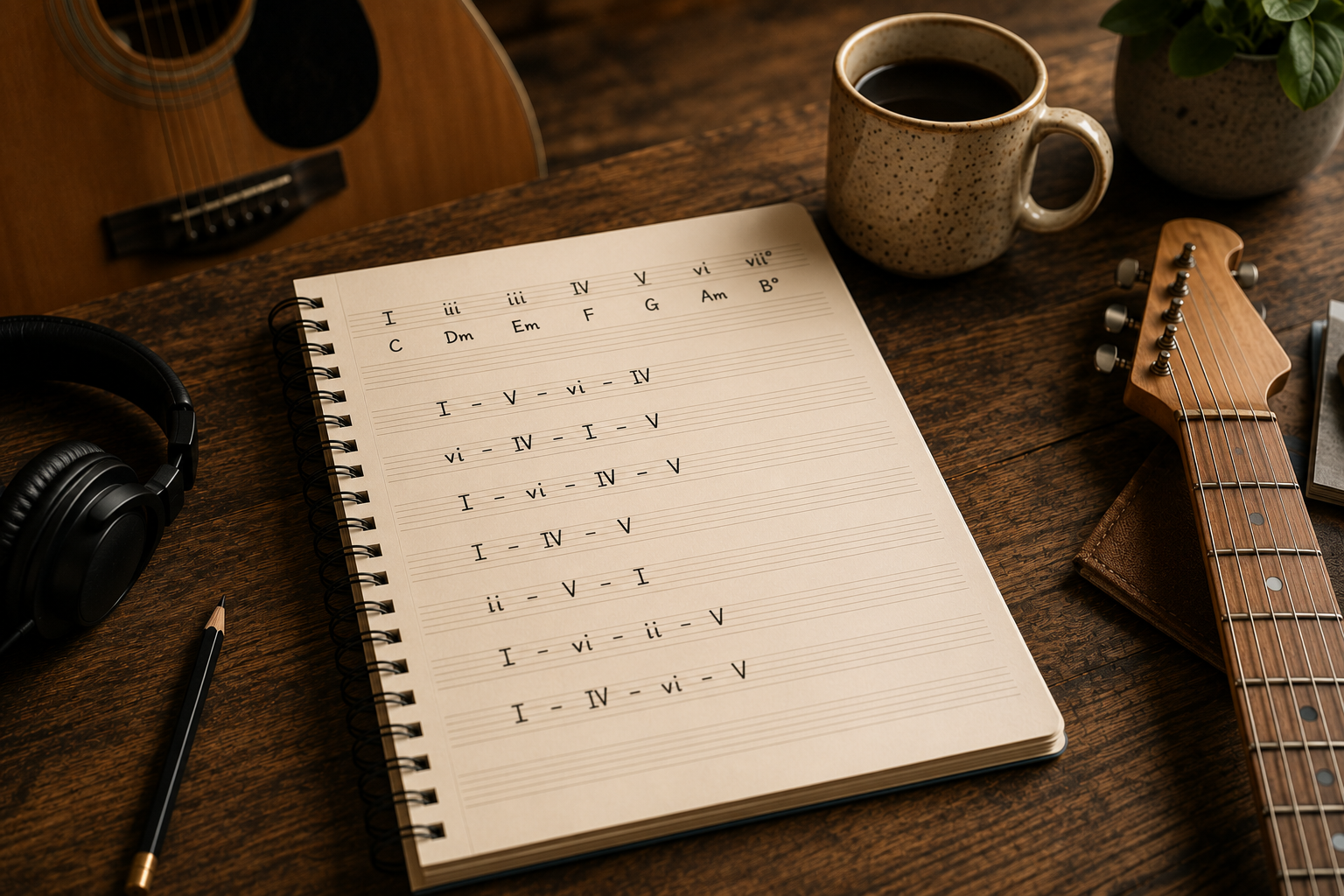
A chord progression chart does one useful thing: it lets you write a progression once, in roman numerals, and reuse it in any key instead of relearning it note by note. This guide collects the progressions you hear most often across pop, rock, jazz, and blues, shows each one in C major, walks the most popular one through the common keys, and names the songs that use them so you can hear what they do. Everything here can be built and played back in Flat, so keep it open as a reference whenever you need a starting point.

How to read this chart
Every progression below is written in roman numerals rather than letter names. A roman numeral stands for a chord's position in the key, not a fixed chord: I is the chord built on the first note of the scale, ii on the second, and so on up to vii. Uppercase means a major chord (I, IV, V), lowercase means minor (ii, iii, vi), and vii° is diminished. That pattern of qualities is identical in every major key, so once you have it memorized you can spell the chords of any key straight from its scale.
The reason musicians bother with numerals is portability. Written as letters, C, G, Am, F only describes one key; written as I–V–vi–IV, the same progression works everywhere, and transposing a song becomes as simple as renaming the numbers. It also makes each chord's job visible: I is home, V creates the strongest pull back toward home, IV is a gentler step away, and the minor chords fill in the color between them. Here are the seven chords of C major, numbered.
| Numeral | Chord in C major | Quality |
|---|---|---|
| I | C | major |
| ii | Dm | minor |
| iii | Em | minor |
| IV | F | major |
| V | G | major |
| vi | Am | minor |
| vii° | B° | diminished |
Those seven chords are all you need for everything below. If you later want the finer points, such as how sevenths and diminished chords are marked, our guide to roman numerals in music covers them.
The most common chord progressions
These are the progressions you will meet most often. Each is shown in roman numerals, with its sound in C major and a song or two where you can hear it. Notice how few chords are actually involved: nearly everything here is built from a small set, I, IV, V, vi, and ii, reshuffled into a different order.
| Progression | In C major | Where you hear it |
|---|---|---|
| I–V–vi–IV | C–G–Am–F | The "axis" of modern pop, heard in songs like "Let It Be" |
| vi–IV–I–V | Am–F–C–G | Emotional ballads; the "sensitive" rotation |
| I–vi–IV–V | C–Am–F–G | The 1950s doo-wop progression |
| I–IV–V | C–F–G | Rock and roll backbone: "La Bamba," "Twist and Shout" |
| ii–V–I | Dm–G–C | The cornerstone of jazz harmony |
| I–vi–ii–V | C–Am–Dm–G | The classic jazz and pop turnaround |
| I–IV–vi–V | C–F–Am–G | A bright, anthemic pop loop |
The reason these few chords do so much work is function. The I chord feels like home, the V chord creates the strongest pull back to it, and IV is a softer step away, so most of these progressions are just different routes out from home and back. Reorder the same chords and the story changes: start on vi instead of I and the loop turns wistful, end on V instead of I and it refuses to resolve, which is exactly why it can repeat under a whole chorus without feeling finished. Choose the one that matches the energy you are after, then write a melody over the top.
This walkthrough is a good way to hear four of them back to back.
The 12-bar blues
One progression is worth writing out in full, because it is a whole form rather than a short loop: the twelve-bar blues. It uses only I, IV, and V, arranged across twelve bars, and it is the backbone of blues, early rock and roll, and a great deal of jazz. Read the grid left to right, four bars per row.
| Bar 1 | Bar 2 | Bar 3 | Bar 4 |
|---|---|---|---|
| I | I | I | I |
| IV | IV | I | I |
| V | IV | I | I |
In the key of C those chords are C, F, and G, and blues players usually turn all three into dominant seventh chords (C7, F7, G7). That is where the form gets its gritty, expressive sound, because a dominant seventh never quite settles and keeps the music leaning forward. The last bar is where the turnaround happens: players often swap the final I for a V chord to push you back to the top for another verse, which is what lets a whole band jam over the same twelve bars for as long as they want.
You will hear variations of this everywhere. The most common is the quick change, which slips to the IV chord in bar 2 before returning to I, and players regularly stretch or compress the form into eight or sixteen bars. Learn the standard grid first and every variation reads as a small edit to it rather than a new thing to memorize.
The same progression in any key
Because a progression is just a set of numbers, you can move it to whatever key suits your singer or your instrument. Here is the axis progression, I–V–vi–IV, written out in the most common keys. The numerals never change; only the letters do, and the major or minor quality of each chord stays fixed no matter where you start.
| Key | I | V | vi | IV |
|---|---|---|---|---|
| C | C | G | Am | F |
| G | G | D | Em | C |
| D | D | A | Bm | G |
| A | A | E | F♯m | D |
| E | E | B | C♯m | A |
| F | F | C | Dm | B♭ |
Choosing a key is a practical decision more than a musical one. Singers pick the key that puts a song in a comfortable part of their range, and instrumentalists lean toward keys that sit well under the hands, such as G, D, and A on guitar. When a song feels a step too high or too low, you are not rewriting the progression at all, you are just sliding the whole chart to a neighboring key.
The same logic powers a favorite trick: shifting an entire song up a step for the final chorus, sometimes called the truck driver's modulation. The progression keeps its shape, only the key moves, and that jump in pitch adds a burst of energy right at the climax. Here is how it works.
Progressions by genre and mood
Here is what the chart alone cannot tell you: the same progression sounds completely different from one genre to the next. K-pop, lo-fi, jazz, and pop all draw on this same handful of loops, but they treat them differently through rhythm, chord extensions, voicings, and production. A I–V–vi–IV strummed as plain triads on an acoustic guitar and the same four chords voiced as lush sevenths over a slow lo-fi beat are worlds apart, even though the chart underneath is identical.
These guides go deeper into the progressions behind specific styles and moods, each with more examples and the songs that made them famous.
- Pop chord progressions
- K-pop chord progressions
- J-pop and anime chord progressions
- Lo-fi chord progressions
- Jazz chord progressions
- Chord progressions and the emotions they evoke
Build any progression in Flat
You do not need to read music to use any of this. Open a new score in Flat, add a piano, and pick a progression from the chart, say I–V–vi–IV. Enter it in C major as C, G, Am, F by writing the names above the staff with chord symbols, or stack the actual notes with chord mode, then press play to hear it with audio playback. In a couple of minutes you have a loop you can build a song on.
From there the chart comes to life. To move the progression to another key, select the bars and transpose up or down: the roman numerals stay the same while the letters change, exactly like the key table above. You can also label each chord with its roman numeral so the score doubles as its own reference, and swap chords in and out, an Fmaj7 in place of the F for instance, to hear how a single change reshapes the mood.
Find scores in the Flat community
A chart shows you the skeleton; real songs show you what people do with it. The Flat community has a large library of public scores you can open and study, so once a progression catches your ear you can go straight to a piece that uses it. Browse the most popular scores and look at how the chords are voiced, how long each one is held, and what the melody does over the top.
Reading how other writers handle their harmony is one of the fastest ways to learn. Notice how someone turns a plain progression into something with character, then take that idea, not their notes, to a blank score of your own. The goal is to understand the reasoning behind the chart so your next progression sounds like you.
Ready to turn a progression into a song? Try Flat for free!
FAQ
What is a chord progression chart?
A chord progression chart is a reference that lists common chord progressions using roman numerals, so each one can be played in any key. It usually shows the numerals, an example in a specific key such as C major, and where the progression is commonly used.
What is the most common chord progression?
The axis progression I-V-vi-IV (C-G-Am-F in C major) is the most common in modern pop, used in a huge number of hits across decades. Its rotations, such as vi-IV-I-V and I-vi-IV-V, are close behind.
Why are chord progressions written in roman numerals?
Roman numerals describe a chord by its position in the key rather than its letter name, so the same progression works in every key. Uppercase numerals mean major chords and lowercase mean minor, which makes transposing a song as simple as changing the key.
What are the three chords in the 12-bar blues?
The twelve-bar blues uses only the I, IV, and V chords of a key, arranged across twelve bars. In C major those are C, F, and G, usually played as dominant seventh chords for the characteristic bluesy sound.
How do I use these progressions in my own music?
Pick a progression from the chart, enter it in a tool like Flat using chord symbols, and press play to hear it. Then transpose it to fit your singer and swap chords in and out to make it your own.