
The saxophone is a versatile instrument known for its distinctive tone, showing up everywhere from jazz to classical to pop. One fundamental skill for any saxophonist is fingering: knowing which keys to press, and in what combination, to produce each note correctly. In this article, we cover the saxophone's core fingering chart, why a handful of notes need an extra key, and how to check a fingering while writing a part in Flat.

How saxophone fingering actually works
The main keys
The saxophone is a single-reed woodwind with a conical bore. Air pressure sets the reed vibrating, and that vibration resonates inside the cone.
Covering or opening tone holes changes the effective length of that resonating column, which changes the pitch. Rest your left hand's index, middle, and ring fingers on the top three main keys, labeled B, A, and G, top to bottom. Rest your right hand's index, middle, and ring fingers on the next three main keys, labeled F, E, and D. Each hand's pinky also covers a small cluster of extra keys off to the side, including the left pinky's G# key.
The octave key
The octave key doesn't produce a new note by itself. It opens a small vent that suppresses the fundamental resonance and lets the next harmonic dominate instead, pushing the same fingering up an octave.
On saxophone this is mechanically split across two separate vents, one on the neck and one lower on the body. The horn automatically routes to the correct one depending on whether your left first finger is also down, so the same key serves the whole second octave without you thinking about which vent it's using.
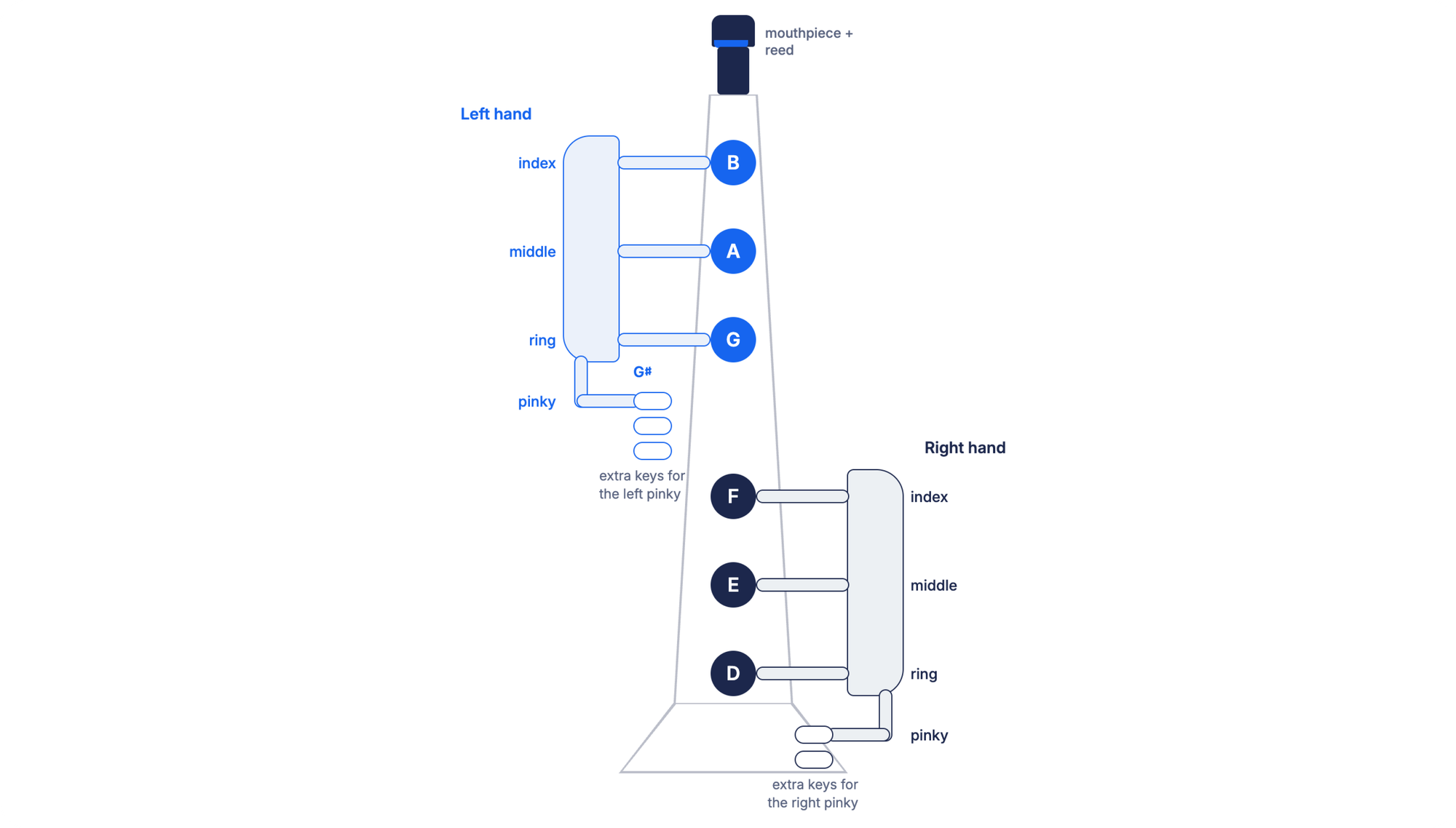
You can download the complete diagram below:
Saxophone fingering chart: core range
The full chromatic range of the saxophone runs from low Bb up through a little over two and a half octaves, built from six main keys (three per hand) plus a set of pinky, side, and palm keys layered on top.
The table below covers reference fingerings that check out consistently across published fingering sources, useful as fixed points once you understand the pattern underneath them. ● means the key is pressed, ○ means it's left open. It applies the same way whether you're playing alto, tenor, or soprano, since the fingering-to-note mapping is identical across the family. The one exception is the low A key some baritones (and a few altos) add below low Bb, an added key on that specific horn rather than a different system.
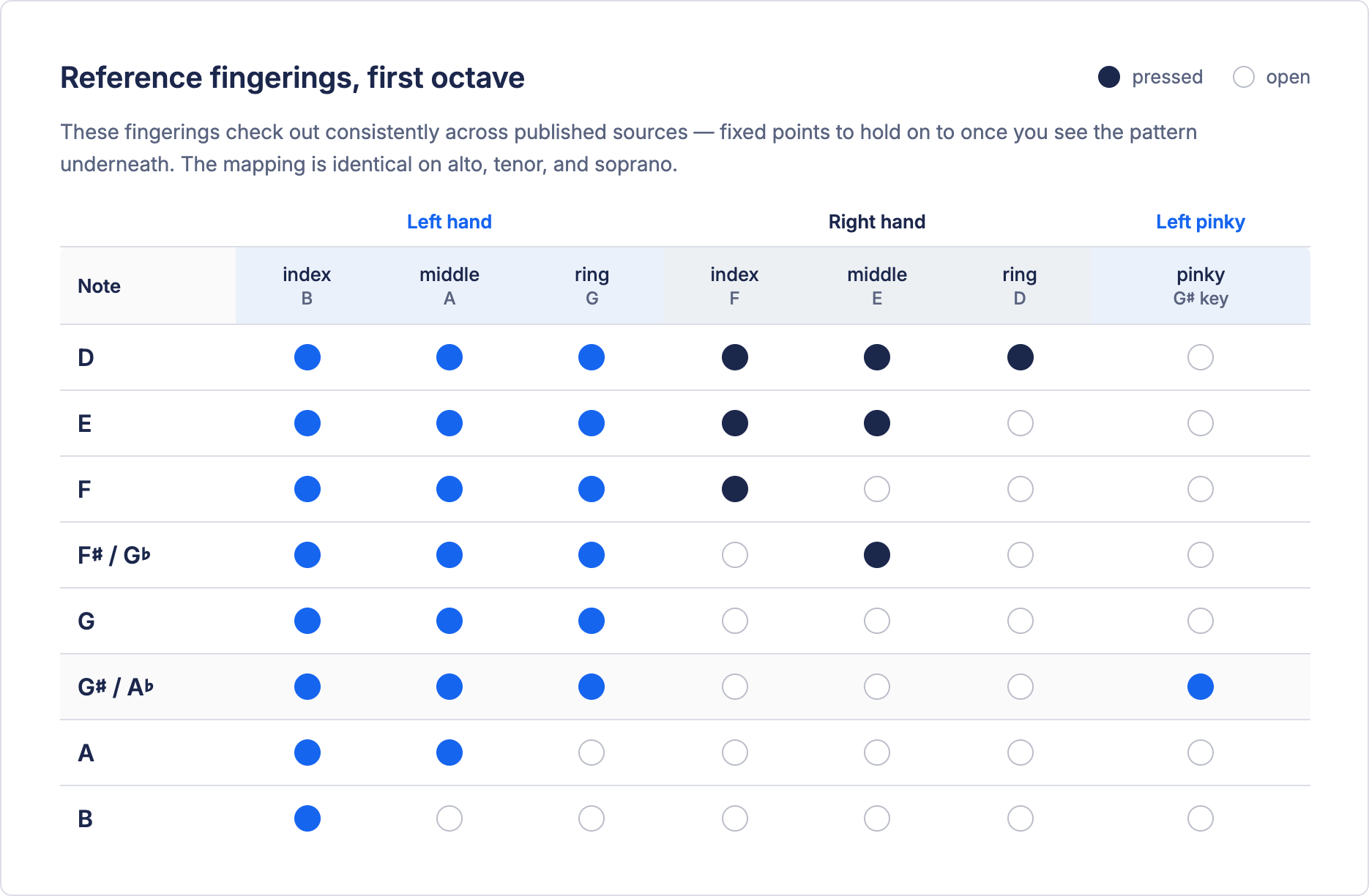
LH = left hand, RH = right hand. The first six columns are the six main keys, one per index/middle/ring finger on each hand. The seventh column is the left pinky's G# key, needed only for G#/Ab, which is why it's the only column that isn't one of the six main fingers. The second octave generally reuses these same fingerings with the octave key added on top, up until the highest notes, where palm keys take over instead.
The lower pinky-key notes below D (low Bb, low B, C, C#/Db, and Eb/D#) follow the same six-main-keys base with one pinky key added, but the exact groupings are easy to get subtly wrong from text alone. For that range, and the very top of the first octave, check a visual fingering chart instead.
You can download the complete diagram below:
Why some notes need special keys
Palm keys
Palm keys are three small keys near the top of the saxophone's neck, played with the palm and lower part of your left hand instead of your fingertips. You need them because the highest notes in the second octave require extra tone holes vented close to the mouthpiece, closer than your normal hand position can reach with fingers alone. To use them, you roll your left hand up slightly and press with your palm while your fingers stay on the main keys underneath.
Bis Bb
Bis Bb is an alternate fingering for the note Bb, using a small key next to your left hand first finger instead of the usual right hand side key. It solves a real problem: without it, moving between A and Bb means sliding a finger across two different keys mid-passage. With bis, the same finger that plays A just drops onto the adjacent bis key to get Bb, so fast passages through that area stay smooth instead of needing an awkward slide.
Altissimo
Above the standard keyed range, saxophonists reach altissimo notes using the same fingerings as lower notes, but with a different oral cavity shape, sometimes described as adjusting your voicing the way your mouth changes shape between vowel sounds. That reshaping isolates a higher harmonic in the note's overtone series instead of the fundamental.
It's a real, teachable technique, not a trick, but it depends on control most players build before attempting it, usually through overtone practice on a familiar low note rather than jumping straight to an unfamiliar high fingering. A common way to start: finger a low note (low Bb, B, or C) and hold that fingering. Without changing it, use only your air and the shape of your oral cavity, raising the back of your tongue the way you would to say the vowel in "he", to move up through that note's natural overtones. Practicing this on a low, secure fingering isolates the voicing skill by itself, before an unfamiliar high fingering is also part of the equation.
How to actually learn saxophone fingerings
Memorizing a chart note by note is slower than learning the pattern underneath it. Once you can see that most of the first octave is built from the same left-hand and right-hand base with one key added or removed at a time, you can predict a fingering before you look it up, then confirm it against the chart.
Start with a slow chromatic scale from low Bb up through the first octave, one note at a time, checking each new fingering against the chart before moving on. If a jump feels unfamiliar, isolate it hands separately first, left hand's three keys, then right hand's three, then both together, so you can feel exactly which finger changes between two neighboring notes.
Once the first octave feels automatic, repeat the same process into the second octave with the octave key added, and treat the palm keys and bis Bb as their own short drill rather than folding them into full scales right away. A fingering that still needs a look at the chart after a few days of this is worth isolating on its own, instead of running the whole range every time you practice.
Writing and playing saxophone in Flat
Add a saxophone part in Flat and it sets up the right clef and transposition for you automatically, so you can enter notes at written pitch without doing the transposition math yourself.
From there you can hear the part back through Flat's real-time playback engine. If you need the same passage for a different member of the sax family, you can transpose the part to the new instrument instead of re-entering it by hand.
Ready to write your first saxophone line? Try Flat for free and hear how it sits against a real fingering before you commit to it.
FAQ
Does one fingering chart work for alto, tenor, and soprano saxophone?
Yes. Every saxophone in the family uses the same written-note-to-fingering mapping, since they're all built with proportionally scaled keywork and read as transposing instruments against the same written part. The one real difference is that some baritones (and a few altos) add a low A key below the standard low Bb, which is an extra key on that instrument, not a different fingering system.
What's the difference between bis Bb and the side Bb key?
Both play the same note, but they suit different situations. Side Bb works best in chromatic passages. Bis Bb is better in passages with flat key signatures that aren't chromatic, since it lets your left index finger stay in position instead of sliding to a separate key.
What is the octave key for?
The octave key doesn't add a new note by itself. It opens a small vent that suppresses the fundamental resonance and favors the next harmonic up, which shifts the same fingering up an octave. On saxophone this is mechanically split between two vents, and the instrument automatically selects the right one based on which other keys are down.
What are palm keys and bis Bb?
Palm keys are three keys near the top of the saxophone's neck, played with the palm of the left hand, used to reach the highest notes in the second octave. Bis Bb is an alternate fingering for Bb that lets a finger stay in place for smoother chromatic movement between A and Bb, rather than sliding to the standard side key.
How do I write and practice saxophone parts in Flat?
In Flat, you can add a saxophone part from the instrument list, and Flat automatically sets up the right transposition and clef for it. From there you can enter notes, hear them back with Flat's real-time playback engine, and transpose the part for a different member of the sax family without rewriting it by hand.