
Most guitarists start with tab and never look back. A smaller group goes straight to standard notation and swears by it. Both camps tend to be pretty convinced they made the right call — and honestly, both are right, depending on what they needed. The problem is that "which should I learn?" is rarely answered with the actual information that would make the choice easy. Here's an honest look at what tab and standard notation each do well, where each falls short, and how to figure out which one fits where you're headed as a guitarist.

What each system actually is
Guitar tablature (tab) is a fretboard map. Six horizontal lines represent the six strings, and numbers on those lines tell you which fret to press. No music theory knowledge required — if you can count frets, you can follow tab. Standard notation, on the other hand, is a pitch-and-rhythm system. Notes on a staff tell you what pitch to play and exactly how long to hold it, independent of any specific instrument.
That difference — fretboard map vs pitch-and-rhythm system — is what drives every other advantage and limitation of each format.
The real advantages of guitar tab
Tab's biggest strength is immediacy. You can pick up a tab for almost any song and start playing within minutes, even as a complete beginner. There's no prerequisite knowledge about clefs, key signatures, or note durations — the fret numbers do the work, and the guitar-specific information is built right in. For self-taught players who want to learn songs quickly, this is genuinely hard to beat.
Tab is also the dominant format online. The vast majority of guitar-specific resources — community sites, YouTube tutorials, artist transcriptions — use tab. If your main goal is to build a personal repertoire and enjoy playing, tab gets you there with the least friction. And it's worth noting: professional guitarists use tab constantly. It's not a beginner-only format — session musicians, touring players, and guitar educators all work with it regularly.
The limitation that matters most: tab tells you almost nothing about rhythm. A "5" on the second string tells you which note to play, but not whether it lasts a beat or four. Most tab either leaves rhythm to guesswork or relies on the reader already knowing how the song sounds. For anything you haven't heard before, this is a real gap.

The real advantages of standard notation
Standard notation's core strength is completeness. Every note has a pitch, a duration, and a position in the bar — nothing is left to interpretation. This makes it the format of choice for composed music, ensemble playing, and any situation where you need to perform something accurately without already knowing how it sounds. It's also instrument-agnostic, meaning a piece written in standard notation can be read by any musician, not just guitarists.
For players who want to work with classical repertoire, study harmony, collaborate with non-guitarists, or develop real sight-reading skills, standard notation is what opens those doors. It also pairs naturally with understanding music theory — if you want to know why a chord progression works rather than just where to put your fingers, notation gives you the framework. This breakdown of chord progressions and the emotions they create is a good example of the kind of musical thinking notation supports.
The limitation: the learning curve is steeper. Reading standard notation fluently takes time, and for guitarists specifically, the treble clef doesn't map to the fretboard as intuitively as tab does. Many players find the early stages frustrating before it starts to pay off.

Who tab is right for
Tab is the right primary format if your goals are centered on playing songs, learning by ear, and building a personal repertoire. It's the better starting point for players who want results quickly and aren't yet drawn to theory or composition. If you play mostly rock, folk, or pop and most of your learning happens through recordings and online resources, tab will serve you well for a long time — possibly your entire playing life, depending on where music takes you.
Who standard notation is right for
Standard notation becomes worth the investment when your goals go beyond playing existing songs. If you want to write your own music, arrange for other instruments, study at a music school, play in ensembles with non-guitarists, or build a serious theory foundation, learning to read notation will open doors that tab can't. The same applies if you're drawn to classical guitar or fingerstyle repertoire, where most published scores use standard notation exclusively.
It's also the better system for anyone who plans to write and share their own music — notation communicates your musical ideas with full precision to anyone who reads it, on any instrument.
You don't have to pick one and stick with it forever
Here's something most of these comparisons leave out: in professional settings, guitarists rarely use just one system. The industry standard for published guitar scores is a hybrid format — standard notation on top, tab directly below — so players get full rhythmic and pitch information alongside the fretboard map. It's the best of both, and it's how most serious transcriptions and method books are laid out.
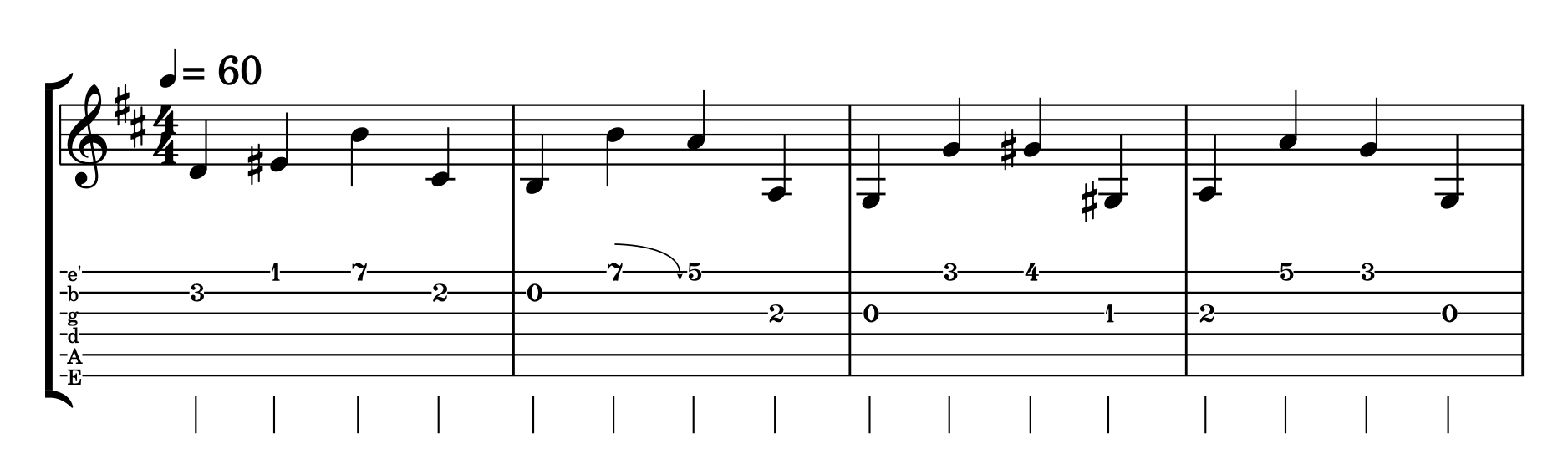
If you already work in one system, you don't have to manually rebuild everything in the other to get there. In Flat, you can convert between tab and standard notation automatically. Write a part in tab and switch to standard notation view instantly — or bring in standard notation and see it mapped to tab without re-entering anything. The two views stay in sync, so you can work in whichever format feels natural and output the hybrid format whenever you need it.

It's a practical way to explore notation without committing to learning it from scratch — and equally useful if you already read notation but want the fretboard reference that tab provides.
Try Flat free at flat.io — no download required, and both formats are there from day one.