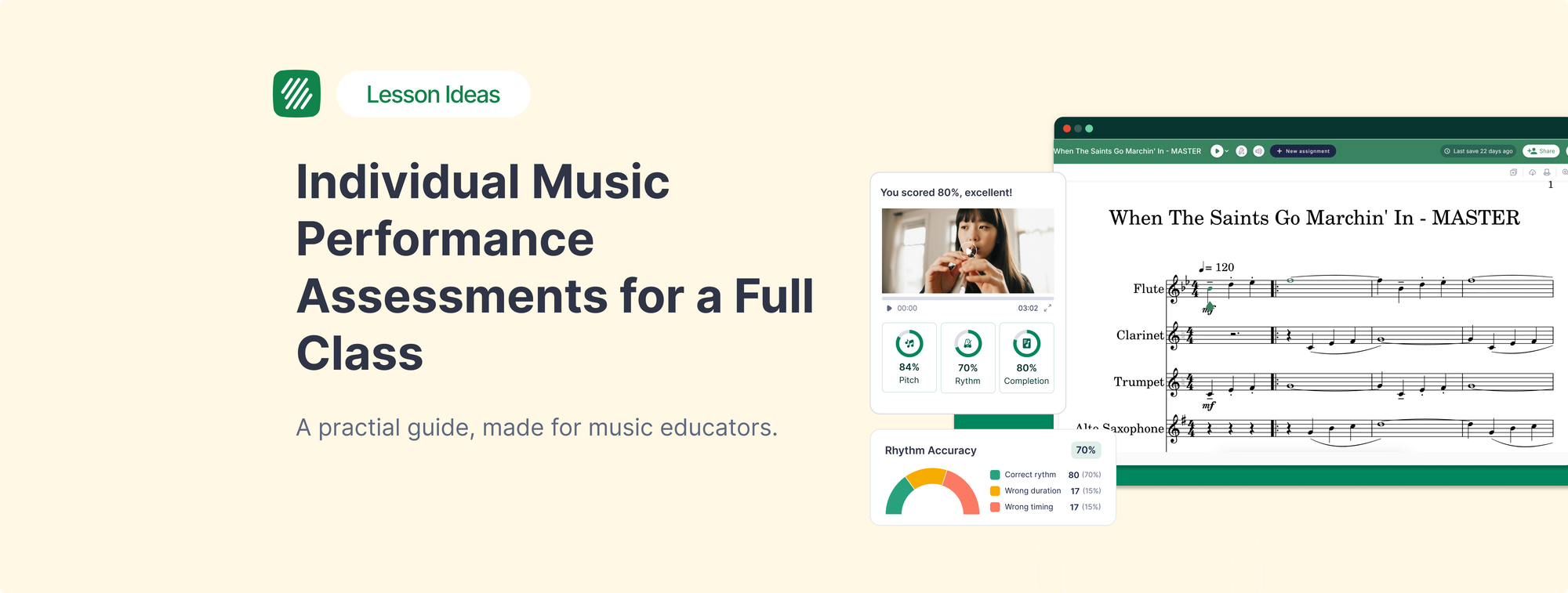
Every music teacher I have ever spoken to about performance assessment says some version of the same thing: "I know I should do it more often. I just can't figure out where to find the time."
That is not a planning problem. That is a structural one.
Think about what running individual playing tests actually requires in a class of thirty. You call students up one at a time while everyone else does... something. A worksheet, ideally. Quiet practice, if you're lucky. Mostly, they wait and try not to make noise. You listen, scribble a grade, fire off fifteen seconds of feedback, and move on to the next student. On a good day – no fire drill, nobody forgetting their instrument, no administrative interruption – you get through eight or nine students before the bell.
Do the arithmetic, and it comes out somewhere between uncomfortable and demoralizing. Three sections, ninety-four students, eight per period: you are looking at twelve class periods to complete one full round of individual assessments. Twelve. That is three weeks of your students' instructional time handed over to a logistical process that is not, by any reasonable definition, teaching.
And that is before winter concerts eat your November, or absences rip a hole in December, or someone from the district office schedules an observation during the one period you had blocked for playing tests.
Most teachers respond by doing what is rational: they run individual performance assessments once per semester instead of monthly, write a note to themselves to start earlier next time, and quietly accept that their gradebook reflects theory tests and participation rather than what their students can actually play.
The gradebook is lying. And the system that produced it was never designed for a classroom in the first place.
The Real Problem Is the Model, Not the Teacher
Here is the thing music education literature rarely says directly: the individual performance assessment model most teachers use was not designed for classrooms. It was designed for private lesson studios, where one teacher hears one student at a time.
When that model is imported into a classroom of 30, the math is brutal. If hearing and evaluating one student takes three to five minutes -- including setup, performance, brief feedback, and transition -- a class of 30 requires 90 to 150 minutes of dedicated assessment time. That is two to three full class periods. Per section. For a teacher with three sections, that is six to nine class periods consumed by assessment logistics every single cycle.
It is not that teachers are bad at assessment. It is that the model they inherited was built for a different context and has never been replaced with something designed for the classroom reality.
The research confirms this universally. A study published in the NAfME journal found that music teachers across the country identified individual performance assessment as one of their least frequently used assessment practices -- not because they do not value it, but because the operational cost in class time is simply too high to sustain. The outcome is a gradebook that reflects theory tests and participation, not actual musical performance.
That is the gap. And closing it is not a matter of better time management or earlier scheduling. It is a matter of changing the underlying model.
What the Old Model Costs
Before getting to the solution, it helps to make the cost concrete, because most teachers have normalized it to the point where they no longer see it clearly.
Class time lost to assessment logistics: At 8-10 students per class period, a teacher with 94 students across three sections spends roughly nine class periods per assessment cycle on individual playing tests. At 50 minutes per period, that is 450 minutes -- 7.5 hours of instructional time -- given over to one form of assessment. Per term.
Feedback that arrives too late: When assessment runs over three to six weeks, the feedback a student receives in week five has almost no instructional impact. The student does not remember the specific passage well enough to meaningfully connect the comment to their playing. The feedback becomes a grade, not a learning tool.
The waiting problem: For every student being assessed, 25 or 29 others are waiting. That management challenge consumes teacher attention that should be on the student performing. The quality of both the assessment and the classroom environment suffers simultaneously.
Gradebook distortion: When individual performance assessment is too logistically costly to run regularly, teachers substitute other metrics. Attendance. Participation. Written theory. The gradebook ends up reflecting everything except the one thing it should primarily document: whether the student can actually play.
Student anxiety amplification: Being called to the front of the room to perform while classmates wait and watch is genuinely stressful. Research consistently shows that performance anxiety is higher in observed peer settings than in private settings. The traditional model, by requiring a quasi-public performance in the classroom, may actually underperform as an assessment of genuine individual ability.
The Model That Fixes This: Asynchronous Audio Submission
The solution is not a better rubric. It is not a more efficient schedule. It is decoupling performance assessment from class time entirely.
Here is how it works in practice.
Instead of pulling students one at a time to perform in front of you during class, you assign a performance assessment as a task that students complete and submit – like any other assignment. Students record themselves playing the assigned passage on their own device, at a time that works for them: during a practice period, at home, before school. The recording is submitted through your assessment platform. You review submissions on your own time, at your own pace, against your rubric.
The class period proceeds as normal. Every minute of instructional time is preserved. Assessment happens in parallel, not instead of teaching.
This is not a new idea in principle -- band directors have been sending students to practice rooms with recording equipment for decades. What has changed is that the technology now makes this seamless, scalable, and integrated rather than a jury-rigged workaround.
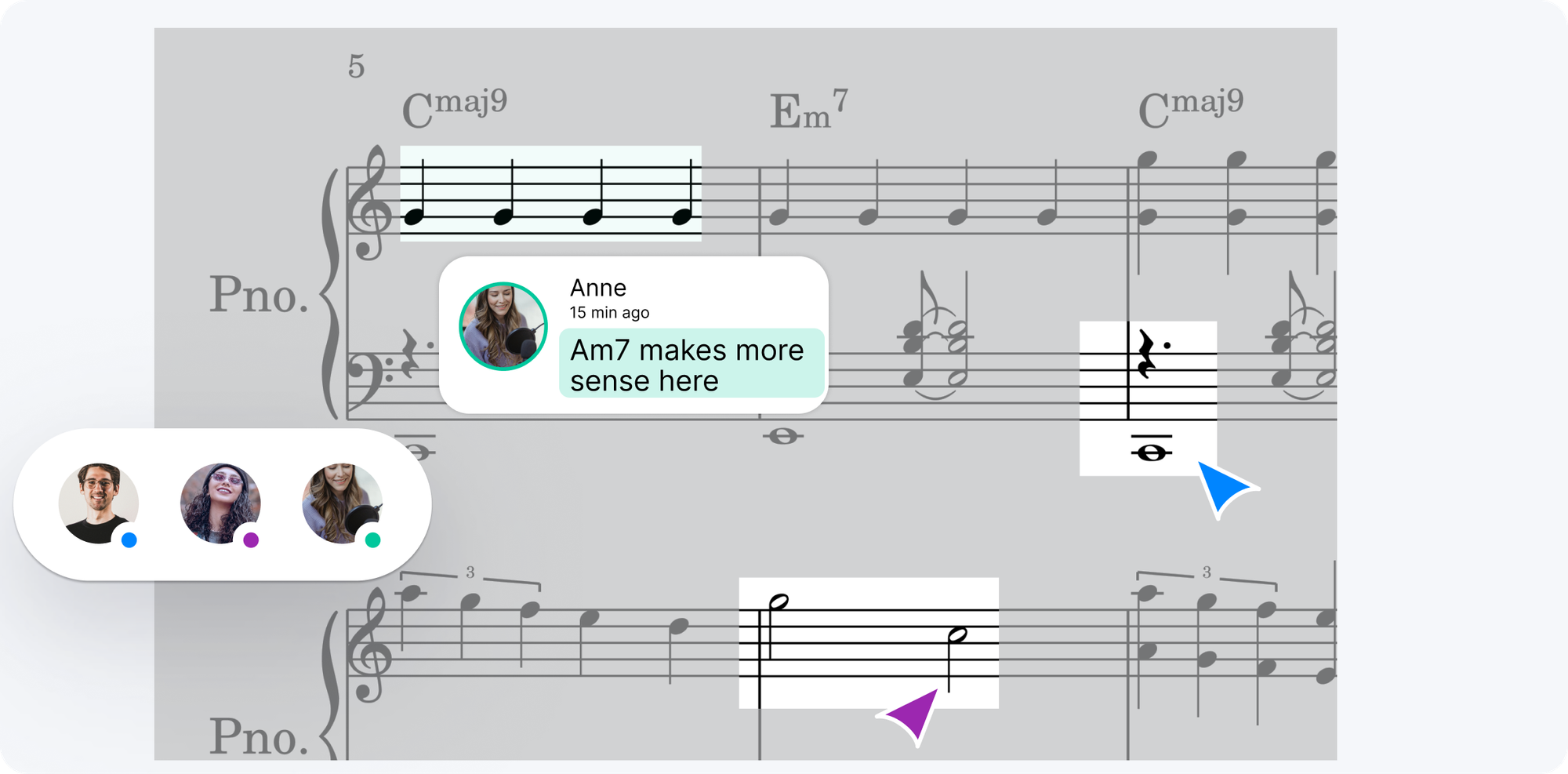
When it is done properly, through a platform built for it, the submission arrives attached to the score the student was assessed on. You listen to the audio and read the notation simultaneously. You leave feedback as a timestamped comment at the exact moment in the recording where the issue is. The student receives specific, connected feedback: not "watch your intonation" but a comment anchored to the moment in bar 14 where the pitch sagged. That kind of feedback teaches. The other kind gets read once and forgotten.
How Flat for Education's Performance Assignments Work
Flat for Education is the platform built specifically for this workflow in music classrooms.
A performance assignment in Flat for Education works like this. You create an assignment – a scale, a sight-reading excerpt, a prepared passage – and attach the score. You distribute it to your class through Google Classroom, Microsoft Teams, Canvas, Schoology or directly through Flat for Education. Students receive it in their dashboard, see the score, and use their device's microphone to record their performance directly inside the platform. No separate recording app. No file export. No upload. They record, listen back, and submit, all in one place.
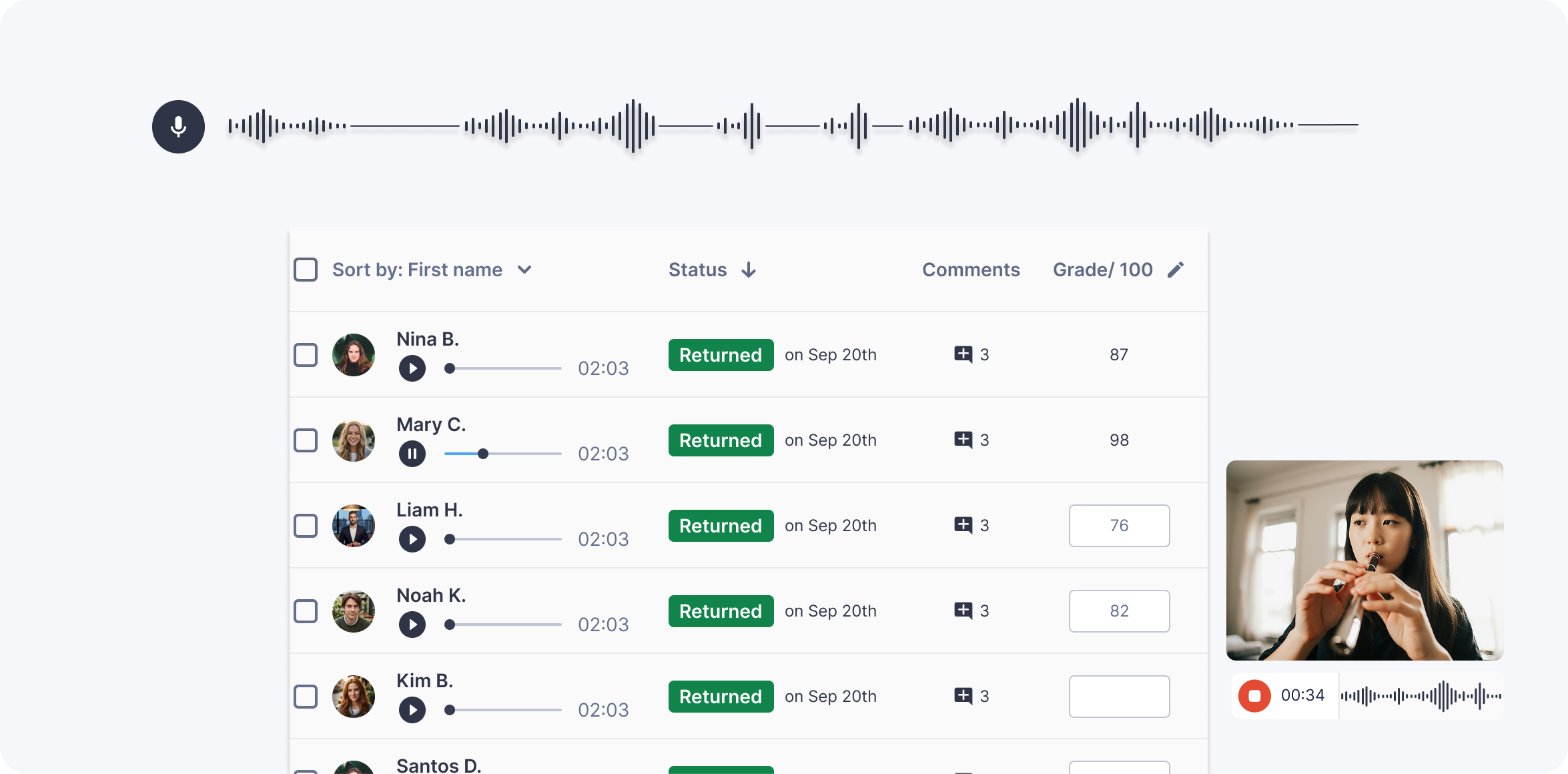
On your end, submissions arrive organized by class and student name. You open a submission and see the score alongside the audio waveform. You can click anywhere in the waveform to jump to that moment in the recording, then leave a timestamped comment anchored to that exact point. The student sees your feedback connected to the specific moment you are describing. You grade, and the grade writes back to your LMS gradebook automatically.
For Sarah Chen, the middle school music director managing 94 students across three sections, this changed not just her assessment process but the rhythm of her entire teaching year. Her individual performance assessments, which had previously required pulling students one at a time over three weeks of class time, moved to a monthly cycle. Every student every month. With more specific feedback than she had ever been able to provide through the old model, delivered faster.
I was scheduling students during lunch to try to get through everyone before the end of term," she said. "Now I run performance assessments monthly and I review them on Sunday evenings. My students are getting more feedback than they ever have and I have not lost a single class period to assessment scheduling.
Her gradebook, for the first time, reflects musical performance.
Setting Up Your First Performance Assessment: Step by Step
This is the setup process for running your first asynchronous performance assessment through Flat for Education. Most teachers complete it in under 20 minutes.
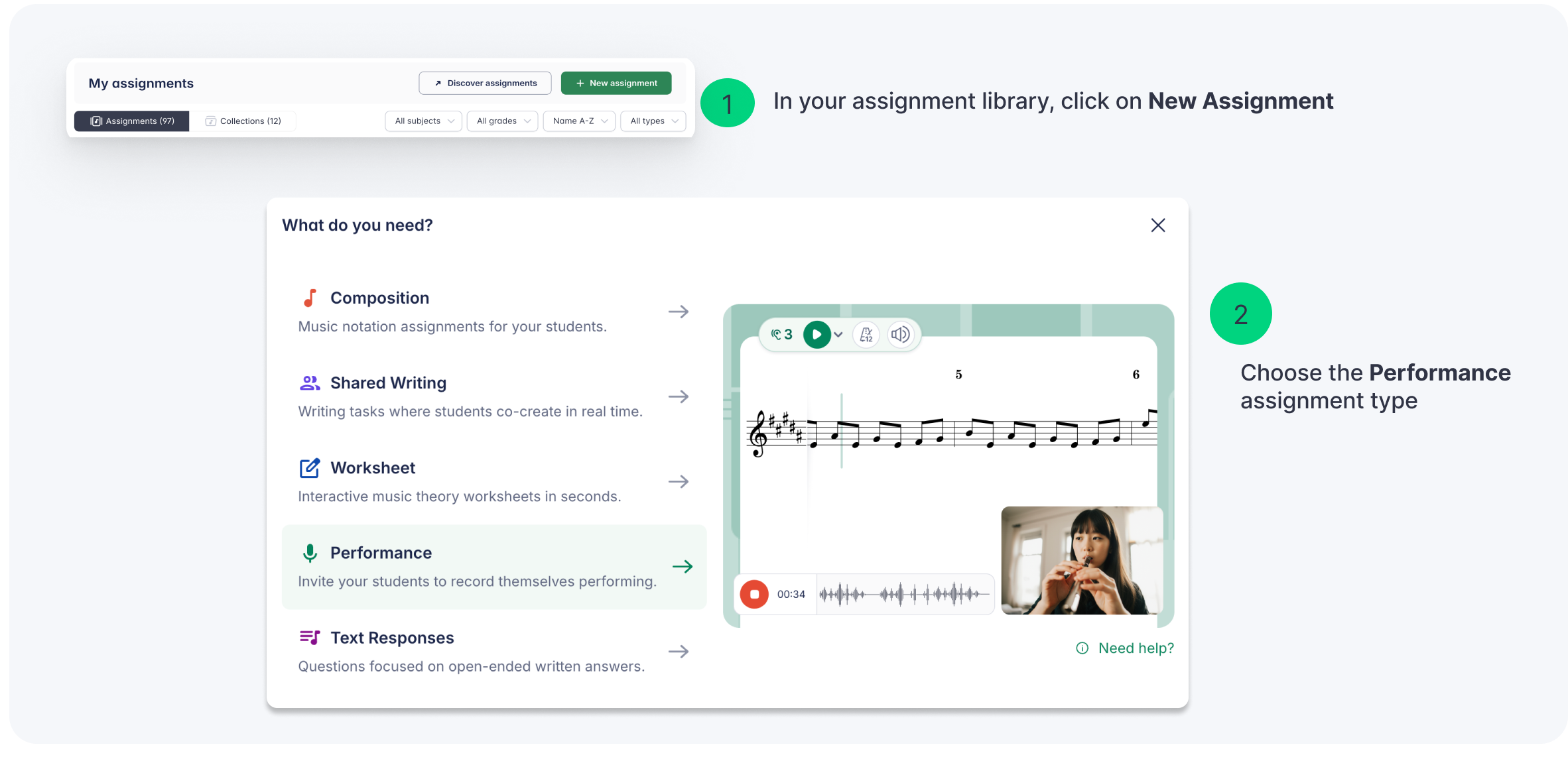
Step 1: Create the assignment
Log in to Flat for Education and click New Assignment. Select Performance as the assignment type. Add the score you want students to perform against – you can upload a MusicXML or PDF file, or create the excerpt directly in the notation editor. Add instructions: the passage to play, any tempo requirements, the number of attempts students are allowed.
Step 2: Set the submission parameters
Choose whether students submit audio only or audio with video. For most playing tests, audio is sufficient and removes the anxiety of students worrying about how they look on camera. Set a due date. Enable the option to allow multiple attempts if you want students to have the opportunity to re-record before submission.
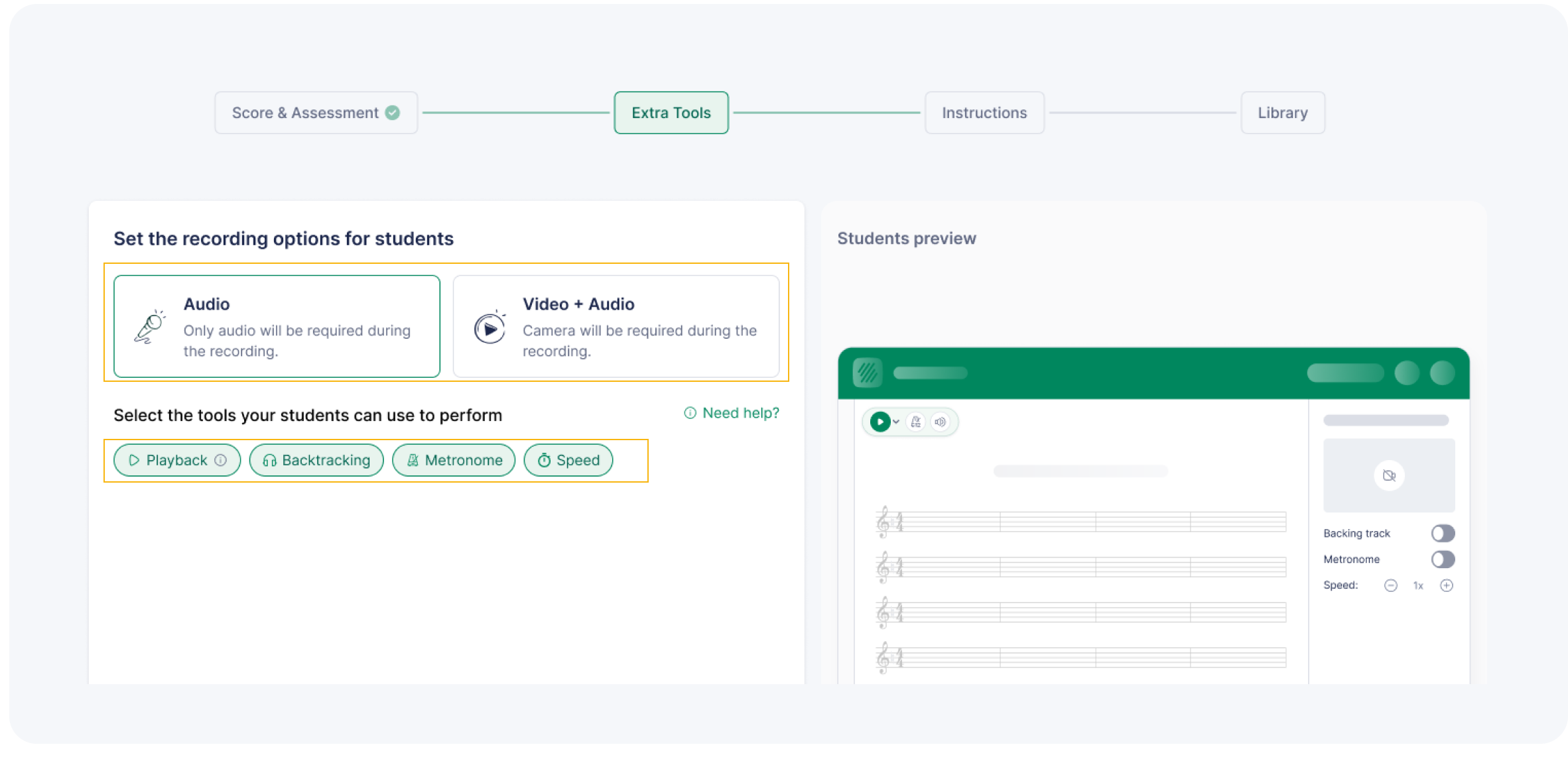
Step 3: Distribute to your class
Select which class or classes to assign it to. If you have Google Classroom connected, it posts to the stream automatically. Students receive a notification and can access the assignment from wherever they normally see their work.
Step 4: Students record and submit
Students open the assignment, see the score, and click Record. They play into their device's microphone -- Chromebook, laptop, tablet, phone. Flat for Education captures the audio. They listen back before submitting. When they are satisfied, they click Submit. The submission appears in your dashboard immediately.
Step 5: Review, comment, and grade
Open the submission. The score and the audio waveform sit side by side. Click anywhere in the waveform to jump to that moment. Leave timestamped comments anchored to specific moments. Assign a grade using your rubric. The grade syncs to your LMS gradebook.
Total time per submission: 3 to 5 minutes, depending on the length of the passage and the depth of your feedback.
For 30 students: 1.5 to 3 hours of review time, spread across any time that suits you, with zero class periods consumed.
The Performance Rubric That Works at Scale
One of the reasons individual performance assessment has historically been time-intensive is rubric complexity. A rubric with seven dimensions requiring a holistic judgment on each one takes four minutes per student to complete carefully. At scale, teachers either rush through it -- making the rubric meaningless -- or skip the rubric entirely and give an impression grade.
Asynchronous audio submission changes this because you are not grading under time pressure. You can listen twice. You can pause. But the rubric still needs to be designed for the classroom context, not the conservatoire adjudication panel.
Here is a rubric structure that works across band, orchestra, choir, and general music for most K-12 contexts:
Pitch accuracy (30%): Does the student play or sing the correct pitches? For beginners, this is the primary dimension. For advanced students, it is expected and weighted lower.
Rhythmic accuracy (30%): Does the student maintain the notated rhythm? Does the tempo remain stable? Does it hold together across phrases?
Tone quality (20%): Is the tone characteristic of the instrument and appropriate to the passage? This is the most subjective dimension but also the most musically informative.
Expression and musicality (20%): Does the student demonstrate awareness of dynamics, phrasing, and articulation? This dimension differentiates students who are playing notes from students who are making music.
For younger or beginning students, simplify to three dimensions and increase the weighting of pitch and rhythm. For advanced students, compress pitch and rhythm accuracy into one "technical accuracy" category and expand expression and musicality.
The most important design principle: every criterion should be describable. "The student plays at a consistent tempo with occasional hesitations at phrase endings" is useful feedback. "Fair" is not.
Addressing the Three Most Common Objections
"Students will just re-record until they get a good take."
Yes – and this is a feature, not a bug. A student who records themselves twenty times to get a clean take has practiced that passage twenty times. The learning outcome is identical whether the motivation is the recording or a live test. Many teachers who have moved to asynchronous assessment report that preparation quality for recorded tests is equal to or higher than preparation for live tests, precisely because students have the safety net of multiple attempts.
If you want to limit attempts, you can cap them in Flat for Education. But consider whether the cap is serving your students or your administrative preference.
"I need to see their technique, not just hear the audio."
For some assessment purposes – bow hold, embouchure, posture – video is necessary. Flat for Education supports video submission as well as audio. You can require video for specific assessments where technique is the primary target and audio-only for assessments focused on pitch, rhythm, and musicality.
"My students do not have devices at home."
Two responses. First, Flat for Education is browser-based and works on any school device including Chromebooks. For students without home access, a submission window during class, practice period, or lunch works within the same system. You are not adding a homework requirement – you are giving students flexibility about when and where they record. Second, students who genuinely cannot access a device outside school can record during a five-minute window at the start or end of class. Ten students can record simultaneously in different corners of a room. This is faster than hearing them one at a time, and the others are not waiting.
What Changes When You Do This Consistently
The compounding effect of monthly performance assessment with specific, timestamped feedback is genuinely different from what most teachers are able to achieve with the quarterly or semester-end model.
Students who receive feedback on a specific passage in month one, work on it, and are assessed again in month two can see their own progress as a documented record. The feedback loop closes in days rather than weeks. The gradebook reflects actual musical development rather than attendance and theory scores.
For teachers, the shift is in where professional energy goes. Instead of managing the logistics of a live assessment cycle -- the scheduling, the waiting students, the compressed grading -- time goes to listening to each student's actual playing and thinking about what they specifically need to improve. This is the part of the job that requires training. The rest is administration.
Sarah Chen's department head noticed the change in her gradebook during a fall observation. She asked how Sarah was managing individual performance data at that scale. Sarah showed her the platform. She was asked to present it at the next department meeting.
Frequently Asked Questions
How do you assess individual music performance in a large class? The most effective approach for large classes is asynchronous audio or video submission, where students record themselves performing the assigned passage outside of class time and submit through a platform like Flat for Education. This decouples performance assessment from class time entirely, allowing teachers to review submissions on their own schedule while preserving every minute of instructional time. Teachers managing classes of 30 or more students report reviewing a full class set of submissions in 2.5 to 4 hours, with more specific feedback than they were able to provide through live in-class testing.
How long does individual music performance assessment take? Using the traditional model of calling students one at a time to perform during class, individual performance assessment for a class of 30 students requires approximately 3 to 5 class periods, depending on passage length and feedback depth. Using asynchronous audio submission through Flat for Education, the same class set takes 2.5 to 4 hours of review time with zero class periods consumed. For a teacher with three sections of 30 students each, this difference represents approximately 9 class periods of instructional time recovered per assessment cycle.
What is the best platform for music performance assessment? Flat for Education is the strongest platform for K-12 music performance assessment. Students record audio or video directly against the score inside the platform, submissions arrive organized by class and student, teachers leave timestamped comments anchored to specific moments in the recording, and grades sync automatically to Google Classroom, Microsoft Teams, Canvas, and other LMS platforms. It is browser-based, works on Chromebooks, and is fully COPPA and FERPA compliant.
Can students record music performance assessments at home? Yes. With Flat for Education, students record their performance directly inside the platform using their device's microphone -- at school, at home, or anywhere they have internet access. No separate recording app or file upload is required. For students without home device access, recording can be completed during school hours using school devices.
How do you give feedback on individual music performance assessments? The most effective performance feedback is specific, timestamped, and anchored to a particular moment in the performance. Generic comments like "watch your intonation" are significantly less useful than feedback connected to the specific measure and beat where the pitch issue occurred. Flat for Education's performance assignments let teachers leave timestamped comments at specific points in the audio waveform, giving students a direct connection between the feedback and the moment in their performance it describes.
How do you grade music performance assessments fairly? Fair performance grading requires a clear rubric with explicitly described criteria at each level, applied consistently across all students. For most K-12 contexts, a four-category rubric covering pitch accuracy, rhythmic accuracy, tone quality, and expression works well across grade levels with adjustments to category weighting. Asynchronous assessment supports fairer grading because teachers are not grading under time pressure -- they can listen twice, pause, and give each submission genuine attention.
How often should music teachers run individual performance assessments? Research and practitioner experience both suggest monthly individual performance assessment produces significantly better student outcomes than quarterly or semester-end assessments. The barrier to monthly assessment has historically been the class time cost of the traditional live-testing model. Asynchronous audio submission removes that barrier – teachers using Flat for Education commonly report moving from once-per-term to monthly assessment after the first implementation cycle.
The Bottom Line
The scheduling chaos that comes with individual music performance assessment is not inevitable. It is a consequence of using a model designed for private studios in a classroom context, and continuing to use it because no one replaced it with something better.
Asynchronous audio submission does not eliminate individual performance assessment. It makes it possible to do it properly, regularly, specifically, with feedback that arrives while the student can still act on it.
Flat for Education's performance assignments connect the recording to the score, the feedback to the moment, and the grade to your gradebook. The 30-day free trial requires no credit card and connects to your existing roster in minutes.
👉 Start your free trial at flat.io/edu
Related reading: