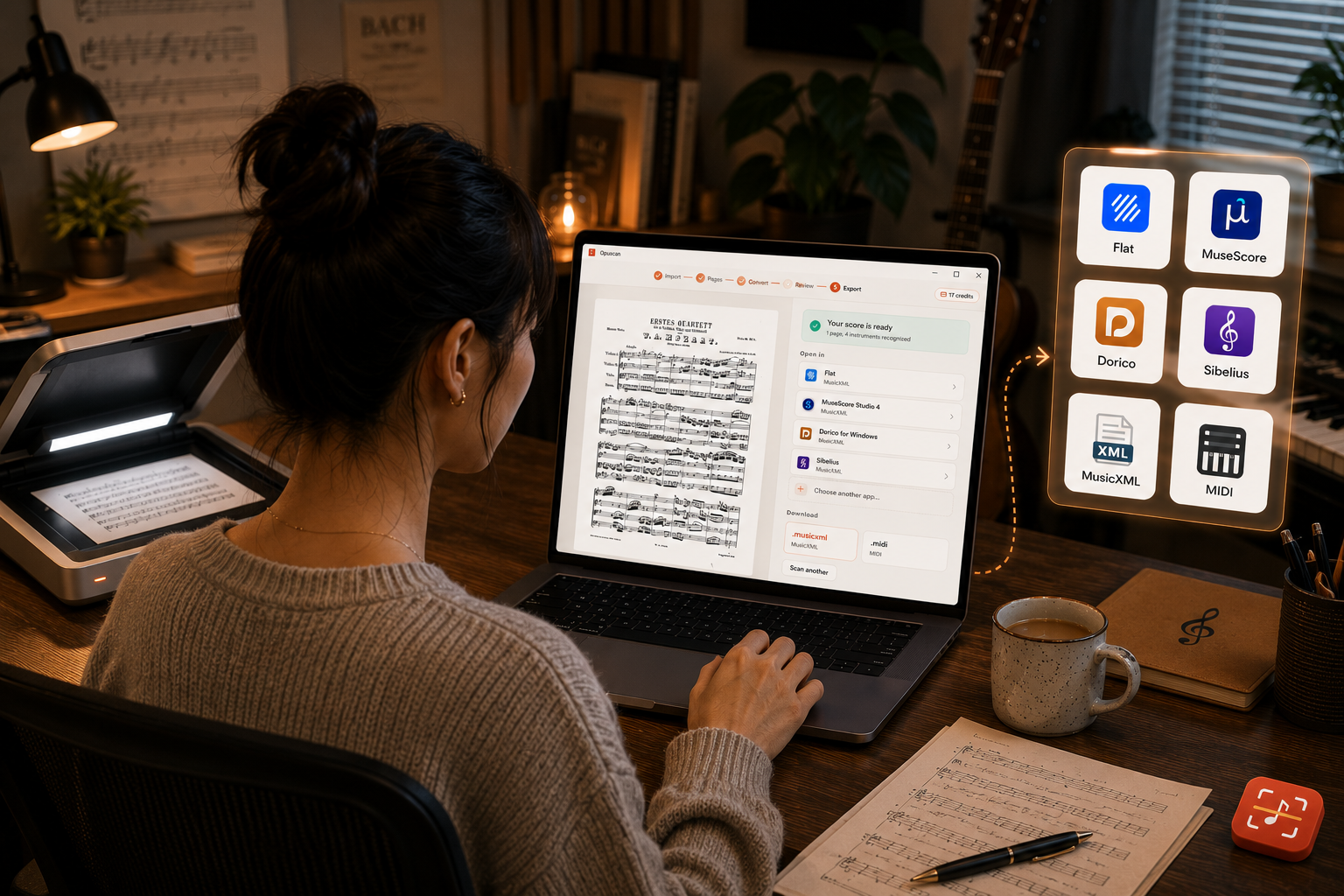
You have a printed score, or a PDF someone sent you, and you need it as something you can actually change: fix a wrong note, swap an instrument, pull out a single part, or open it in your notation software. Retyping it by hand takes hours. Opuscan is a sheet music scanner for Windows: it reads the page and hands you a clean, editable score in seconds, with the rhythms, chords, lyrics, and dynamics carried straight across. From there you keep working wherever you already do, from Flat to MuseScore, Dorico, Sibelius, or a DAW. Here is what it does.
 Microsoft Store
From page to editable score in five steps
Converting a score takes a few clicks, and it always follows the same five steps.
- Import. Open a PDF, add images, or scan straight from a scanner your Windows PC recognizes.
- Sort the pages. Reorder, rotate, and crop so the model gets clean pages to read.
- Convert. See the exact cost before anything runs, then Opuscan reads the pages in the cloud.
- Review. Confirm the title, the score language, and each part's instrument and transposition. A confidence hint on every guess tells you what is worth a second look.
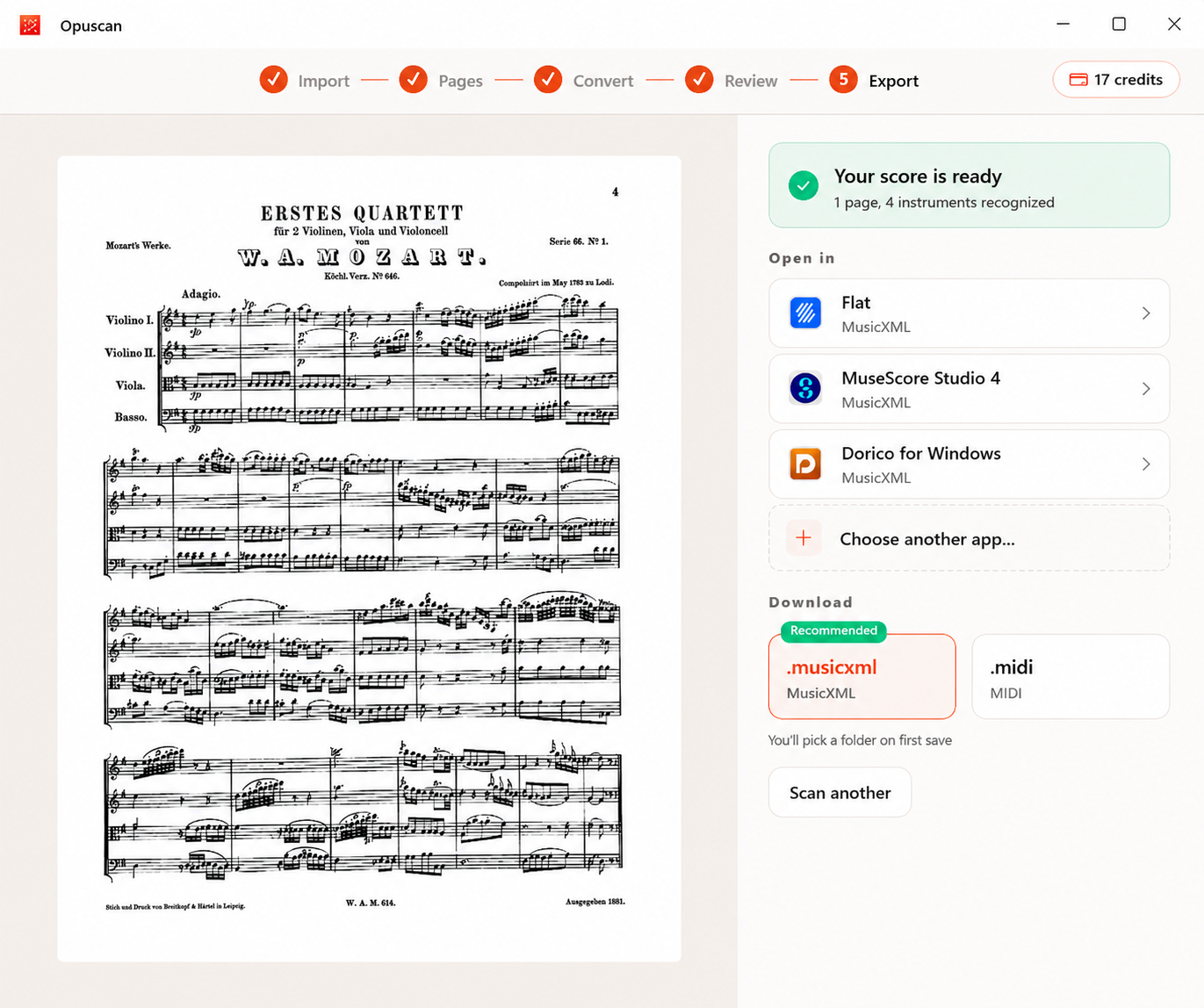
- Export. Save it as MusicXML or MIDI, or send it straight to your editor.
Keep working in the software you already use
A scan is only worth doing if it opens in the tool where you actually work. Opuscan hands the score off directly, or exports the two formats every editor reads:
- Straight to your editor. Send the finished score to your notation app in one click, with no export-and-import detour in between.
- MusicXML for notation. Open it in Flat, MuseScore, Dorico, Sibelius, or Finale to arrange and edit the score.
- MIDI for production. Drop it into Ableton Live, FL Studio, Cubase, Studio One, Reaper, Pro Tools, or any other DAW and build a track around it.
Recognition that reads the music, not just the symbols
Opuscan runs on Tutteo's own optical music recognition model, built and trained in-house rather than licensed from another company. It does not read one mark at a time. It reads rhythm, pitch, and layout together, the way a musician would, so it separates instruments and voices and attaches lyrics, chords, and text to the right notes.
Conversions run on cloud GPUs, so each one is quick and always uses the newest model, and the recognition keeps improving with each release (the OMR changelog tracks what has changed). Here is what it picks up on the page:
| Category | What Opuscan recognizes |
|---|---|
| Clefs | Treble, bass, alto and tenor C clefs, octave-shifted and percussion clefs, including clef changes mid-piece |
| Key and time signatures | All key signatures, plus a wide range of time signatures including common and cut time |
| Notes and rhythm | Note values with augmentation dots, tuplets, standard and custom beaming, and beams that span rests |
| Pitches, chords, voices | The full pitch range with ledger lines, chords, and multiple voices on a single staff |
| Accidentals | Sharp, flat, natural, double, courtesy, and quarter-tone accidentals |
| Slurs and grace notes | Ties, slurs, grace notes, acciaccatura, and cue notes |
| Dynamics and articulations | ppp to fff, sf and sfz, crescendo and decrescendo hairpins, staccato, tenuto, accent, and marcato |
| Ornaments and tremolos | Trills, mordents, turns, and one to four stroke tremolos |
| Lines and tempo | Octave lines (8va, 8vb, 15ma), metronome marks with BPM, and rit. and accel. |
| Barlines and repeats | Normal, double, and final barlines, voltas, Segno, Coda, D.C., D.S., and Fine |
| Multi-staff and percussion | Grand-staff instruments up to seven staves, plus percussion staves and noteheads |
| Chord symbols, text, lyrics | Chord symbols as editable chords, plus lyrics aligned to syllables, rehearsal marks, and annotations |
It is built for standard Western notation, printed or digitally engraved, which covers most sheet music, method books, parts, and lead sheets with chords. Handwritten music and guitar or bass tablature are not supported yet, and pages with no standard notation, such as text-only or lyrics-only sheets, will not convert. For lyrics in Japanese, Korean, or Chinese, set the score language before you convert. The full list lives on the recognition page.
Get the best results from a scan
The model can only read what is clearly on the page, so your source sets the ceiling for the result. The rule of thumb: if a page is hard for a person to read, it is hard for the model too.
What helps:
- High-resolution scans, or sharp, well-lit photos.
- Pages laid flat and straight, filling the frame.
- Printed or digitally engraved music rather than handwriting.
- One piece per file, and one instrument per file for solo parts.
What hurts:
- Low-resolution or blurry files.
- Bent or curved staves, which happens when you photograph a book near the spine.
- Faint, partially erased, or heavily marked-up notation.
- Shadows, scanning artifacts, and skewed or rotated pages.
No subscription, no catch
Two things usually hide the catch in an app like this: what you pay, and what happens to your files. Opuscan keeps both straight. You pay once for the pages you actually convert, with no recurring fee and no bill for a failed read:
- Buy a pack of page credits from the Microsoft Store.
- One credit, one page, charged only when a conversion succeeds.
- See the price up front, before anything runs.
- Credits never expire, so you can scan in bursts and come back later.
Your music is just as protected. Our recognition model learns from music we own or that is free to use, not from the scores you feed it:
- We train only on synthetic scores from our own engraving engine and on public-domain music.
- We never use your scores, uploads, or private work for training.
Start scanning on Windows
Opuscan is on the Microsoft Store now. Get Opuscan for Windows and turn that stack of printed music into scores you can actually edit, starting with your first page today.
It runs on Mac and Android too, with iPhone and iPad on the way, so the same scan-to-score workflow follows you across your devices. Have feedback on the Windows app? Tell us what works and what does not at hello@flat.io, your input shapes what comes next.
FAQ
What do I need to run Opuscan on Windows?
Opuscan is a Windows app you install from the Microsoft Store. Conversion runs in the cloud on Tutteo's own recognition model, so you need an internet connection while a page is being converted.
Can I scan straight from my scanner?
Yes. You can scan directly from any scanner your Windows PC recognizes, or import a PDF or images. Opuscan then reads the pages and rebuilds them as an editable score.
What can I export to?
Opuscan exports standard MusicXML and MIDI. MusicXML opens in Flat, MuseScore, Dorico, Sibelius, and Finale, and MIDI drops into DAWs like Ableton Live, FL Studio, Cubase, Studio One, Reaper, and Pro Tools.
How much does Opuscan cost on Windows?
There is no subscription. You buy a pack of page credits from the Microsoft Store, one credit converts one page, and you see the exact cost before anything runs. Credits do not expire.
How accurate is the recognition?
Clean printed or engraved music converts with high accuracy across rhythms, chords, lyrics, dynamics, and multi-staff layouts. A review step flags anything the model was unsure about so you can fix it before the score is built. Handwritten music and tablature are not supported.