Most composition projects for middle school band students either ask too little or collapse under their own ambition. The ones that ask too little look like fill-in-the-blank worksheets with a clef drawn on them. The ones that collapse ask a 12-year-old to "write a piece in ABA form" with zero constraints and then wonder why every submission is either four bars long or completely unplayable.
What works is constrained composition. Give students a specific problem to solve within tight musical parameters, and the creative decisions they make inside those constraints are far more instructionally valuable than anything that comes from a blank page. The constraint isn't a limitation. It's the assignment.
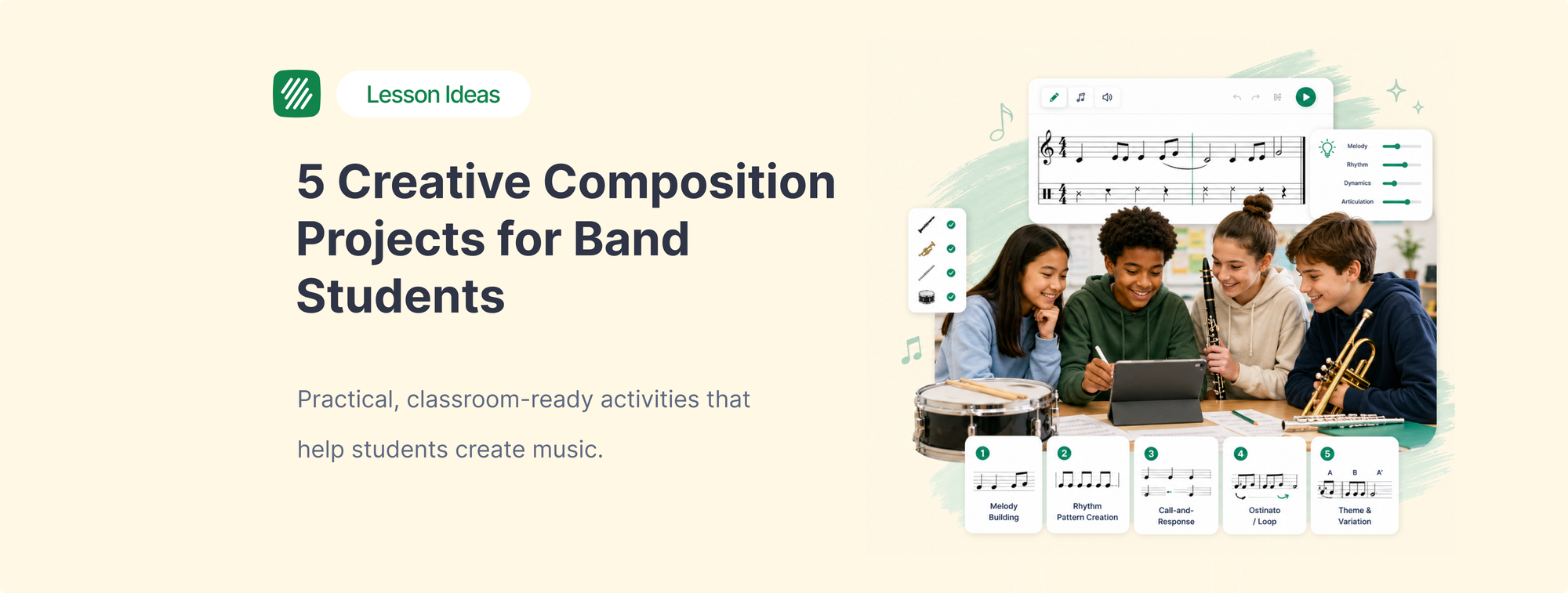
All five projects below are designed for grades 6–8 general music or beginning/intermediate band classes. Each one fits inside a 50-minute block, maps to NAfME Creating standards, and works inside Flat for Education without any setup headaches.
Why Constrained Composition Works in Band Class
Band directors don't have trouble teaching students to play someone else's music. The challenge is getting students to make musical decisions independently, and to defend them. That's where composition comes in.
But "write me a melody" with no other instructions produces one of two outcomes. Either the student writes random notes and calls it done, or they freeze because the task feels too big. Neither outcome teaches them anything about music.
Constrained composition solves this. When you tell a student to write a four-bar B section that contrasts with the provided A section in dynamics and articulation, they have to make three or four deliberate musical choices. They have to think about why piano sounds different from forte. They have to decide whether slurs or staccato fit the character they're going for. Those decisions are the lesson. The notation is just how they record it.
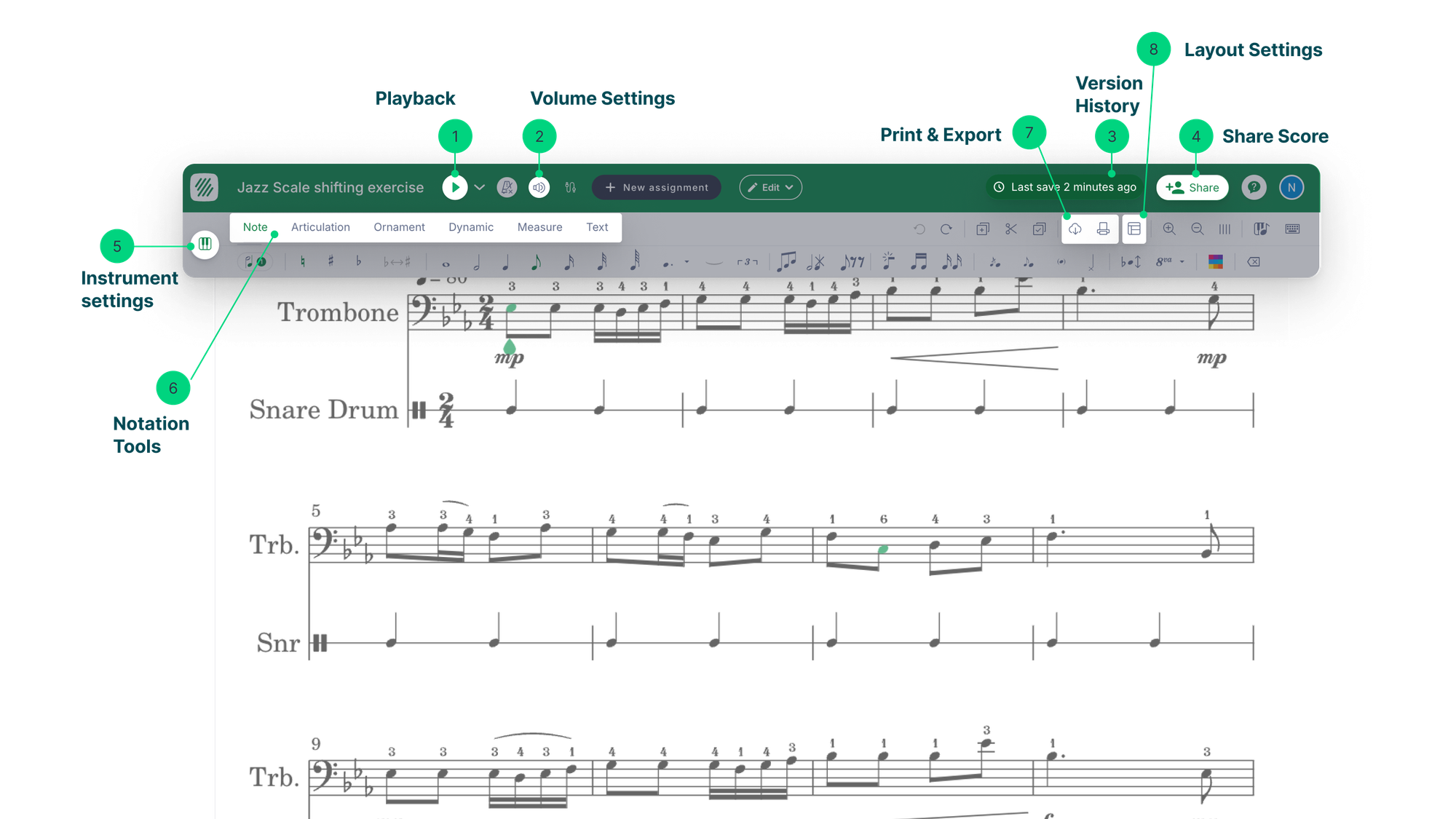
Flat for Education's browser-based score editor works on any device, so students can compose during class without needing to install anything or bring instruments. For band teachers juggling rehearsal schedules and limited tech time, that matters.
Project 1: Write the B Section
Give students a completed, simple A section (8 bars, one instrument, 4/4 time, stepwise motion only). Their task: write an 8-bar B section that clearly contrasts with it.
Define contrast. That's the teaching moment. Contrast means: if the A section is legato and quiet, the B section should be something different. If A uses mostly quarter notes, B should use something other than mostly quarter notes. Don't tell them exactly what to do. Tell them what contrast means and let them choose how to get there.
Parameters to give students:
- Same time signature as the A section
- Same instrument
- 8 bars exactly
- At least one dynamic marking and one articulation marking
- Must end on the tonic note
The reflection question: "Write one sentence explaining how your B section contrasts with the A section." That sentence is worth more diagnostically than the score itself. It tells you whether the student understands contrast as a concept or just moved notes around.
Inside Flat for Education, you can provide the A section as a locked template and have students add measures below or after it. Composition assignments let you set up the task, distribute it to the class, and see all submissions in one place.
Project 2: Add a Countermelody
This one works particularly well for students who've been playing in unison for a semester and are ready for something harder. Give them a simple melody (a folk song or a theme from repertoire you're already rehearsing works well here). Their task: write a countermelody for a second instrument.
Rules that keep this manageable:
- The countermelody must use different rhythms from the melody at least 50% of the time
- No parallel unisons or octaves for more than two consecutive beats
- The second instrument must be within a realistic range (specify this for each instrument)
- Both parts should work when played simultaneously
The last rule sounds obvious but isn't. Students often write countermelodies that look fine on paper and sound terrible together. Having them play or listen to both parts at the same time inside Flat for Education — which plays back both staves simultaneously — is the most efficient feedback loop you'll find. They hear the problem immediately and fix it faster than any written comment would prompt them to.
This project also sets up a genuine performance opportunity. If two students write complementary countermelodies, they can perform them together. That's a compositional outcome that connects directly to ensemble skills.
Project 3: Rhythmic Elaboration
Start with a very simple melody, something like a whole-note or half-note version of a familiar tune with the rhythmic interest stripped out. The task: add rhythmic interest without changing the pitches.
This sounds easier than it is. Students quickly discover that adding too many eighth notes makes the piece feel rushed, that rests need to be placed deliberately, and that where a beat falls can completely change the character of a phrase. Those are not abstract theory concepts. They're things the student figures out by listening to their own composition and deciding it doesn't sound right yet.
Specific constraints:
- Cannot change any of the given pitches
- Must use at least three different note values
- Must include at least one rest
- Must stay in the same time signature
The variation here is worth exploring: give the same skeletal melody to the whole class and compare what different students produce. No two will be the same. That's an excellent discussion starter about how rhythm creates character, and it makes the listening activity at the end of the project genuinely interesting for the students doing the listening.
Project 4: Compose for Your Own Instrument
This one is simple in concept and surprisingly difficult in practice. Students compose a 16-bar solo for the instrument they play, with the constraint that every note must be within their current comfortable range and every rhythm must be something they can actually perform.
The constraint isn't about limiting creativity. It's about making the composition functional. "Would you be able to play this at a comfortable tempo?" is a question that forces students to think about playability, breathing, bow changes, valve positions, all the instrument-specific knowledge they've been building for months.
You can extend this in two directions. For stronger students, add a requirement for one technical challenge just beyond their current ability, something they'd need to practice. For students who struggle with open-ended tasks, pre-fill the first four bars and ask them to complete the phrase.
Flat for Education's instrument-specific playback makes this work particularly well. Students can hear exactly what their part sounds like before submitting, which catches obvious range errors and motivates revision in a way that teacher comments rarely do.
Project 5: Reharmonise a Melody
This one is for students who are ready for something more theoretically demanding, typically late in 8th grade or in a music theory elective. Give them a simple melody in C major and a set of allowed chords (I, IV, V, and optionally vi). Their task: choose which chord to place under each phrase and explain why it fits.
The "explain why it fits" part is what makes this a composition project rather than a theory exercise. Students have to connect harmonic choices to expressive intent, which is a genuinely difficult cognitive task and exactly the kind of work that NAfME's Creating standards are pointing toward.
Constraints:
- Choose one chord per bar (or two if the melody moves slowly)
- The first and last bars must use the I chord
- Write two sentences after submitting: what effect does your harmonic choice create at bar 5, and why did you choose it?
If you have access to keyboard instruments or student devices, having students play or listen to two different harmonisations of the same melody, one using mostly I and IV, one using more V and vi, is a quick and memorable demonstration of how harmony changes emotional character.
How to Set These Up in Flat for Education
Each project can be created as a composition assignment in Flat for Education in a few minutes. Here's the general workflow:
- Go to your class and create a new assignment, selecting Composition as the type.
- If you're providing a template (a pre-filled A section, a skeletal melody, etc.), create that score first and set it as the starting template for the assignment.
- Add the constraints and the reflection question in the assignment instructions field.
- Set any parameter locks you need, for example locking the provided A section so students can only edit their B section.
- Distribute to the class. Students open the assignment on any device and work directly in the browser.
- Review submissions in the assignment dashboard, where you can see every student's score and leave comments directly on the notation.
All five projects work with a free 30-day trial, so you don't need a school plan in place to try them with your next class.
Explore our NAfME-Aligned Video Series!
10 videos with plenty of assignment ideas, tips, and additional resources!
Flat for Education integrates with Google Classroom, Microsoft Teams, Canvas, Schoology, and MusicFirst, so assignment distribution fits into whatever workflow your school already uses. If you want to try these projects with your next class, a free 30-day trial gives you full access to composition assignments and everything else in the platform.
FAQ
How long should a middle school composition project take?
Most of these projects work well as two-to-three-session units: one session for instruction and initial work, one for revision after hearing playback, and optionally one for sharing and peer feedback. Avoid stretching composition work over multiple weeks without structured checkpoints, since students lose momentum and the task starts to feel like homework rather than music-making.
Do students need prior notation knowledge before composing?
Projects 1, 3, and 4 require basic notation literacy, meaning students can place notes on a staff and understand rhythmic values, and Projects 2 and 5 build on that. For students still shaky on notation basics, starting with Project 3 (rhythmic elaboration on given pitches) works well because it removes pitch decision-making entirely and focuses purely on rhythm.
How do you grade student compositions fairly?
The most effective approach is criterion-referenced grading against the specific constraints you set, such as whether the B section used a contrasting dynamic or the piece ended on the tonic. Those are observable, objective criteria. Grading for "creativity" in isolation tends to disadvantage students still developing musical vocabulary and is hard to explain, so combining a constraint checklist with the reflection question produces a grade that is both fair and diagnostic.
Can these projects work in a general music class, not just band?
Yes. Projects 1, 3, and 5 work well in general music settings because they do not require instrument-specific knowledge. Project 4 is specifically designed for band because it connects composition to the student's own instrument, and Project 2 works in both settings if you adapt the instrumentation to whatever your students are working with.