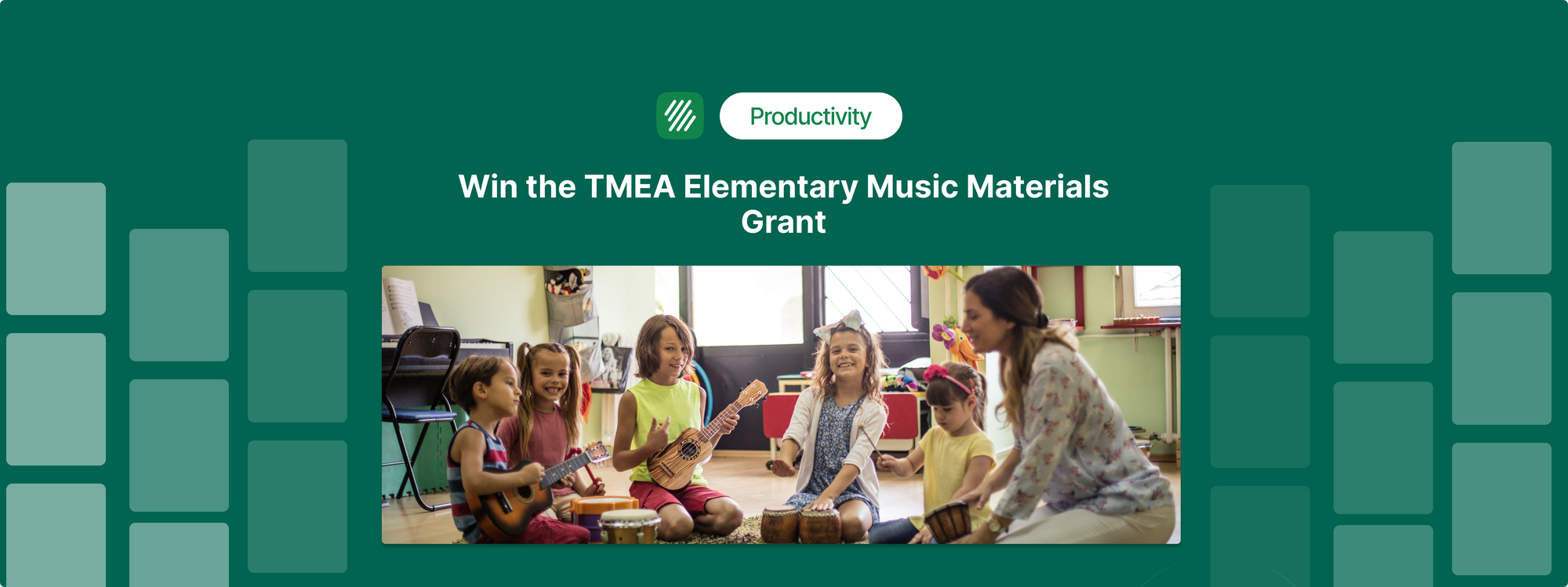
Every year, hundreds of Texas elementary music rooms run on shoestring budgets while a pool of grant money sits waiting for someone to claim it. The TMEA Elementary Music Materials Grant hands out awards of up to $1,000 per campus to buy the materials your PreK–5 students actually need.
The catch? You have to apply, and the application window is short. This guide walks you through who qualifies, what you can spend the money on, and exactly how to build an application that stands out, so you can spend less time worrying about your budget and more time teaching.

What the grant is (and where the money comes from)
The TMEA Elementary Music Materials Grant is a benefit funded directly by the Texas Music Educators Association, not by state legislation or a school district line item. That distinction matters: because it comes from TMEA's own board-approved funds, it's tied to your membership, and the rules are set by TMEA rather than a government agency.
Each award is worth up to $1,000, and the money must go toward materials for the specific campus elementary music program named in your application. It's meant to strengthen your program, not replace money you already have. TMEA calls this "supplement, not supplant," which simply means grant dollars have to be on top of your existing budget, not a substitute for it.
Are you eligible?
Two boxes have to be checked before you apply:
- You are a current Active Member of TMEA.
- You are teaching elementary music at a Texas school.
Good news for more teachers than you might expect: private school elementary music teachers are eligible too, as long as they meet the membership and teaching requirements. And if you teach at more than one campus, you can submit a separate application for each campus where you teach elementary music, since the funds are tied to a specific program.
What you can (and can't) buy
This is where teachers most often trip up, so read carefully. Grant funds cover music, classroom equipment, instruments, instructional software, and other educational materials for your program. But a few big-ticket categories are off the table.
| Eligible | Not eligible |
|---|---|
| Sheet music, method books, songbooks | Technology hardware (tablets, laptops) |
| Classroom equipment and materials | Band/orchestra instruments (violins, flutes) |
| Elementary instruments (Orff, recorders) | Items issued to an individual, not the program |
| Instructional software and digital tools | Purchases outside your district process |
That software line is easy to overlook, but it's one of the highest-impact ways to spend the money. A subscription to a browser-based tool like Flat for Education, for example, equips an entire class with composition and notation without touching the banned "hardware" category, and it keeps working long after a set of consumables would have run out. Because it's software your students access on devices the school already owns, it fits squarely inside what the grant is designed to fund.
The five things your application needs
When the application opens, you'll log in to your TMEA account and complete an online form. Have these five components ready before you start:
- Applicant and program information: your details, the campus program, grade levels you teach, and the total number of students served.
- Current resource information: this year's funding for your program, including district or campus money and any support from PTA, PTO, fundraising, or donations.
- Financial need statement: a short explanation of why you're seeking assistance and how the funding helps your program.
- Materials impact statement: a short explanation of which materials you're requesting, how you'll use them, and the impact they'll have on your students.
- Itemized price quote(s): uploaded as a PDF, from one or more vendors, listing every item, estimated shipping, and the total.
The total you request has to match the combined total of your uploaded quotes, so line these up before you submit.
How to make your need and impact statements land
Selection is based on financial need, existing program funding, the number of students served, and the expected instructional impact of what you're requesting. Reviewers are reading many applications, so specificity wins.
For the financial need statement, put real numbers on the page. "Our program serves 480 students on a $300 annual campus budget" tells a reviewer far more than "we are underfunded." Name the gap and show what you currently cover out of pocket or through fundraising.
For the materials impact statement, connect each item to a classroom outcome. Don't just list what you'll buy; explain what students will do with it. "A class set of software licenses lets every third grader compose and hear back their own eight-bar melody" is concrete and easy to picture. Tie your request to the number of students it reaches, because breadth of impact is one of the criteria.
Getting a clean price quote
Your quote is the backbone of the application, so make it easy for reviewers to say yes.
Try this before you apply: Contact your chosen vendor, tell them the quote is "for the TMEA Elementary Music Materials Grant," and ask for an itemized PDF that lists each item, estimated shipping, and a clear total. Confirm the total lands at or under $1,000, then save the file so it's ready to upload. That's it, three steps, and a big chunk of the application is done.
A few pointers: there's no TMEA-approved vendor list, so follow your school or district's normal purchasing process. TMEA does encourage applicants to request quotes from Sustaining Members, the companies that support the association, and many of them are set up to turn around grant quotes quickly. You can also combine quotes from multiple vendors as long as the grand total fits the cap.
Key dates and how you actually get the money
Mark these on your calendar:
- September 1 — Applications open.
- October 30, 4:30 PM CT — Applications due. This is a hard deadline.
- Week of December 22, 2026 (estimated) — Award notifications go out by email.
- January — Funds are distributed.
One important detail about payment: grant money is issued to the school or district purchasing entity named in your application, never directly to you, a vendor, a PTA, or a booster club. Make sure you know your district's correct financial entity before you apply, because listing the wrong one can slow everything down.
Don't leave the money on the table
The TMEA Elementary Music Materials Grant is one of the most accessible funding sources available to Texas elementary music teachers: up to $1,000, a short list of requirements, and a review process that rewards a clear, specific application. Get your numbers and a PDF quote ready before September 1, write need and impact statements that name real outcomes, and double-check your district's purchasing entity. Do that, and you've given yourself a strong shot at a better-equipped classroom this spring.

Ready to make your grant dollars go further? Flat for Education gives every student an elementary composition tool and music-ed classroom right in the browser. No hardware to buy, no software to install. This makes it a natural fit for an eligible grant quote. Explore Flat for Education and request a quote for your application.
FAQ
Can I apply for more than one campus?
Yes. Submit a separate application for each campus where you teach elementary music, since the funds are tied to a specific program.
Are private school teachers eligible?
Yes, as long as you're an Active TMEA member teaching elementary music at a Texas school.
Can I use quotes from more than one vendor?
Yes. Combine them, and make sure the total you request matches the combined quote total, shipping included.
Can I buy iPads or a class set of ukuleles for band?
No. Technology hardware and band or orchestra instruments are excluded, though elementary classroom instruments and instructional software are eligible.
Who receives the funds?
Your school or district purchasing entity, paid out in January. Funds are never sent directly to you, a vendor, a PTA, or a booster club.