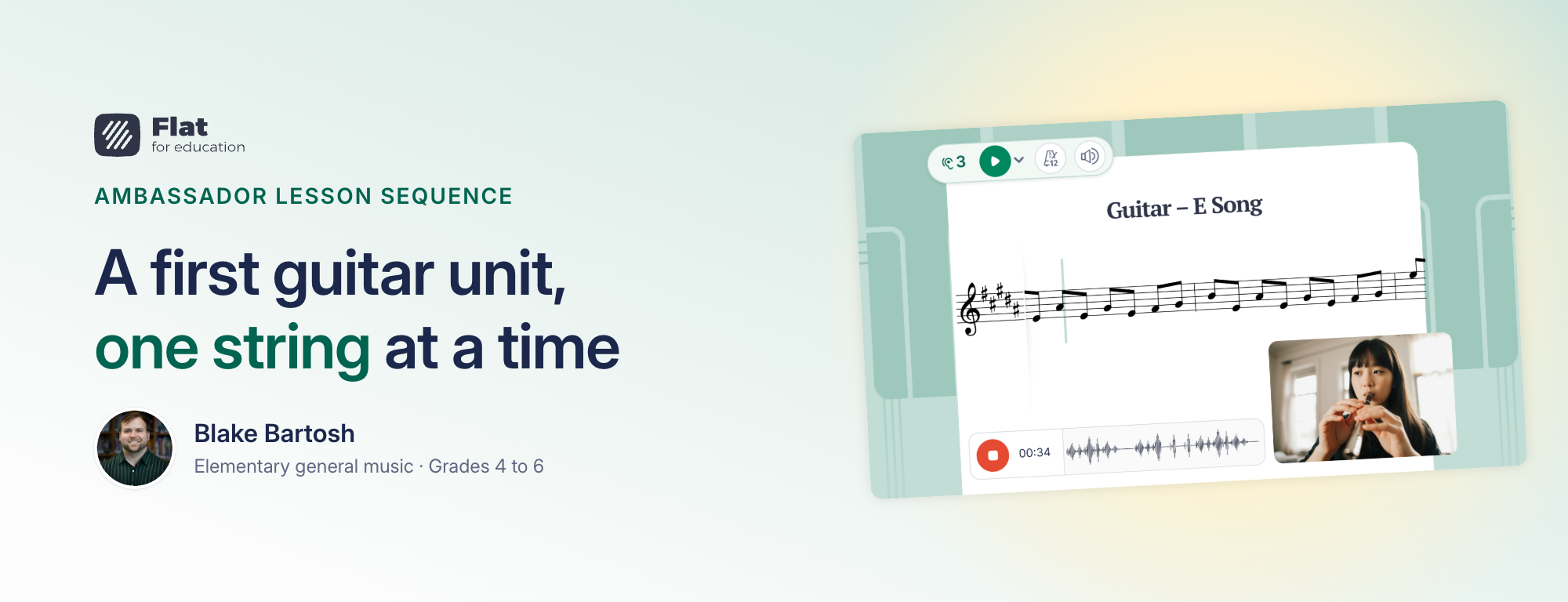
Hand twenty-five fourth graders a guitar each and you'll get about ninety seconds of silence. Then everyone strums at once. The first guitar lesson is rarely about music. It's about getting a room full of excited kids to play one clean note at the same time.
Blake Bartosh teaches K to 5 general music in Austin, Texas. He's a saxophone player, and his kindergarteners treat him like a rock star. His beginner guitar lesson plan for grades 4 to 6 deliberately does very little: three notes, one string, four short songs. He shared it through the Flat for Education Ambassador Program, and every step is ready to assign.
Why start a beginner guitar unit on one string?
Chords are the obvious place to start, and they're the reason so many elementary guitar units stall. A G chord asks a nine-year-old to place three fingers on three strings, press hard enough, and avoid muting the strings in between. Most can't yet. Single notes on the high E string ask for one finger at a time, so students hear success in the first lesson instead of the fourth.
The high E string also gives you a tidy set of first notes. E is the open string. F is the first fret. G is the third fret. That's enough to play real melodies, and enough to start reading them on the staff.
The four-step beginner guitar sequence
| Step | Activity | New skill |
|---|---|---|
| 1 | Guitar: E Song | Open string, steady rhythm, clean tone |
| 2 | Guitar: F Song | First fretted note |
| 3 | Guitar: G Song | Reaching the third fret |
| 4 | Guitar: Walking on Quarters | Moving between all three notes in steady quarter notes |
Every activity shares the same learning objective: perform with accurate rhythm and pitch, with correct guitar technique. What changes is the left hand. By step 4, students walk between E, F and G in quarter notes, which is where timing problems show up fast. That's the point. A student who rushes the F in step 4 needs a different conversation from a student who can't find it.
How recording changes a guitar class
In each activity, students record themselves playing the song on guitar and re-record if they need to. The optional extension asks them to sing the song while they play, or tap the rhythm on their hands while they sing. Students can work solo or in pairs.
This is where the unit saves class time. Instead of listening to twenty-five students one by one while twenty-four wait, every student records on their own time. Recordings are scored automatically against the music, and the activities use the Kind auto-assessment setting, which keeps the pressure low for beginners. When you review the recordings, you can pin a comment to the exact measure where a note buzzed.
If you want the full picture of collecting performances this way, our guide to running individual performance assessments for a full class walks through the setup.
How to teach the beginner guitar unit with Flat for Education
- Open Guitar: E Song from the activity library and add it to your assignments. If you're new, start the 30-day free trial.
- Demonstrate the note in class first. Play it, have students copy it, then play the song together once before anyone records.
- Assign the recording as practice, not as a test. Flat for Education integrates with Google Classroom, Microsoft Teams, Canvas, Schoology, and MusicFirst, so it appears where students already look.
- Listen to a few recordings before the next lesson and note the most common problem, whether that's a buzzing F or a G on the wrong fret.
- Unlock the next song once most of the class can play the current one cleanly.
A practical tip: put pairs together for the first recording. One plays, one holds the device and watches the left hand. Then they swap. Nervous students tend to record more willingly when a friend is pressing the button.
What comes after E, F and G?
Once students can walk between three notes on one string, they're ready for the B string and the notes below it. They're also ready to read. Our article on sight reading for guitar students picks up from here, with ideas for building notation fluency rather than relying on tab alone. Free Record mode is useful at this stage too: students can record a riff they made up without needing a score attached, which is a nice reward between assigned songs. There's more on that in our post about Free Record performance assignments.
Bring Blake's guitar unit into your class
These four activities were written by an elementary teacher and run with his own students before they joined the Flat for Education activity library. They're short on purpose. Open the first one, adjust the instructions for your room, and see how many students record a clean E by the end of the week. Flat for Education offers a free 30-day trial, so you can run the whole unit before you decide.
FAQ
What are the first notes to teach on guitar?
Many teachers start with E, F and G on the high E string. E is the open string, F is the first fret and G is the third fret, so students can play real melodies with one finger at a time.
Should beginner guitar students learn chords or single notes first?
For upper elementary students, single notes are usually easier because they need one finger at a time. Chords ask for finger strength and coordination that many 9 and 10 year olds haven't built yet.
How can I assess a whole guitar class without hearing every student live?
Have students record themselves on their own time and submit the recording. In Flat for Education, recordings are scored automatically against the music, and you can pin comments to specific measures when you review them.
What grade is this beginner guitar unit for?
Blake Bartosh's unit is written for grades 4 to 6. You can adapt the instructions for older beginners by moving faster through the first three songs.