Most guitar students in school programs have never seriously sight-read standard notation. They know chord charts. They can follow tablature. Some can pick out single-note lines if given enough time. But genuine notation sight reading, first-encounter reading of a standard score at tempo, is the skill that almost no classroom guitar program develops systematically.
The reason is cultural rather than practical. Guitar has a long history of being taught through chord charts and tablature because those formats serve the popular music context that most students enter the instrument through. But standard notation is where the instrument's full range becomes accessible: ensemble playing, classical repertoire, musical theatre, and studio reading. Students who can only read tablature are permanently limited in those contexts.
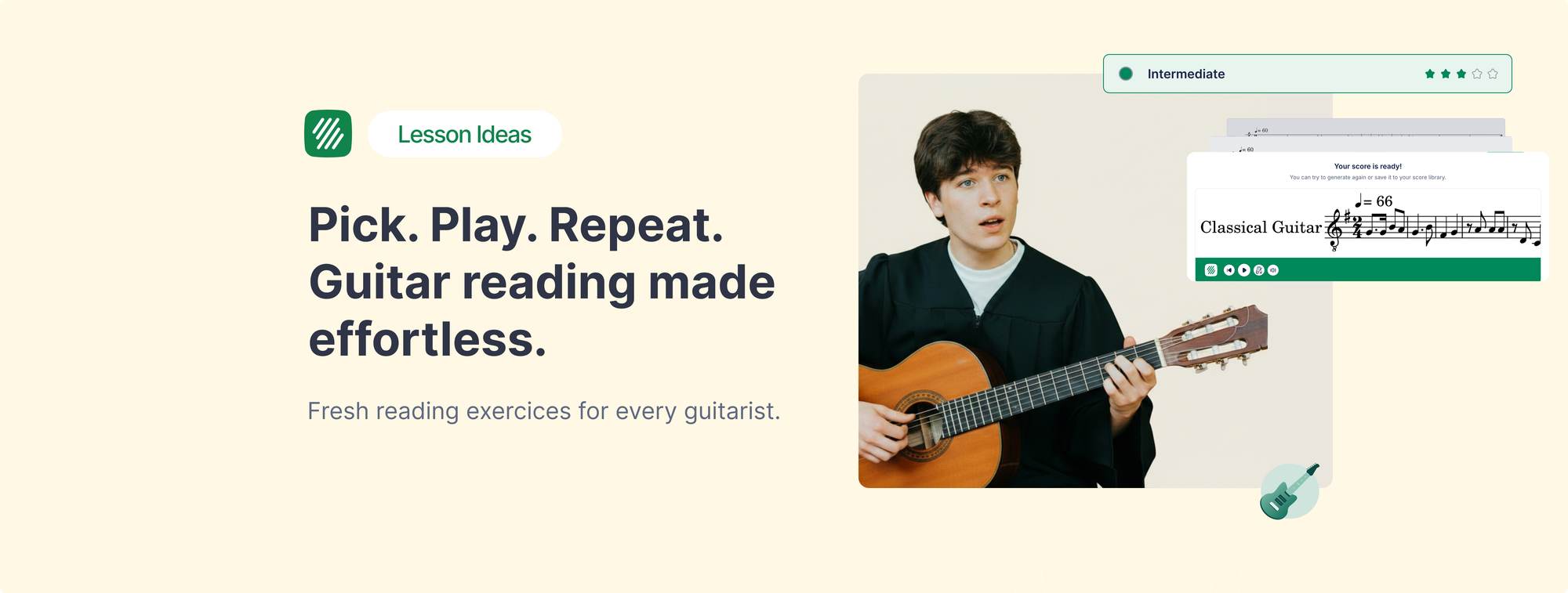
Flat for Education's sight reading generator creates standard notation guitar exercises. Here's how to use them in a classroom that might never have done notation sight reading before.
The position problem in guitar sight-reading
Guitar is unique among the instruments in the sight-reading generator because the same note can be played in multiple positions on the neck. A D on the second string, third fret, sounds identical to the D on the fourth string, open. Most beginners learn first position almost exclusively. But first-position guitar sight reading covers a very limited range, and students who've only learned first position will encounter notes above the first-position range relatively quickly.
When starting guitar sight-reading, explicitly establish which position students should use. For most beginners, first position only. State this clearly: "All notes are in first position today." This removes the guessing about fingering and lets students focus on reading.
String crossing and right-hand reading
Guitar sight reading requires two kinds of reading happening simultaneously: the left hand decodes the pitch, and the right hand determines the string to play. Students who are still thinking consciously about right-hand technique (which pick direction, which finger on which string) have less attention available for reading.
Use easy exercises specifically to automate the right-hand technique in a reading context. The exercise is below the student's technical level. The goal is right-hand fluency on unfamiliar material: can they navigate string crossings without thinking about it? Students who can do this in a simple exercise will have more attention available for reading in harder ones.
Guitar sight-reading as a gateway to ensemble playing
One of the most motivating things you can tell guitar students is that notation sight-reading is what opens up ensemble playing. A guitarist who can read notation can play in a chamber ensemble, read a musical theatre book, work from a printed score in a production context. A guitarist who can only read chord charts is limited to contexts where chord charts are available.
This framing often lands better with secondary school guitar students than "sight reading is good for your musicianship." Career relevance is motivating in a way that abstract skill-building often isn't.
Assign exercises as performance submissions through Flat for Education via Google Classroom, Microsoft Teams, Canvas, Schoology, or MusicFirst. Students record at home and submit. The evidence of developing notation fluency over a term is visible in the recordings.
Single-line melody first
Guitar exercises from the generator are single-line melodic exercises. This is actually ideal for classroom use because it removes the complexity of chord-melody playing that advanced guitarists work with. Students read one note at a time, in sequence, at a set tempo.
For students whose note reading is insecure, connect the notation to fretboard position visually: project the exercise and, before playing, ask students to finger each note (not play it, just finger it) in position on the neck. This kinesthetic preparation is the guitar equivalent of the trombone position-calling exercise, and it serves the same function: connecting the visual symbol to the physical action before time pressure adds difficulty.
Fretboard geography sight-reading game
Project a generated exercise. Ask students to identify every note in bars 1 and 2 by name before anyone plays anything. Then play bars 1 and 2. Repeat for bars 3 and 4.
This is slower than a typical sight-reading exercise, but it targets the specific weakness that limits most classroom guitar students: they don't know the names of the notes they're playing. Students who have learned guitar primarily by ear or tablature often have poor note-name-to-fretboard mapping. This exercise builds it explicitly and turns notation sight-reading into a fretboard geography lesson at the same time.

Flat for Education's sight reading generator creates standard notation guitar exercises instantly, at whatever difficulty level your students need. Assign them through Google Classroom, Microsoft Teams, Canvas, Schoology, and MusicFirst for recorded submissions. Free 30-day trial at flat.io/edu.
FAQ
Should guitar students learn to sight-read notation?
Yes, particularly in school programs where musical literacy is a curriculum goal. Tablature is useful for learning specific pieces quickly, but it does not develop transferable reading skills or enable access to the full range of notated music. Students who sight-read notation can access ensemble music, classical repertoire, studio charts, and musical theatre scores, while students who only read tablature cannot.
How do I start notation sight-reading with students who have only used tablature?
Start in first position only and limit exercises to the range students know well, from open strings to the fifth fret. Use the lowest difficulty settings initially and establish the habit of identifying each note by name before playing. Progress is slow at first but accelerates once students have mapped the first-position fretboard to staff notation, because note-name-to-fretboard mapping is the prerequisite, not rhythmic complexity.
What is a realistic sight-reading level for a beginner guitar student?
A beginner who has been playing for about a year should be able to read single-line notation in first position, in 4/4 time, using quarter notes, half notes, and dotted half notes, in the key of C or G. Progress beyond this requires consistent weekly sight-reading practice rather than occasional sessions, since short, regular exercises produce faster development than infrequent longer ones.