Alto saxophone students deal with a sight-reading challenge that isn't talked about enough: their instrument is a transposing instrument in E-flat, which means they're reading in a different key from every concert pitch instrument in the ensemble. A piece written in C for the piano is actually in A for the alto saxophone. Students who understand this theoretically don't always process it intuitively when sight-reading in an ensemble context.
For classroom saxophone sight reading, this creates a specific goal: build fluency in the written keys that alto saxophone parts actually appear in, rather than working from concert pitch down. Most alto saxophone parts appear in written keys of one to three sharps or one to two flats. That's where sight reading practice should be concentrated.
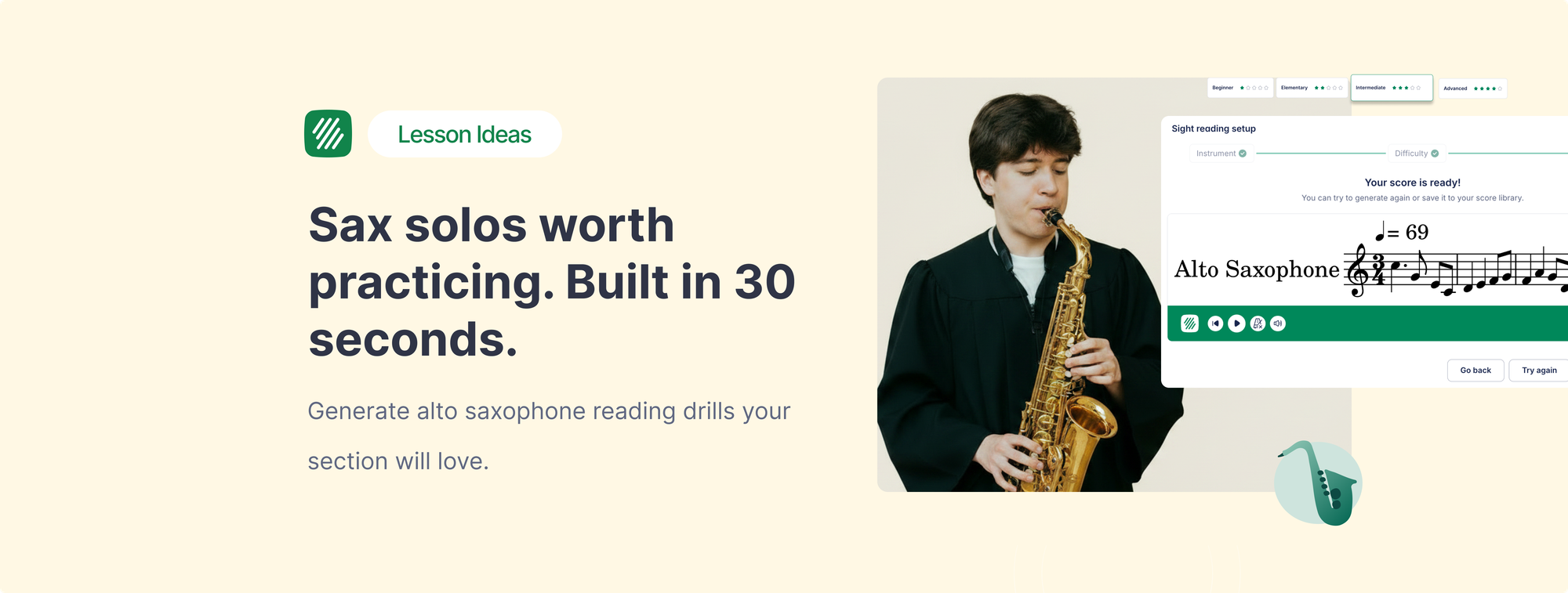
Flat for Education's sight reading generator produces exercises written for the alto saxophone's range and reading context directly. The transposition is handled automatically. Here's how to use that well.
The key signature problem in alto sax sight reading
Ask an alto sax student what key their instrument is in and most can answer correctly: E-flat. Ask them what concert pitch a written G sounds like on their instrument and watch the pause. The theoretical knowledge is there but the real-time application lags behind.
This matters for sight reading because a student who doesn't have automatic key orientation takes longer to orient to a new exercise. They're doing mental arithmetic while trying to read. Lower difficulty levels in the generator provide good opportunities to work in familiar keys without harmonic complexity. Use them frequently to build key fluency, not just rhythmic fluency.
A useful warm-up before sight reading: ask students to name the concert pitch of a written note in today's exercise key. C in A major is... (pause) ... A concert. This kind of quick theoretical activation before reading helps orient students to the key before they encounter it in motion.
Altissimo register reading, introduced deliberately
Alto saxophone's upper register, above the standard two-octave range, requires different voicing and air support. Most intermediate students have accessed a few altissimo notes but haven't automated them. Higher difficulty settings in the generator may introduce upper register material, depending on the difficulty level.
Use this intentionally: reserve higher difficulty settings for students who have already worked on upper register technique in their regular lessons. Don't assign exercises where the sight reading challenge is "can you produce this note at all" rather than "can you read this passage fluently." That's a technique problem, not a reading problem, and mixing the two up produces frustration rather than progress.
Saxophone sight reading with articulation focus
The alto saxophone's tongue articulation is one of its most expressive characteristics, and it's almost always absent in sight reading because students are using all available attention on pitch and rhythm. Try this: generate an exercise at a comfortable level, well within the student's range, and ask them to read it with only one performance target: all slurred notes are legato, all staccato notes are short. Nothing else matters.
Students who read a simple exercise with articulation often sound more musical than students reading a harder exercise without it. And the habit of reading articulation marks in the first read, rather than adding them later, is exactly what fluent sight reading looks like in a real ensemble context.
Saxophone-specific sight-reading vocabulary
Before reading an exercise, ask students to identify: the time signature, the key signature, the highest written note, and any articulation markings. This 20-second pre-read activates the scanning habit that experienced players do automatically but beginners skip entirely.
For saxophone students specifically, add a fifth item: "Is there anything in the upper register you need to prepare for?" This targets the specific physical preparation that distinguishes saxophone sight reading from other instruments and builds the pre-performance awareness that good ensemble players develop over time.
Group sight reading in a saxophone section
Generate the same exercise for every student in the section, or generate variations at different difficulty levels if the section has a wide ability range. Have the whole section read simultaneously, with a tuner visible on screen and the shared expectation that they keep a steady beat regardless of individual errors.
The saxophone section is one of the most harmonically rich sections in a concert band when every part is reading fluently. Working on sight reading as a section, rather than as individuals, builds the listening habit alongside the reading habit. Students who can read their own part while hearing their section neighbours are much more useful in rehearsal.
Assign section sight readings as performance submissions through Flat for Education via Google Classroom, Microsoft Teams, Canvas, Schoology. Record once a month. The progress over a semester is audible.

Flat for Education's sight reading generator creates fresh alto saxophone exercises instantly, written for the instrument's range and reading context. Assign them to individuals or whole sections through Google Classroom, Microsoft Teams, Canvas, Schoology, and more. Try free for 30 days at flat.io/edu.
FAQ
What makes alto saxophone sight reading different from other woodwinds?
The main distinction is transposition: the alto saxophone is an E-flat instrument, so students are always reading a major sixth above concert pitch. This is automatic for experienced players but requires conscious attention from intermediate students, so building key fluency in the written keys saxophone parts actually appear in is a more useful focus than working through all keys systematically.
How should I handle the altissimo register in sight reading exercises?
If a student's altissimo register is not yet reliable in rehearsed music, exercises that require it in sight reading are a technique problem, not a reading problem. Use lower difficulty levels for students still developing their upper register, and reserve higher difficulty settings for students who can produce upper-register notes consistently in rehearsed contexts. Reading challenges and technique challenges should be separated whenever possible.
Is saxophone sight-reading important for band students?
Absolutely. Ensemble sight-reading is a required skill in most state music education standards, and saxophone sections that sight-read well are significantly more useful in rehearsal. A director who can hand out new music and have the saxophone section make a credible first attempt saves hours of rehearsal time over a year.