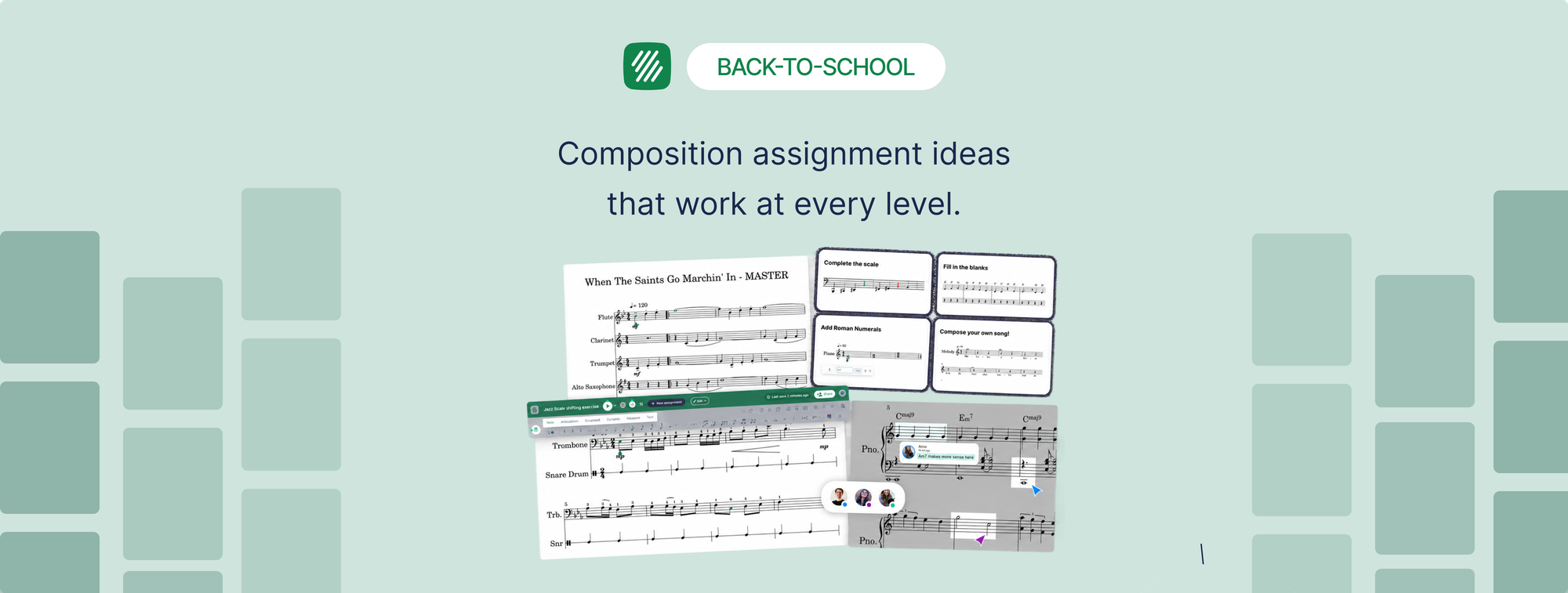
Every music teacher has had this experience: the semester plan looks great in August, and then October arrives and you realize you have assigned the same composition exercise four times in a row because you ran out of ideas. This post is the list you build before that happens.
These are practical composition assignment ideas for fall semester, each designed to work inside Flat for Education and aligned to the NAfME National Core Arts Standards. They range from first-week activities to multi-lesson projects, and they cover general music, band, orchestra, and choir contexts.
Why composition belongs in every music class, not just theory
The NAfME Creating standards apply across all music contexts, from general music to ensemble. Creating MU:Cr1.1 asks students to generate and conceptualize artistic ideas and work. That does not mean every student needs to write a symphony. It means students need regular opportunities to make musical decisions and put them on paper, or on a screen.
Composition assignments in Flat for Education connect directly to this standard. You can document the work, give timestamped feedback on specific measures, see revision history, and have students submit a final version for assessment, all in one place without shuffling between tools.
First-week ideas: get students into the editor fast
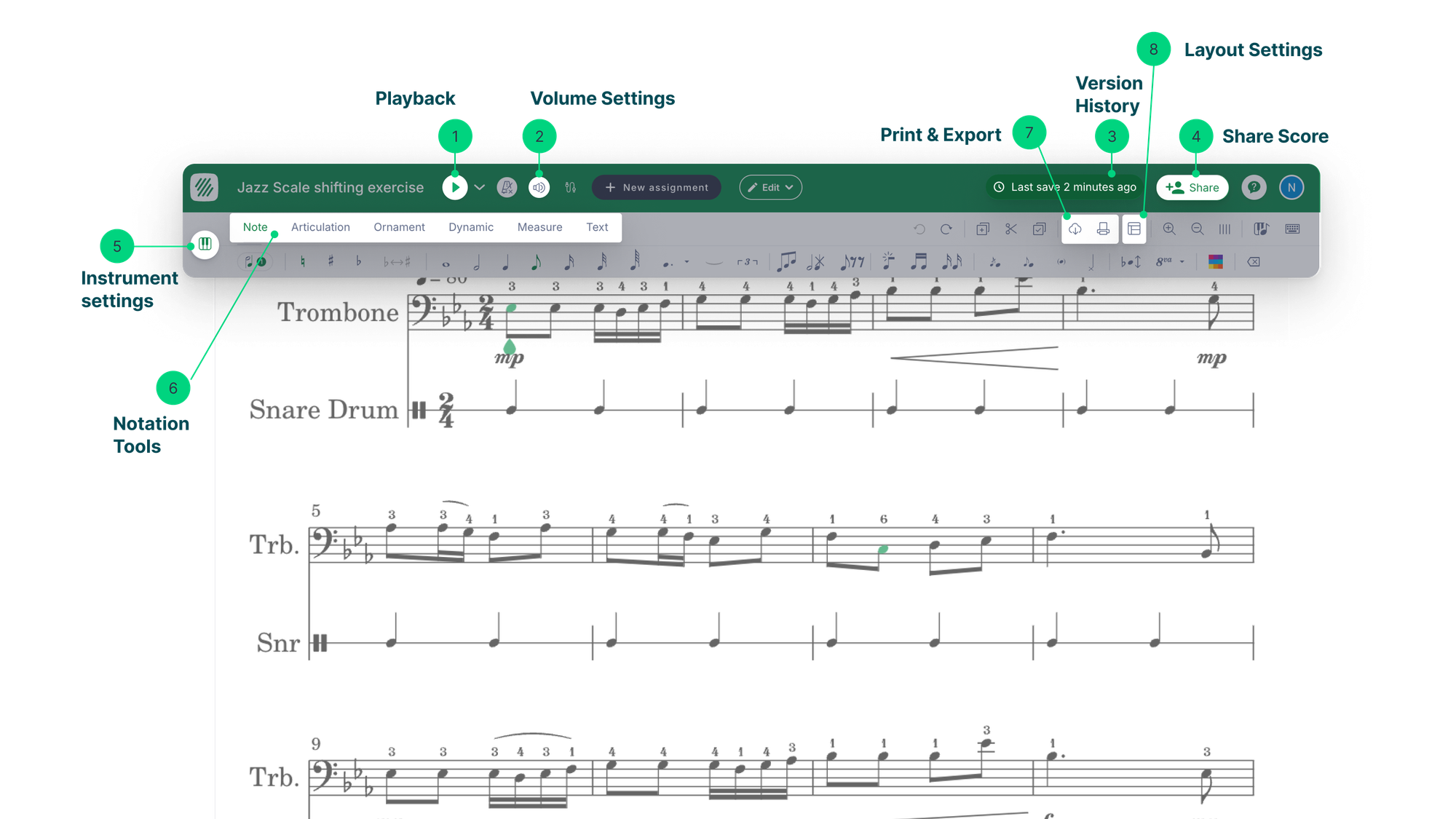
Four-measure melody in C major. Give students a key, a time signature (4/4 works well), and a note value restriction: quarter notes and half notes only. The constraint makes it accessible. Students who finish early can add dynamics or articulation. This gets every student into the notation editor on day one, and you see immediately who is comfortable and who needs support.
Rhythm-only composition. Students compose a four-measure rhythm on a single pitch (C or middle line of the staff). No melodic decisions, just rhythmic ones. Works well as a first assignment for younger students or classes with mixed notation experience. Can be assessed against a clear rubric: correct note values, measure lines in the right places, rhythms that add up to the time signature.
Complete the phrase. You write measures 1 and 2. Students write measures 3 and 4 to complete the musical phrase. This is easier to grade because you control the musical context, and it introduces the idea of melodic continuation and cadence without needing to lecture about it first.
Mid-semester projects for more depth
ABA form composition. Students write an A section (eight measures), a contrasting B section (eight measures), and return to the A section. The brief can be as open or constrained as your class needs. For general music, you might specify a key and instrument. For theory students, you might add requirements: modulation in the B section, specific harmonic rhythm, voice leading rules. This maps to NAfME MU:Cr2.1 (organize and develop artistic ideas) and generates genuinely interesting student work.
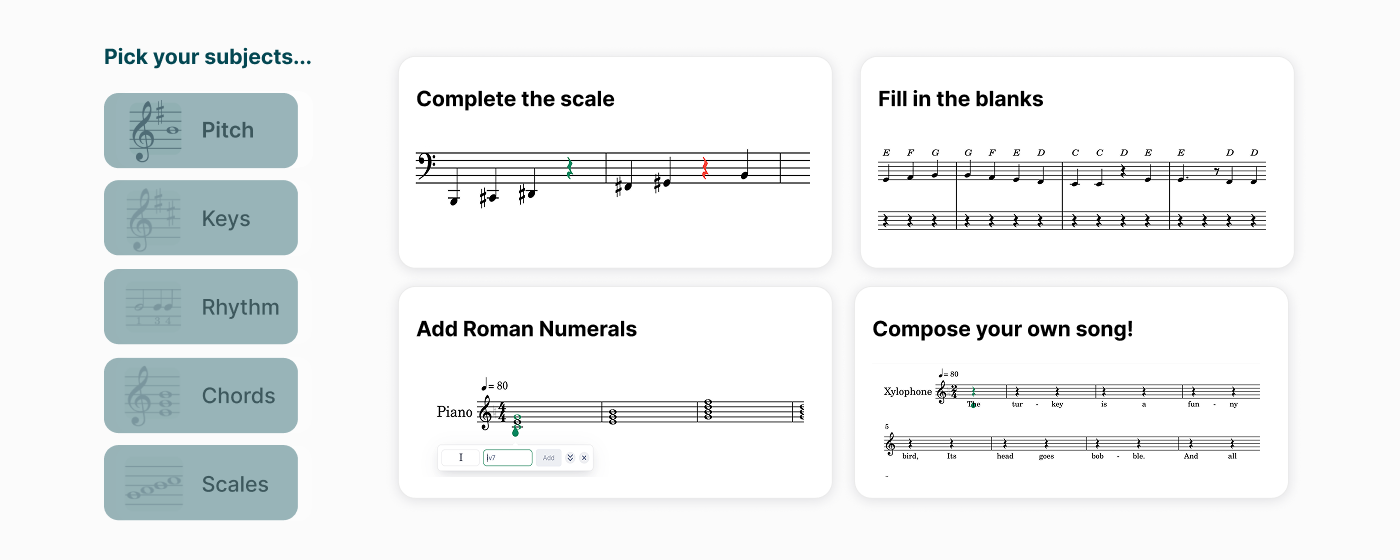
Melody over a given chord progression. You write a chord progression in the score. Students compose a melody that fits it. You can do this in Flat for Education by creating an assignment template with the chords pre-notated and a blank melody line above. Students fill in the melody line and submit. This works well for theory classes and is straightforward to assess: does the melody fit the harmony? Does it have a clear shape? Are there obvious clashes?
Arrangement of a folk song or public domain melody. Give students a single-line melody (many are available in Flat for Education's score library). Ask them to arrange it for two instruments: add a second part, a bass line, or a counter-melody. This is composition in a structured context, and it builds arranging skills that are genuinely useful for ensemble players.
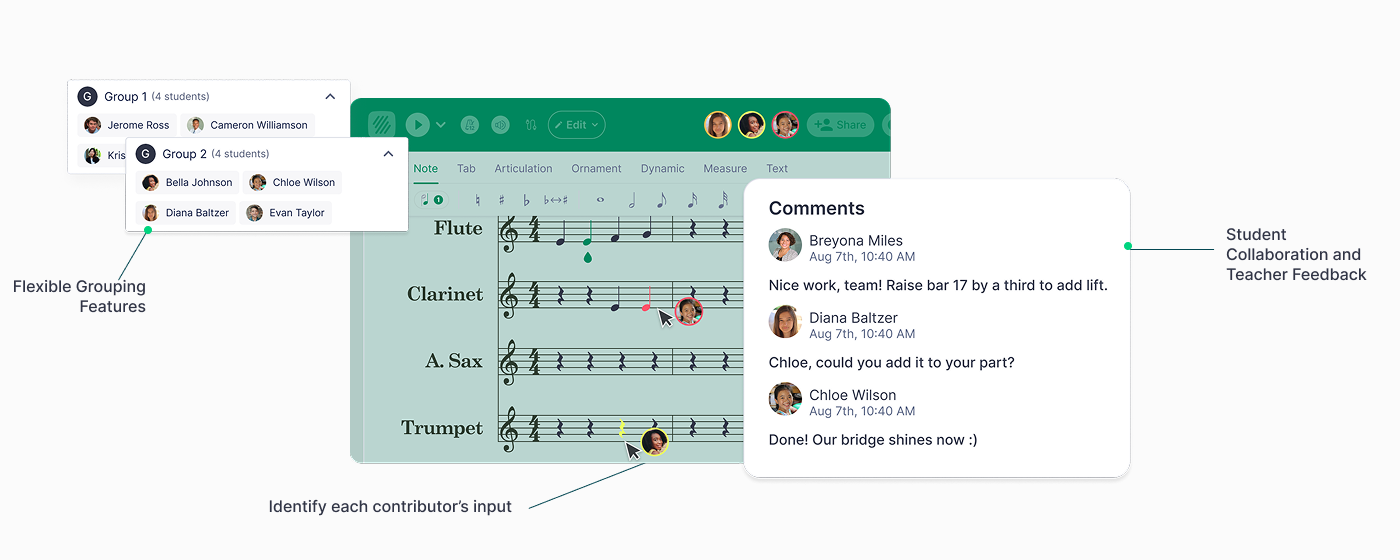
Collaborative class composition. Assign each student or small group one section of a larger piece. Using Flat for Education's real-time shared writing, groups can work simultaneously in the same score. This is particularly effective for a class concert piece where students perform something they composed themselves.
Performance and composition combined
One of the most underused assignment types in Flat for Education is the performance assignment layered on top of a composition assignment. The workflow looks like this:
- Students compose their piece (composition assignment, week 1)
- They revise based on your feedback (week 2)
- They record a performance of their finished piece directly in the platform (performance assignment, week 3)
The submission includes both the score and the audio recording. You grade the composition on notation and musical decisions. You grade the performance on execution. Two rubrics, one workflow, no separate submission system.
This maps cleanly to NAfME MU:Cr3.2 (present polished creative work) and MU:Pr4 (analyze and interpret music for performance). For administrators asking how your program covers multiple strands, this single assignment sequence answers the question.
Ideas by ensemble type
Band and orchestra. Ask students to compose a 16-measure melodic exercise for their own instrument, within a comfortable range. Students in different sections of the ensemble end up with exercises tailored to their instrument. The class can then sight-read each other's exercises, which doubles as a sight-reading assessment.
Choir. Two-voice writing is an accessible composition challenge for choral students who understand basic voice leading. Soprano and Alto in parallel thirds is a starting point. From there, you can introduce contrary motion, oblique motion, and simple two-voice independence. Flat for Education's playback makes it immediately audible whether the voices are working or fighting each other.
General music (grades 6 to 8). The free nine-lesson NAfME-aligned unit built for Flat for Education includes a complete composition arc from initial ideas through ensemble performance. Every lesson is documented with NAfME strand references and includes rubrics. Access the unit here.
Assessment that does not add to your workload
Composition grading is often cited as the reason teachers avoid it. Two things that help in Flat for Education:
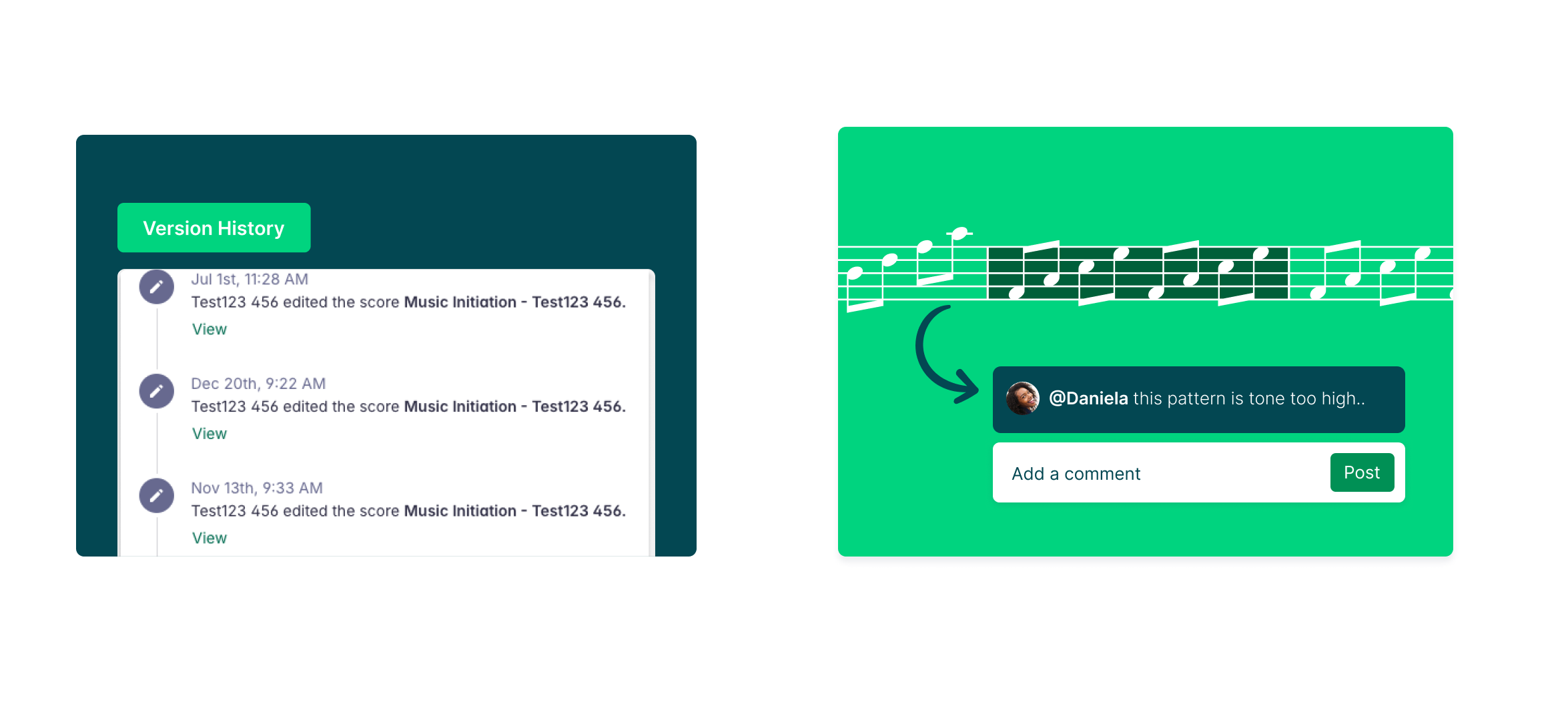
First, timestamped in-score comments. You do not write a paragraph of feedback at the end. You click on measure 7, type "the leap here is too large, try stepwise motion," and move on. The student sees the comment in context, not in a separate document they have to cross-reference with the score.
Second, version history. You can see every save state of the student's score. This means you can look at where they started, where they went after your feedback, and where they ended up. That is assessment data that a paper submission cannot provide.
Start building your fall assignment library
The assignments above are a starting point, not a complete plan. The ones that work best for your class will depend on your students' level, your instrumentation, and what you want them to be able to do by the end of the semester.
Flat for Education makes it easy to save assignments you like and reuse them across class sections or future years. Build one version, adjust it for different sections, and your fall assignment library grows without starting from scratch each time.

Try Flat for Education free for 30 days at flat.io/edu. No credit card required. Your first composition assignment can be published to your class the same day you set up your account.
FAQ
How do I grade composition assignments fairly?
Rubrics with clear criteria make composition grading manageable. Focus on things students can control: correct notation, rhythms that add up to the time signature, and musical decisions that respond to the brief (staying in the key, using the required form, fitting within a given range). Avoid grading subjective quality unless students have the vocabulary to understand what "musical quality" means and why their piece does or does not have it.
Can students compose in Flat for Education without reading notation?
Flat for Education uses standard notation, so some basic literacy helps. That said, students with limited notation experience can still take part by using playback to check their work as they go. The platform is forgiving: students hear what they are writing immediately, so they self-correct faster than they would on paper.
How many composition assignments should I include per semester?
There is no single right number, but building in at least one short composition activity per month keeps the creative process alive without making it a special event. Short assignments of four to eight measures with constraints work well as regular practice, while longer projects like ABA form, arrangements, or collaborative pieces fit better as monthly or mid-semester milestones.