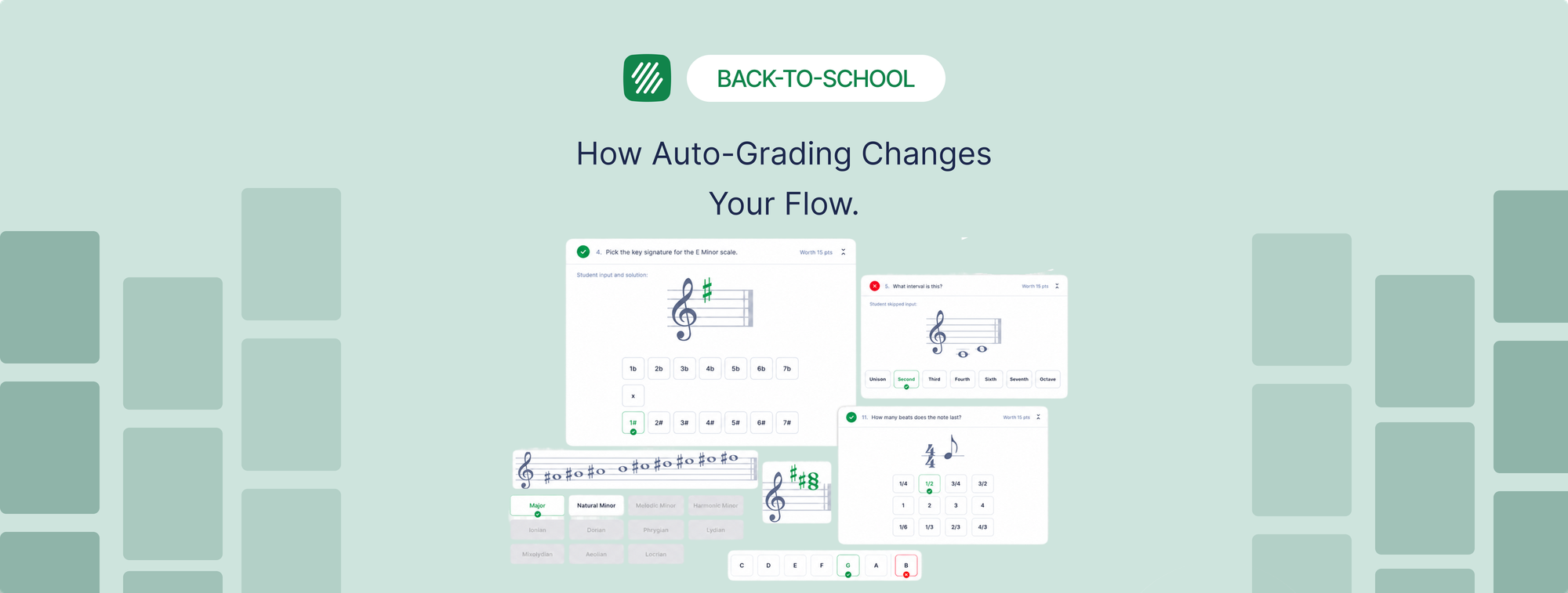
A five-question worksheet at the start of class takes students three minutes to complete. It takes you zero minutes to grade. And it tells you, before you have taught a single thing that day, whether your students are ready for what you planned or whether you need to adjust.
That is the case for music theory worksheets in Flat for Education. Not as a test. Not as a way to fill time. As a short, consistent diagnostic that makes every other part of your teaching sharper.
This post covers what worksheets are in Flat for Education, how to build them, and how to use them as a genuine classroom tool rather than a box-ticking exercise.
What a worksheet is in Flat for Education
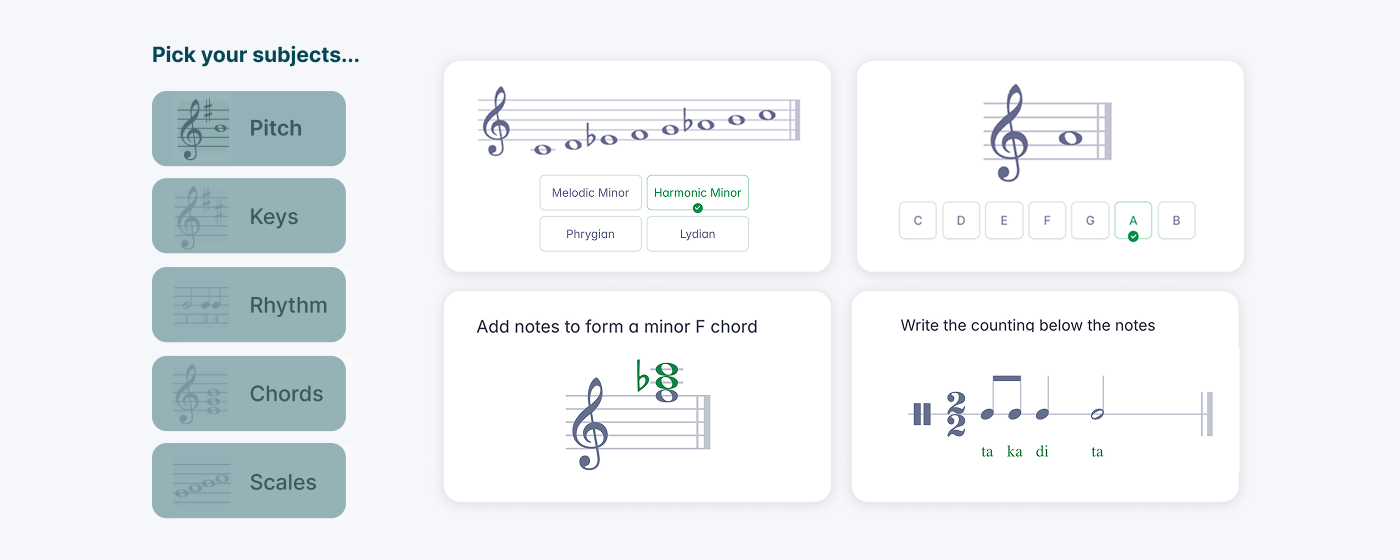
Worksheets in Flat for Education are auto-generated music theory exercises. The platform creates them. You do not build them from a score or write questions manually. You select the exercise type, set the parameters, and the platform generates a unique set of questions for each student.
All worksheet types are auto-graded when completed digitally. If you print them, you grade them manually. The auto-grading is the point: results appear in your gradebook the moment a student submits, without any action from you.
One important distinction before getting into the types: worksheets are not the same as score exercises. A score exercise is something you build yourself by importing a score, deleting notes, and asking students to complete the passage. Worksheets are the auto-generated, auto-graded tools described here. They work differently and assess different things.
The full worksheet family
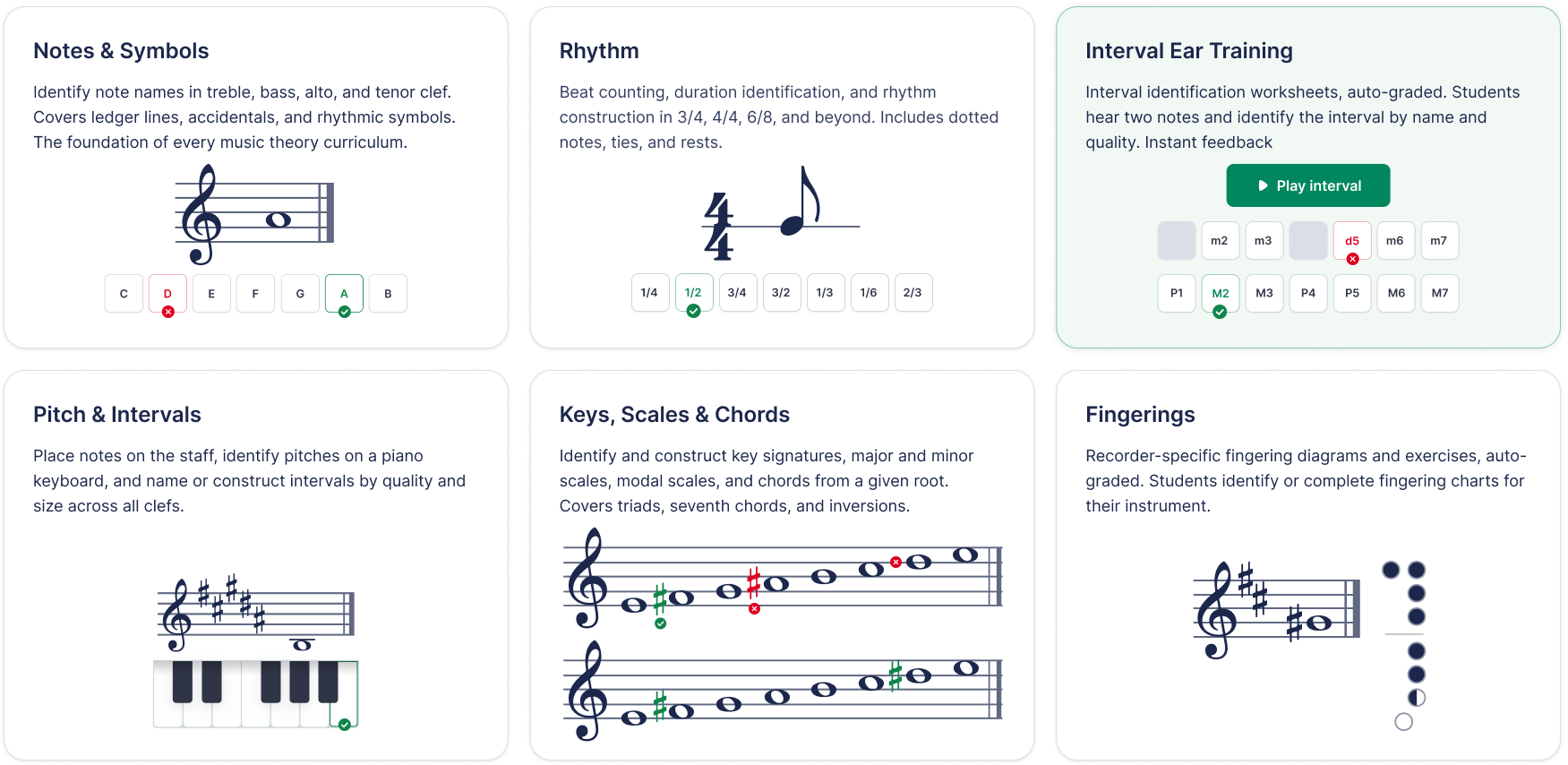
Flat for Education currently offers six categories of worksheet, covering notation, rhythm, harmony, ear training, and instrument fingering. Every type listed here is auto-graded when completed digitally.
Pitch and keyboard. Three types covering note reading in both directions, on the staff and on the keyboard:
- Pitch recognition: students identify the name of a given note, using letter names or solfège in fixed or movable Do.
- Pitch construction: students place a note on the staff and select the correct accidental.
- Keyboard pitch construction: students are given a note on the staff and find it on a piano keyboard. You can also ask them to identify the octave.
Keys, scales, and intervals. Six types covering the theory that underpins everything else:
- Key recognition: students identify the tonic from a given mode and key signature.
- Key construction: students select the correct key signature for a given tonic and mode.
- Interval recognition: students name a given interval on the staff.
- Interval construction: students place a second note to match a given interval.
- Scale recognition: students identify the mode of a given scale.
- Scale construction: students are given a scale with no accidentals and add the accidentals needed to match a given mode and tonic.
Chords. Two types covering triads and sevenths:
- Chord identification: students identify the type of a given chord.
- Chord construction: students are given a root note and build the chord above it. You can ask for root position or for inversions.
Rhythm. Four types covering the part of classroom theory that most often gets skipped:
- Beat counting: students notate the beat count below a given rhythm.
- Beats identification: students identify the correct beat count for a rhythm.
- Duration identification: students name the duration of a given rhythmic symbol.
- Duration construction: students select the correct symbol for a given duration.
Ear training. Students hear audio playback built directly into the worksheet and identify what they hear. Current coverage: interval identification, across all intervals within an octave, adjustable by the teacher based on what the class has studied.
Recorder fingering. Students toggle the holes on a recorder diagram to produce the correct fingering for a given note. Current coverage: Soprano Recorder (Baroque) and Alto Recorder (Baroque).
All worksheet types are available on the Teacher Plan and School Plan. They are not available on legacy plans.
Want to see the format first?
Before setting up your first worksheet assignment, it helps to see what students actually receive. We put together a free printable sample pack that includes examples across the main exercise types, covering pitch, interval, ear training, and recorder fingering, so you can preview the format and share it with colleagues before rolling anything out digitally.
Download the free worksheet sample pack
Once you're ready to assign digitally with auto-grading, a 30-day trial gives you full access to create and assign worksheets to a real class and see the gradebook results.
How to build a worksheet in Flat for Education
- Go to your class and click New Assignment.
- Select Worksheet as the assignment type.
- Choose the exercise category and type.
- Set the number of questions. Five questions for a short check-in, ten for a more thorough assessment.
- Set the difficulty or scope. For notation exercises, you can specify which pitches, keys, scales, chords, or intervals to include. For ear training, you can filter which intervals students will hear. Start narrow for a beginner class and expand the range as students develop.
- Set a due date and publish to your class.
Students open the assignment, complete the questions, and submit. Results appear in your gradebook automatically. You see each student's score and, for most exercise types, which specific questions they got wrong. That last detail is the useful part.
The 5-question check-in at the start of class
The most practical use of worksheets is also the simplest. Five questions, first five minutes of class, every week or every other week.
Students walk in, open the assignment, complete it while you take attendance or sort out the room. By the time you are ready to teach, they have submitted. You can see the results before the end of that class period, and you can adjust what you do next based on what you see.
This works because the questions are consistent in format. Students are not learning a new activity every time. They know exactly what they are doing the moment they open it, which means the cognitive load is entirely on the musical content, not on figuring out the task. That is a genuine measurement of what they know, not a measurement of how well they navigate a new exercise type.
Over a semester, a weekly 5-question check-in generates 20 or more data points per student. You can see who has developed interval recognition steadily across the term and who plateaued at a certain difficulty level. You can see which exercise types the whole class consistently misses, which is the most actionable piece of information: it tells you exactly what to address next.
The 10-question check-out at the end of class
A 10-question worksheet at the end of class serves a different purpose. You have just taught something. The check-out tells you whether it landed.
Ask students to complete it in the last 5 minutes. You review the results that evening or the next morning. If 80% of the class got the questions right, you move on next lesson. If 40% got them right, you revisit before introducing the next concept. You make that decision based on data, not on how the lesson felt or on the confidence of the few students who put their hands up.
This is the most direct application of worksheets to lesson planning. The check-out is not a test. It is a feedback loop between what you taught and what students understood. The faster you close that loop, the less time you spend re-teaching material at the end of a unit when it is too late to adjust the plan.
What worksheets tell you that other assessments do not
Performance assessments tell you what students can do with an instrument. Composition assignments tell you what musical decisions they make when given freedom. Worksheets tell you something more specific: whether a student has internalized a piece of musical knowledge at the level where they can apply it under mild time pressure, independently, without help from the person next to them.
Interval recognition is a good example. A student might be able to sing back an interval you demonstrate in class. That is imitation. A worksheet asks them to identify an interval they have not heard before in that session. That is internalization. The difference matters for planning: a student who can imitate needs more exposure. A student who can identify independently is ready for the next concept.
Worksheets also surface students who are falling behind before they fall far enough to be a problem. A student who consistently scores below 50% on ear training check-ins at the start of each week is giving you a signal. Without the data, that signal is invisible until the student is significantly behind the rest of the class. With the data, you can act in week three instead of week ten.
How to read the results in your gradebook
When students submit a worksheet in Flat for Education, results appear in your gradebook with a score and a breakdown of which questions they answered correctly and which they missed. You do not have to open each student's submission individually to see this. The class-level view shows you patterns across the whole group.
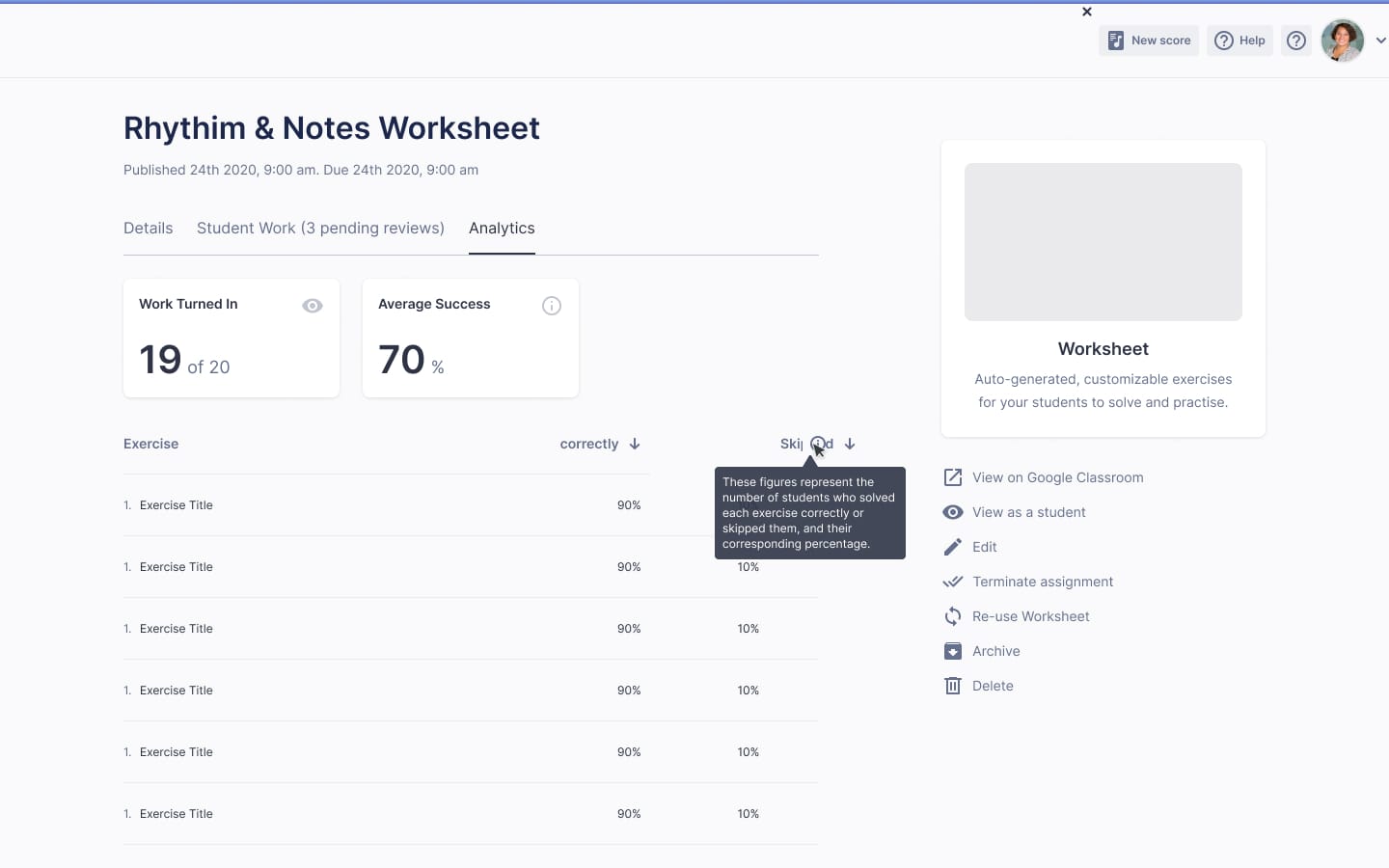
Three things worth looking for when you review results:
First, the class average. If it is below 60% on a concept you have already taught, that concept needs revisiting before you move on. If it is above 80%, you have confidence to introduce the next level of difficulty.
Second, consistent individual low scores. A student who scores under 50% week after week on a worksheet that peers are completing successfully is telling you something. That student needs a different approach, more practice time, or a conversation about what is getting in the way.
Third, specific question patterns. If the whole class consistently misses minor sixths on interval recognition but gets major thirds reliably, that is a teaching target. It is not a reflection on the students. It is data about what has been taught well and what has not been taught enough.
Combining worksheets with other assignment types
Worksheets work best as part of a broader assessment diet, not as the only evidence you collect. A semester sequence that uses all four assignment types in Flat for Education gives you a complete picture of each student:
Worksheets tell you what they know about music theory at the level of automatic recall. Score exercises tell you whether they can apply that knowledge to notation in context. Composition assignments tell you what they do with musical freedom and whether their theoretical knowledge informs their creative decisions. Performance assignments tell you what they can execute on their instrument.
Each one assesses something different. A student who scores well on worksheets but struggles in composition assignments has theoretical knowledge they are not yet translating into creative work. A student who composes confidently but scores poorly on ear training worksheets is working intuitively without the theoretical underpinning. Both patterns are useful to know, and you cannot see them without data from multiple assignment types.
What to do with the data, practically
The data from worksheets is only useful if it changes something you do. Here is a simple decision framework:
If the class average on a check-in is above 75%: proceed with your planned lesson. The concept is solid enough for the group to build on it.
If the class average is between 50% and 75%: spend the first 10 minutes of the next lesson addressing the most commonly missed question type before moving on. One targeted warm-up is usually enough to close the gap.
If the class average is below 50%: the concept needs a different approach. Re-teach it with a new method, a different exercise type, or a different context. Something about how it was introduced is not connecting with this particular group of students.
For individual students consistently below 50%: this is a conversation, not just a re-teach. Find out what is getting in the way. Is it hearing? Is it reading the question format? Is there something happening outside of class that is affecting their capacity to engage? The data tells you who to look at. The conversation tells you what to do.
Start with one check-in per week
The teachers who find worksheets most useful are not the ones who use them the most. They are the ones who use them consistently. One 5-question check-in at the start of each week, reviewed before the next lesson, is enough to change the quality of your planning over a semester.
You do not need to analyze the data deeply every time. A quick scan of the class average and a look at who scored below 50% is enough to make a decision about next lesson. That decision, made ten times over a semester, is how students stop falling behind without you noticing.

Flat for Education offers a free 30-day trial with full access to worksheets and all other assignment types. Start at flat.io/edu. No credit card required.
FAQ
What types of exercises are available in Flat for Education worksheets?
Flat for Education offers six categories of worksheet. Pitch and keyboard covers pitch recognition, pitch construction, and keyboard pitch construction. Keys, scales, and intervals covers key recognition and construction, interval recognition and construction, and scale recognition and construction. Chords covers chord identification and chord construction, including inversions. Rhythm covers beat counting, beats identification, duration identification, and duration construction. Ear Training covers interval identification by ear with audio playback built in. Fingering Worksheets currently cover Soprano and Alto Baroque recorder. All types are auto-graded when completed digitally and available on the Teacher Plan and School Plan.
How long does it take students to complete a worksheet?
A 5-question worksheet typically takes 2 to 4 minutes for most students, and a 10-question worksheet takes 4 to 7 minutes, varying by exercise type and difficulty. For a start-of-class check-in, 5 questions in the first 5 minutes is a reliable format that does not compress the rest of the lesson.
Can I see which questions individual students got wrong?
Yes. The gradebook shows each student's score along with a breakdown of which questions they answered correctly and which they missed. This is more useful than a percentage alone because it tells you exactly which concept to address rather than just how well a student performed overall.
Are worksheets available on all plans?
Worksheets are available on the Teacher Plan and School Plan, and are not available on legacy plans. Legacy plan users can see the worksheets in the platform but they appear locked; to access them, a legacy user needs to move to the Teacher Plan or School Plan at their next renewal.
Can I print worksheets for students who do not have devices?
Yes. All worksheet types can be printed directly from Flat for Education, but auto-grading does not apply to paper submissions, so you grade those manually. Ear training worksheets require audio playback, so the printed version cannot replicate the listening component and works best for in-class tests where you play the intervals yourself.