Most seventh graders can name the C chord. Far fewer can tell you why "When the Saints Go Marching In" sounds finished when it lands back on it. That gap, between knowing a chord and hearing what it does, is where a primary chords lesson usually stalls. Students fill in a chart of I, IV and V, pass the quiz, and never use the chords again.
Anton Boktor teaches orchestra, band and piano to grades 6 to 8 in Los Angeles, and he has been a music director since 1998. His answer is to stop treating chords as theory homework and make them the raw material of a song students write themselves. He shared the four activities he uses as part of the Flat for Education Ambassador Program, and each one is ready to open, adapt and assign.
What are primary chords?
Primary chords are the three chords built on the first, fourth and fifth degrees of a major scale, written I, IV and V. In C major they are C, F and G (often G7, the dominant seventh). Together they can harmonize a huge number of folk songs, hymns and pop tunes, which is why they're the natural first step into harmony for middle school students.
A primary chords lesson sequence for grades 6 to 8
The order matters here. Each activity hands students one new skill and asks them to use everything that came before it.
| Step | Activity | Grade | What students do |
|---|---|---|---|
| 1 | Count the Beats, Basic | 6 | Write the counts under each note |
| 2 | Identify the C, G7 and F Chords | 7 to 8 | Find I, V7 and IV in a familiar tune |
| 3 | Aura Lee with a Twist | 7 | Write a new second half for a folk song |
| 4 | My Song | 8 | Compose a 12-measure song in C major |
Step 1: Make the beat visible
You can't write a melody over chords if you're guessing where beat three is. So Anton starts with a rhythm worksheet, not a chord. In Count the Beats, Basic, grade 6 students write the counts directly under each note in a guided template. It's quick. It's also auto-graded, and the results show you which questions each student missed, so you know who needs another pass before chords arrive.
Step 2: Find the chords in a song they know
Identify the C, G7 and F Chords uses "When the Saints Go Marching In." Students study the three chords, then find where each one appears in the score. Because the tune is so familiar, they recognize the I, V7 and IV progression by ear as well as by sight. Play it back after they label it. The moment the G7 resolves to C is the moment the word "dominant" stops being vocabulary.
Step 3: Borrow half a melody
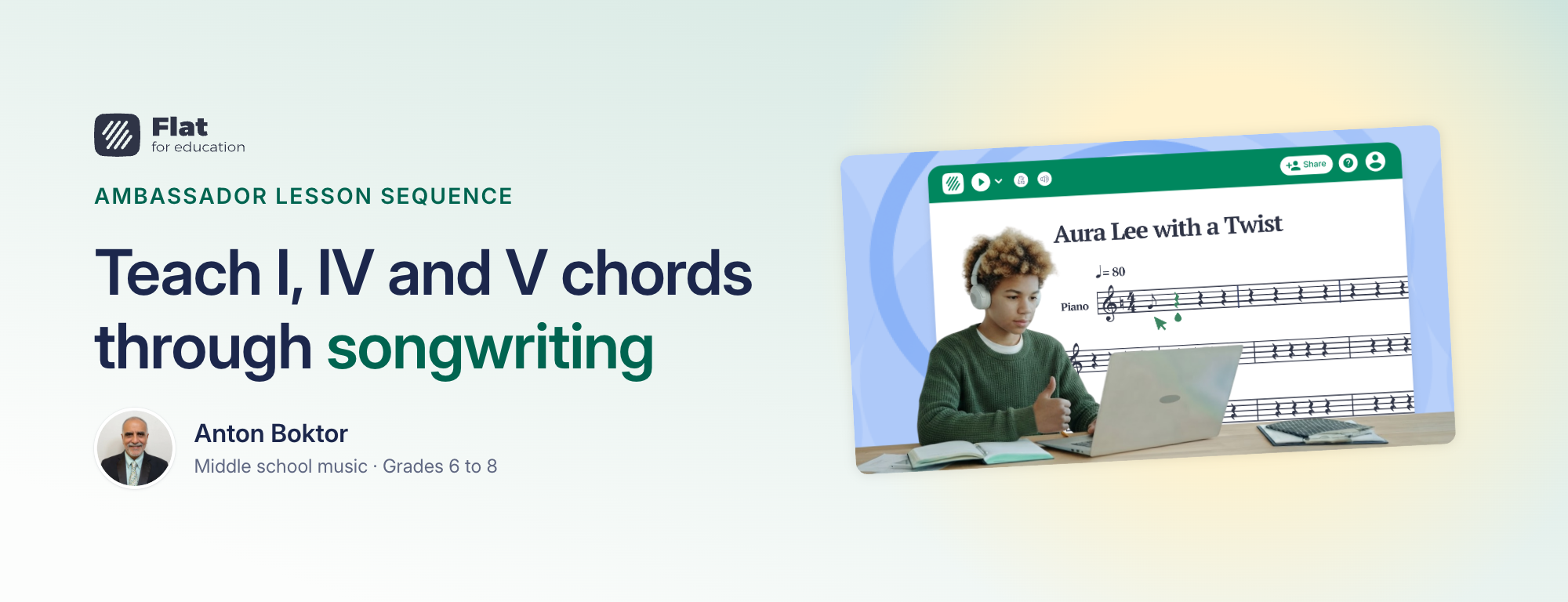
A blank staff terrifies a lot of twelve-year-olds. Aura Lee with a Twist removes that problem. The first half of the folk song stays exactly as written, locked so students can't change it. Their job is to replace the rests in the second half with their own notes, keep the note durations consistent, and leave the last note alone. They practice melodic contour and variation inside a frame that guarantees the piece still ends somewhere that makes sense.
Step 4: Write the whole song
My Song is the payoff. Grade 8 students write a 12-measure keyboard song in C major: their own topic, their own lyrics, a treble clef melody and primary chords in the bass clef. They choose the title first, which sounds minor but changes everything. A song called "My Dog Won't Listen" gets finished. A song called "Untitled Composition" doesn't.
"Flat for Education replaced paper, red pens, and standalone notation tools in my classroom: students write, hear, and share work in real time, I can turn a PDF into a score in under a minute, and even the quarter-tone hymns I grew up with finally have a place on the page."
Anton Boktor, Flat for Education ambassador
Why songwriting works better than chord drills
Drills test recognition. Songwriting forces a decision: which chord goes under this note, and does it sound right? Students make that call dozens of times in a 12-measure song, and they hear the answer every time they press play. Wrong choices aren't marked in red. They just sound wrong, and students fix them.
It also lines up with how the NAfME music standards describe Creating: imagine, plan and make, evaluate and refine, present. A chord chart covers none of that. A song covers all four.
How to run the primary chords sequence in Flat for Education
- Open each activity from its page on Flat for Education and add it to your assignments. If you're new, the 30-day free trial gives you access.
- Adapt the instructions. Swap the song in step 2, shorten My Song to 8 measures for a younger group, or move it to F major for a band class.
- Choose the notation tools each class sees, so grade 6 isn't distracted by tuplets and grade 8 has what it needs.
- Assign through your LMS. Flat for Education integrates with Google Classroom, Microsoft Teams, Canvas, Schoology, and MusicFirst.
- Comment while students compose. Catch the melody that sits on a B over an F chord before it becomes the whole chorus.
Try this tomorrow: assign step 2 as a ten-minute warm-up, then play the score back with the chord labels visible. Ask the class which chord the song "wants" to end on. Most of them will already know.
Adapting it for band and orchestra students
Anton teaches ensembles too, so none of this is piano-only. Have wind players compose the melody for their own instrument while the chords stay in a keyboard part. Strings can play the bass line as a section. If you're looking for more ensemble-specific ideas, our list of composition projects for middle school band students pairs well with this sequence, and the fall semester composition assignment ideas give you options once students finish My Song.
Bring Anton's activities into your class
All four activities were written by a teacher and run with his own students before they reached the Flat for Education activity library. Open one, change what doesn't fit your room, and see how far your students get. Flat for Education offers a free 30-day trial, so you can try the whole sequence before you commit to anything.

FAQ
What are the primary chords in C major?
The primary chords in C major are C (I), F (IV) and G (V). Teachers often use G7, the dominant seventh, in place of G because its pull back to C is easier for students to hear.
What grade should students learn I, IV and V chords?
Many teachers introduce primary chords in grades 6 to 8, once students can read and count basic rhythms. Anton Boktor's sequence starts with beat counting in grade 6 and ends with a full 12-measure song in grade 8.
How do you teach primary chords to middle school students?
Start with a song students already know, have them find the I, IV and V chords in it, then ask them to write their own melody over those chords. Hearing playback after each choice helps students connect chord names to how the harmony sounds.
Can I change these activities for my own class?
Yes. Once you open an activity in Flat for Education you can edit the instructions, the score and the notation tools students see, then assign it to your class.