Ask a class of fifth graders to compose a melody and watch what happens. A few dive in. Most stare at the empty staff, then ask how many notes it has to be. The problem usually isn't skill. It's that a blank page feels like a test they can fail.
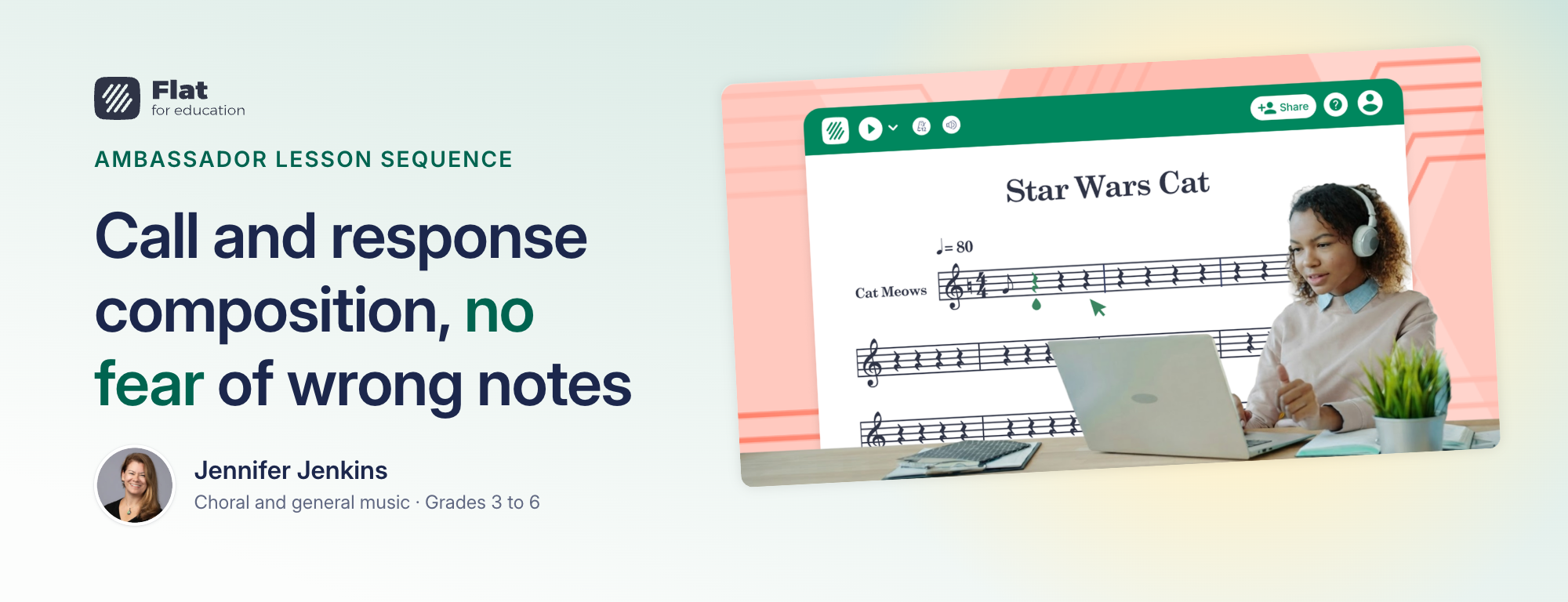
Jennifer Jenkins has taught choral and general music for more than 25 years, currently grades 5 to 9 in Metuchen, New Jersey. Her first composition unit gets around the blank page with a call and response composition lesson that's hard to take too seriously. One of the activities pairs Star Wars sounds with cat meows. She shared the full set through the Flat for Education Ambassador Program, and you can open each one in your own class.
What is call and response in music?
Call and response is a musical form where one phrase (the call) is answered by a second phrase (the response). It runs through work songs, gospel, jazz, playground chants and a lot of pop. For young composers it's ideal, because the form tells them exactly what to write next: an answer to what they just heard.
Why call and response works for a first composition
It gives students a shape before it asks for ideas. Write a short idea. Answer it. Do it again. That structure removes the "how long does it have to be" question, and it teaches phrase thinking without ever using the word.
The other half of Jenn's approach is sound. When the instrument is a cat meow, nobody worries about a wrong note, so students spend their attention on rhythm and structure instead. That's not a gimmick. It's a way of lowering the stakes until composing feels normal.
A four-step composition unit for grades 3 to 6
| Step | Activity | Grades | Focus |
|---|---|---|---|
| 1 | Notating in Flat: a practice activity | 4 to 6 | Learning the editor with steady rhythms |
| 2 | Star Wars Cat | 4 to 6 | Unpitched call and response |
| 3 | Melodic Messages (call and response) | 3 to 8 | Melodic call and response, timbre |
| 4 | YOUR Rhythm Story | 5 to 8 | Paper composition to digital score |
Step 1: Learn the editor on a cowbell
Notating in Flat is a low-stakes warm-up for the software itself. Students build simple, steady rhythms on a cowbell track: choose a duration first (quarter, eighth or sixteenth), then tap it in. On an iPad they use the bar at the bottom of the screen. It plays like a game, and it means no one is learning the editor and composing at the same time in step 2.
Step 2: Star Wars Cat
Students create a new score, pick the special sound sets, and add Star Wars sounds and cat meows. Then they write a conversation between the two. Cinematic brass calls, a cat answers. The sounds are funny on purpose. Students laugh, play it back, change the rhythm of the meow, and play it again. Without anyone saying so, they're revising a composition.
Step 3: Melodic Messages
Now the conversation gets pitch. Students start a new score called "Melodic Messages," choose one brass instrument and one woodwind instrument, and write a call and response between them. Each instrument gets its own role in the dialogue. Picking the instruments themselves gives students ownership, and it's a quiet first lesson in timbre and orchestration: a tuba asking a question sounds nothing like a flute asking the same one.
Step 4: YOUR Rhythm Story
The last activity bridges paper and screen. Students start from a rhythm story they wrote on a worksheet, swap the template's instrument for unpitched percussion of their choice, set the tempo, enter their notes, then decide where the music should be strongest and add dynamics. Hearing a handwritten idea played back is a small thrill, and it gives students a reason to check their own notation.
How to teach call and response composition with Flat for Education
- Open the activity from its page and add it to your assignments. New to Flat for Education? The 30-day free trial covers it.
- Model a call out loud first. Clap four beats, have the class clap an answer, then show the same idea on screen.
- Limit the notation tools to what this grade needs, so younger students aren't hunting through menus.
- Assign it through your LMS. Flat for Education integrates with Google Classroom, Microsoft Teams, Canvas, Schoology, and MusicFirst.
- Comment while students compose, and use version history to see how a piece changed between the first idea and the final one.
Try this in your next lesson: play two students' Star Wars Cat pieces back to back and ask the class which call got the better answer, and why. You'll get a better discussion of phrase structure than any worksheet would give you.
Where this unit fits
Use it at the very start of the year, before any longer project. Once students are comfortable, our elementary songwriting lesson plan in ABA form is a natural next step, since it asks for a longer structure with a return. For group work, our list of collaborative composition activities turns call and response into a pair activity, one student per phrase.
If you teach choir as well, Jenn also shared Umoja Tunaimba, a grades 6 to 9 activity where singers rehearse and record their own part over a backing track.
Bring Jenn's activities into your class
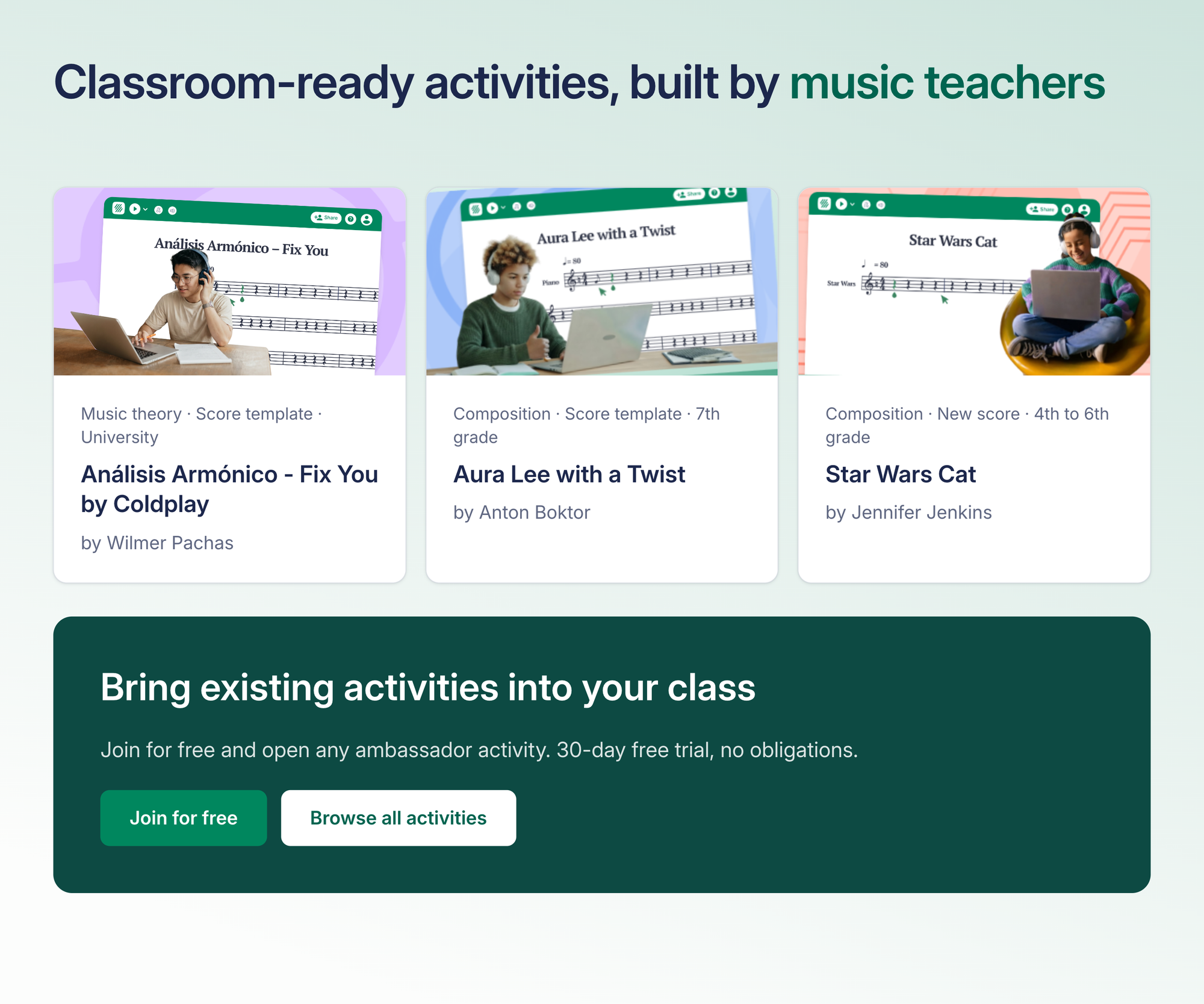
Every activity here was written by a working music teacher and used with her students before it reached the Flat for Education activity library. Start with the cowbell, then let the cat answer the Star Wars brass. Flat for Education offers a free 30-day trial, so you can try the whole unit with your students before you decide.
FAQ
How do you teach call and response to elementary students?
Start by clapping or singing a short call and having the class answer it, then move the same idea into notation. A clear structure, one call and one answer, helps young students compose without worrying about length or form.
What is a good first composition activity for grades 3 to 6?
A short call and response piece works well because the form tells students what to write next. Using playful sounds, like the cat meows in Jenn Jenkins's Star Wars Cat activity, lowers the fear of making mistakes.
Do students need to read music to compose call and response?
Not at first. Students can start with unpitched rhythms and playback, then add pitched instruments once they are comfortable entering notes in the editor.
Can students compose these activities on an iPad or Chromebook?
Yes. Flat for Education runs in the browser on Chromebooks, laptops and tablets, and the Notating in Flat activity includes instructions for entering rhythms on an iPad.