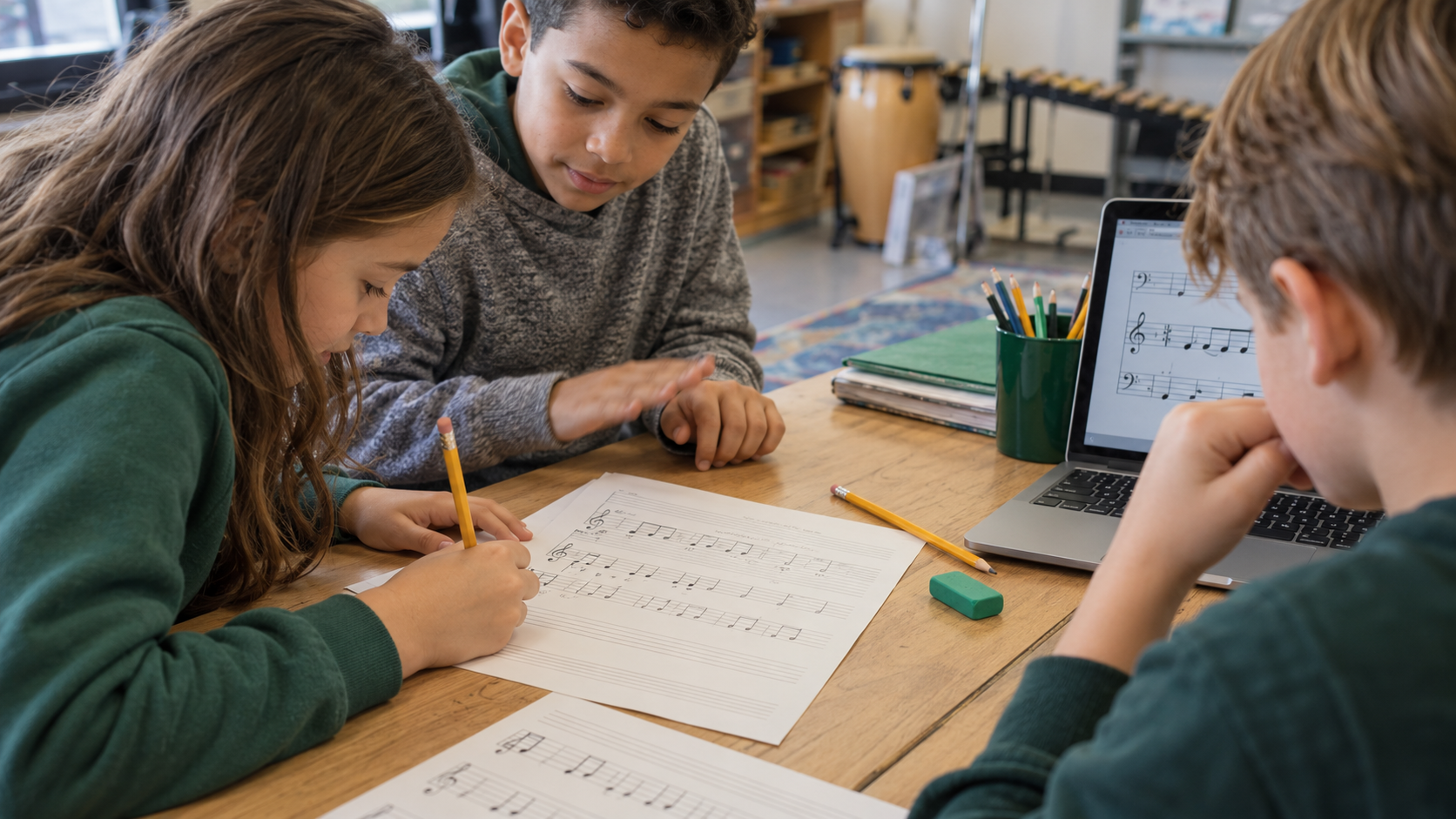
Ask a room of nine-year-olds to "write a song" and you'll get two reactions. A few kids start scribbling right away. Everyone else looks at you like you asked them to build a car.
The problem usually isn't creativity. It's the blank page. This elementary songwriting lesson plan gets rid of the blank page one step at a time. Over six lessons, 4th graders write an ABA song about their favorite food: they find a hook, brainstorm details, write lyrics that fit the beat, then compose a pentatonic melody in Flat for Education. Every student ends up with a finished, notated song they can play back and share.
The unit was built by James Green, Customer Success & Learning Lead at Flat for Education, and it comes with student pages, differentiation notes and ready-made score templates. Everything is free to copy.
What is ABA form?
ABA form is a three-part song structure: an opening section (A), a contrasting section (B), then a return of the opening section (A). It's one of the first forms elementary students learn, because they can hear the "return home" without any theory vocabulary. In this unit, A is the hook and B is the verse.
| Section | Songwriting name | Measures | Its job |
|---|---|---|---|
| A | Hook | 1 to 4 | States the main idea with the catchiest line. Ends on do. |
| B | Verse | 5 to 8 | Contrasts with A. Each line adds one detail. |
| A | Hook returns | 9 to 12 | Brings the song home. Ends on do. |
Twelve measures. That's short enough for a 30-minute lesson and long enough to feel like a real song.
Why favorite food works as a song topic
Kids don't have strong opinions about seasons or friendship, at least not ones they'll put in writing. But ask about pizza and every hand goes up. A concrete topic means students spend their energy on the music, not on finding something to say.
It also pays off in Lesson 2, when students fill a Five Senses Idea Web. What does it look like, smell like, sound like? Who do you eat it with? Their four best details become the four lines of the B section. The verse basically writes itself.
The 6-lesson songwriting unit at a glance
Each lesson runs 30 to 45 minutes. If you see students once a week, spread it across a grading period.
- Song Detective. Students listen to a song like a songwriter, find the words that keep coming back (the hook), and stand for A sections and sit for B. Exit ticket: draw your favorite food.
- Five Senses Idea Web. Students brainstorm sensory details and circle their four best.
- Fill-the-Beat Frames and Rhyme Ladder. Students write a hook and four verse lines, then speak them over a steady beat and clap the syllables. Teacher check: does every line fit 4 beats?
- Making a Melody in Flat for Education. After a hand-sign warm-up on do, re, mi, so and la, students open the assignment, type lyrics under the notes and move pitches up from do.
- Two-Chord Mood Lab and Partner Feedback. Students hear the same melody over C and G, then over C and A minor, and vote on the mood. Partners trade "Two Stars and a Wish" feedback.
- ABA Song Showcase. Students perform with playback, reflect and submit their final score.
The plan lines up with the NAfME Core Music Standards for Creating at grade 4 (MU:Cr1.1.4a, Cr2.1.4a, Cr2.1.4b, Cr3.1.4a, Cr3.2.4a). You can check them on NAfME's standards page.
The pentatonic trick that removes "wrong notes"
Lesson 4 is where most songwriting units fall apart. Kids put notes down, it sounds strange, and they give up.
So this unit limits the palette. Students only use C, D, E, G and A, the C pentatonic scale. Every combination sounds good. There's one rule: end both A sections on do so the song sounds finished. That's it.
Playback does the rest. A student moves a note, presses play and hears the result immediately. They don't need to read the pitch confidently yet, because their ears are making the decision. Hearing it isn't cheating. It's scaffolding.
How to set up the songwriting templates in Flat for Education
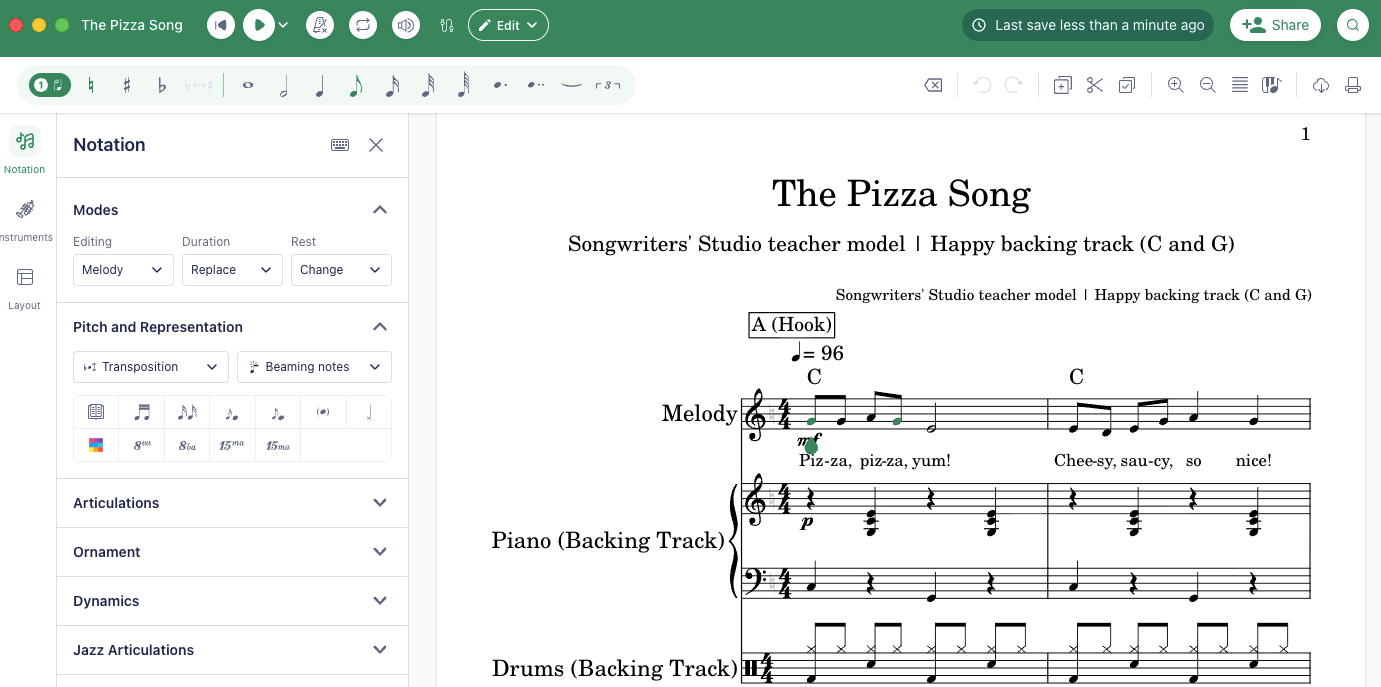
The unit comes with a teacher model (The Pizza Song) and student templates with the rhythm already built on middle C. Students change pitches and add lyrics; they don't start from an empty staff.
- Download the score file (.mxl) for the template you want.
- Import it in Flat for Education: choose Create score, then Import file.
- Play back the Pizza Song teacher model once to check the tempo.
- Create a composition assignment and attach the student template.
- Decide whether to turn on Lock Template. [verify behavior] Test it on a student account first, since students need to edit pitches, lyrics and chords.
- Add the directions and the I Can checklist, and set the due date for Lesson 6.
- Test the full student workflow on a student device with headphones: type a lyric, move a note, press play, submit.
If your school uses an LMS, the assignment can go out there too. Flat for Education integrates with Google Classroom, Microsoft Teams, Canvas, Schoology, and MusicFirst. The Composition assignments guide covers Lock Template and toolsets step by step.
Try this first: open The Pizza Song, delete the melody in measures 5 to 8, and rewrite it yourself using only C, D, E, G and A. Five minutes, and you'll know exactly where your students will get stuck.
[IMAGE: student template with A / B / A section labels]
Differentiating the unit
| Learners | Supports |
|---|---|
| Need more support | Rhythm Scaffold templates, picture word banks, do-mi-so only, partner writing, pre-filled chord symbols |
| Ready for more | Add a C section for ABACA (rondo form), half notes and rests, an ostinato on classroom instruments |
| English learners | Bilingual lyrics welcome, picture idea webs, sentence frames |
| Special education | Pre-filled template, zoom, choice to speak or sing, peer buddy |
The ABACA extension also makes the unit easy to adapt for a beginning choir or a middle school general music class.
Get the free Songwriters' Studio unit
If you'd like to run this with your class, Flat for Education offers a free 30-day trial . Import the templates, assign the first one, and see what your students do with it. For more ideas, see our guide to teaching songwriting with music notation software and The Kodály Method explained.
FAQ
How long does an elementary songwriting unit take?
This one runs six lessons of 30 to 45 minutes. On a weekly schedule, that's about one grading period. You can fold Lessons 2 and 3 together if your students write quickly.
Can 4th graders compose a melody without reading music fluently?
Yes. Because the rhythm is pre-built and the notes are limited to the pentatonic scale, students make melodic choices by ear using playback. Reading fluency builds along the way rather than being a prerequisite.
What is a hook in songwriting?
A hook is the catchiest, most repeated line in a song, usually the one listeners remember. In this unit, the hook is the A section, and it always includes the name of the student's favorite food.
How do I assess a songwriting project?
Use the formative checkpoints during the unit, such as the Song Detective sheet, the idea web and the 4-beat lyric check. Then assess the final submitted score against the student's I Can checklist.