The hardest part of collaborative composition isn't the technology. It's the structure.
Put students in groups with a shared score and an open brief and you'll get one of two outcomes: one student takes over while everyone else watches, or the group fragments into parallel solo efforts that happen to be in the same file. Neither of those is collaboration. They're just proximity.
What makes collaborative composition work is giving students a musical problem that genuinely requires multiple perspectives to solve. A countermelody that needs to work against someone else's melody. A score that has to accommodate the range of the instruments each student plays. A piece that has to incorporate everyone's four-measure contribution and still make musical sense as a whole.
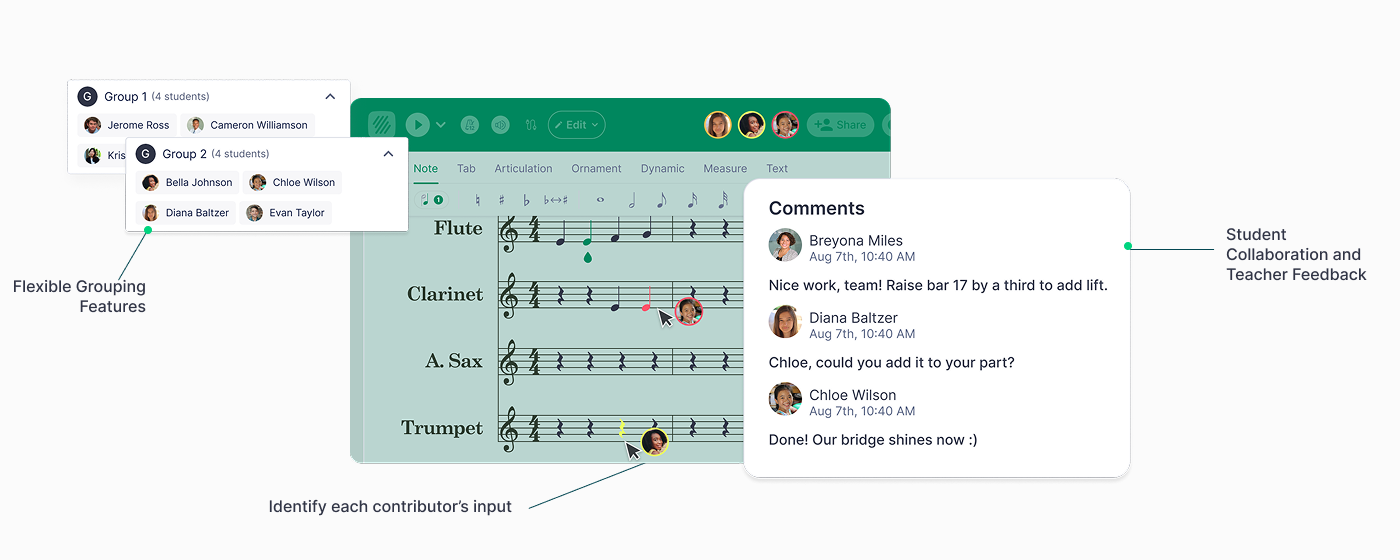
The five activities below are structured to produce real collaboration rather than shared document chaos. Each one works inside Flat for Education's Shared Writing feature, which allows students to work simultaneously on the same score, with individual contribution tracking and real-time teacher oversight. But the pedagogy comes first. The tool is how you implement it.
What Collaborative Composition Actually Develops
Before getting into the activities, it's worth being clear about what you're trying to develop. Collaborative composition, done well, develops four things that individual composition doesn't.
Musical listening in context. When students compose individually, they can ignore whether their choices sound good next to someone else's. In collaborative work, they can't. The countermelody has to work against the melody. The accompaniment figure has to support the harmony someone else chose. Students develop the habit of listening to what's already there before they add something, which is exactly the listening habit that ensemble performance requires.
Justification of musical decisions. Individual composition lets students make choices without defending them. Collaborative composition forces the conversation: "Why did you write a forte there when the melody is piano?" That conversation is more instructionally valuable than any worksheet on dynamic contrast.
Revision through external feedback. Students revise their own work reluctantly. They revise work that a partner has pointed out doesn't work more readily, because the issue has been externalised. Collaborative composition builds the habit of revision as a normal part of the creative process rather than an admission of failure.
Awareness of range, balance, and ensemble texture. Ensemble teachers spend years trying to get students to hear how their individual line contributes to the whole. Collaborative composition gives students a direct experience of this from the composer's side.
Activity 1: The Musical Conversation
This is the most accessible activity for students who haven't done collaborative composition before. It works well from grade 5 upward.
The setup: Pairs of students. Student A writes a four-measure melodic phrase, ending on a note that feels unresolved (avoiding the tonic). Student B writes a four-measure response that answers and resolves it. Together, they form an 8-measure period.
The musical constraint: Student B cannot simply repeat Student A's rhythm. The response must use at least two different note values from the opening phrase. The final note must be the tonic.
What it teaches: Question-and-answer phrasing, which is one of the most fundamental structures in tonal music. Students hear the difference between a phrase that feels complete and one that doesn't, and they have to create both intentionally.
In Flat for Education: Set up a Shared Writing assignment with an 8-measure template. Students work in sequence: Student A completes their four measures first, then Student B adds their response. The shared score means Student B always has Student A's phrase visible as a reference while writing. The contribution tracking shows you who wrote what.
Extension: Once both pairs are done, combine two pairs: the A-B phrase from Group 1 becomes the opening period, the A-B phrase from Group 2 becomes the contrasting period. You've just built a 16-measure binary form collaboratively.
Activity 2: The Layer-by-Layer Build
This activity works particularly well for classes that have been doing ensemble work and understand instrument roles, typically grade 7 upward or any ensemble class.
The setup: Groups of three to four students, each assigned a role: melody, bass line, harmonic fill, and (optionally) rhythm/percussion. Each student writes their own layer, but the layers have to work together.
The sequence matters here. Don't let all four layers start simultaneously. The melody goes first. Once it's written, the bass line student writes a root-movement bass that supports it. Then the harmonic fill student adds inner voices. Then percussion.
The musical constraint: Melody stays in treble clef range. Bass stays below middle C. Harmonic fill must use chord tones only (no non-chord tones on strong beats). Each layer must be 8 measures.
What it teaches: Orchestration thinking. Students viscerally understand why the melody has to exist before the bass line, because they experience the alternative: a bass line written without a melody to support, which produces harmony that may or may not fit whatever comes next. They also learn about register. Bass voices written in the wrong range sound muddy. Playback in Flat for Education makes this immediately audible.
In Flat for Education: Use Shared Writing with a multi-stave template, one stave per student. Have students complete one layer at a time and check in with you before the next student begins their part.
Activity 3: The Composition Relay
This one produces surprising results and generates strong discussion. It works from grade 6 upward and is particularly good for general music classes where composition experience varies widely across the group.
The setup: Groups of four. The score is 16 measures. Students write in sequence: Student 1 writes measures 1 through 4, Student 2 continues from measure 5 through 8 connecting smoothly from what Student 1 wrote, and so on around the group.
The musical constraints: Each student must begin their section on the last pitch that the previous student ended on. Each section must include at least one dynamic marking. The final four measures must end on the tonic.
What it teaches: Continuity and formal thinking. Students quickly discover that if they end their section in a dramatically different register or key area from where they found it, the next student has a problem to solve. This produces real musical negotiation: "I can't start on a high C because you ended on a low E-flat." That conversation is exactly what musical form is about.
In Flat for Education: Use Shared Writing and establish a clear turn order before students start. Since all students can edit the full shared score, the structure of this activity is social and procedural rather than technical. Before starting, agree as a group who writes which section and in what order. Students stick to their assigned measures by agreement, not by a system lock. The contribution tracking in Flat for Education shows who added what and when, so you can verify the relay order was followed and use that as part of your assessment conversation.
The follow-up discussion is as important as the activity. Ask each group: what was the hardest moment of the handoff? Where does the piece feel connected, and where does it feel like four separate things? That discussion covers melodic continuity, phrase structure, and formal coherence without ever naming those concepts directly.
Activity 4: Arrange It for Your Section
This activity works best in ensemble classes where students all play different instruments, typically grades 7 through 12 band or orchestra.
The setup: Groups built around instrument families or sections. Give each group a simple 8-measure melody in concert pitch. Their task: arrange it for their specific combination of instruments, with each student writing their own part.
The musical constraint: Every instrument must play. No instrument can simply double another at the unison for the entire 8 measures. The arrangement must be playable by the actual players in the group (meaning students have to know their own range and their groupmates' ranges). At least one instrument must have a different rhythmic profile from the melody.
What it teaches: Instrument knowledge, range awareness, and ensemble balance, all in a context where the stakes are real. Students are writing for their friends, who will actually read and attempt to perform the result. The social dimension drives the musicality: nobody wants to write a part that makes their section-mate look bad.
In Flat for Education: Set up a score template with all the instruments in the group pre-loaded. Each student edits their own stave in Shared Writing mode. Playback lets the group hear the full arrangement together before submitting.
Performance extension: If time permits, have each group perform their arrangement. The comparison between groups, where different students made different decisions about the same melody, is one of the most effective ways to demonstrate that there are multiple right answers in arranging.
Activity 5: The Theme and Variations
This is the most demanding activity and works best with students who have prior composition experience, typically grade 8 and up or music theory classes.
The setup: One student (or the teacher) writes an 8-measure theme. Each other student in the group writes one variation: same harmonic structure, same length, different melodic surface. The result is a theme and variations with as many variations as there are group members.
The musical constraint: Each variation must be recognisably derived from the theme (the chord progression must be preserved and the phrase structure must remain intact), but the surface melody must be different. Each student must name the technique they used: melodic ornamentation, rhythmic augmentation, change of mode, change of register, or something else they can identify and explain.
What it teaches: The concept of variation as a compositional technique, and the difference between surface and structure in music. Students who grasp this distinction are significantly better equipped for harmonic analysis than students who haven't experienced it from the inside.
In Flat for Education: The theme lives in the first section of a Shared Writing score. Each variation gets its own section, assigned to one student. Students can see the theme at all times while working on their variation, which helps maintain the harmonic connection.
The assessment question: "What technique did you use and how does your variation stay connected to the theme?" That answer tells you more about the student's understanding of musical structure than any test question will.
How to Assess Collaborative Composition
Assessing group work in composition always raises the question of individual accountability. Flat for Education's contribution tracking in Shared Writing assignments shows who added which notes and when, which means you have a record of individual activity even within group submissions. That's useful for identifying students who contributed substantially versus those who were present but passive.
For grading, combining a group score (does the piece meet the musical constraints?) with an individual component (did the student write their measures, and can they explain their choices?) tends to produce the most useful assessment picture. The reflection question at the end, asking each student to identify one moment in the piece they're proud of and one thing they'd change, gives you individual written evidence without requiring separate submissions.
For a full rubric framework and grading workflow for composition assignments, see How to Grade Music Composition Assignments (Without Losing Your Weekends).
All five activities work with Flat for Education's Shared Writing feature. If you want to try one with your next class, a free 30-day trial gives you full access to Shared Writing assignments along with everything else in the platform. It integrates with Google Classroom, Microsoft Teams, Canvas, Schoology, and MusicFirst.
Related articles:
- How to Grade Music Composition Assignments (Without Losing Your Weekends)
- How to Run Individual Music Performance Assessments for a Full Class
- The Practical Guide to Music Technology in the Secondary Classroom
- Are You Using the Right Tools to Assess Your Music Students?
FAQ
What is collaborative composition in music education?
Collaborative composition is an approach in which two or more students work together to create a piece of music. Unlike individual composition, it requires students to make musical decisions in response to what others have already written, negotiate choices, and produce a coherent result from multiple contributions. It develops skills individual composition doesn't, including musical listening in context, justification of creative decisions, and awareness of ensemble balance and texture.
How do you stop one student from dominating a group composition?
Structure is the answer. Activities like the composition relay and the layer-by-layer build assign specific measures or staves to specific students, making the division of labour clear from the start. Flat for Education's Shared Writing feature includes contribution tracking, so you can see who wrote what and when, and assigning individual reflection questions ensures each student has to articulate their own contribution separately from the group grade.
Can collaborative composition work with students who have very different skill levels?
Yes, with the right activity design. The musical conversation and the composition relay work well with mixed skill levels because each student's contribution is of equal length and importance. The layer-by-layer build can be differentiated by assigning the melody to the strongest student and the bass line or percussion to students who need more support, and the constraint-based approach means less experienced students work within parameters that level the task rather than competing on open-ended creative grounds.