Most music teachers know sight reading matters. Most also know they're not doing it enough. And the reason is almost always the same: preparing a good exercise takes longer than the practice itself.
Think about what's actually involved. You need something appropriately challenging for your stronger readers without demoralising the students still consolidating basic fluency. The rhythms need to be varied enough to be interesting but not so complex that the exercise turns into a notation decoding lesson. The key needs to match where you are in the curriculum. And if you teach an ensemble or multiple classes, you may need transposed parts for every instrument in the room.
Done properly, that's close to an hour's work. So most teachers don't do it properly. They reuse the same exercises until students have them half-memorised, or they drop sight-reading from the plan entirely and tell themselves they'll come back to it next term.
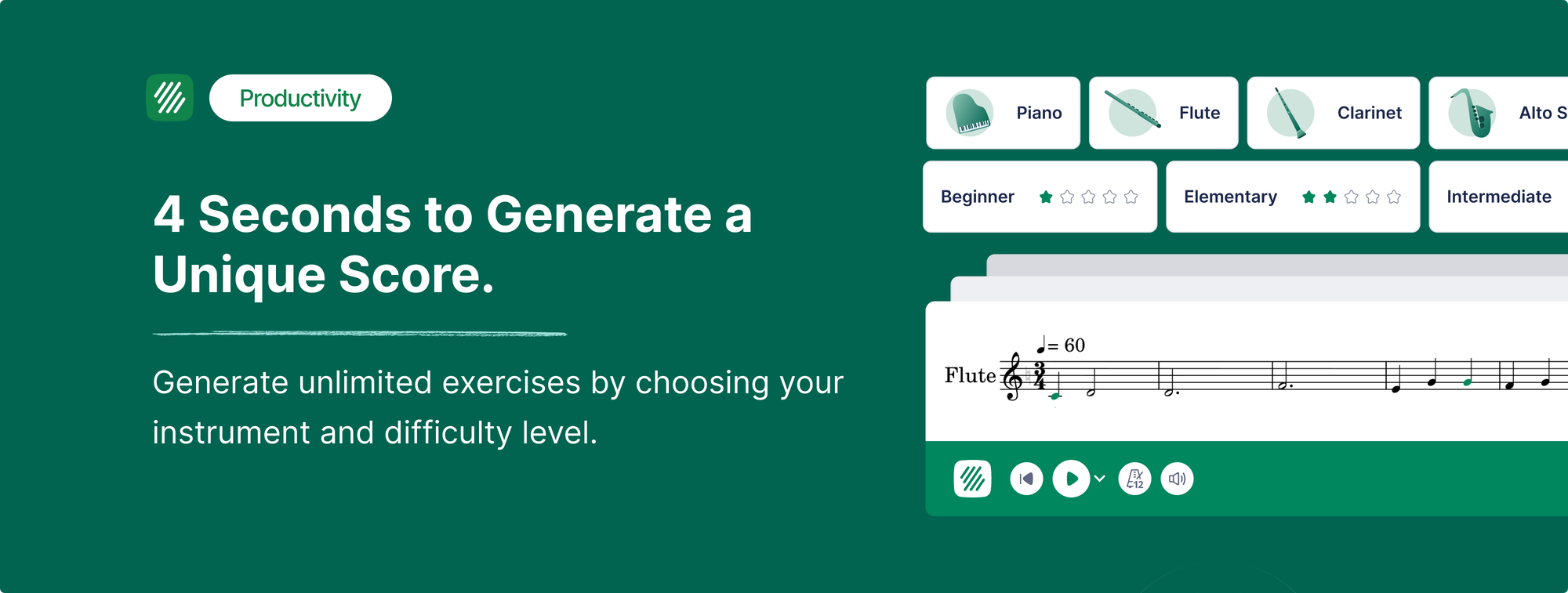
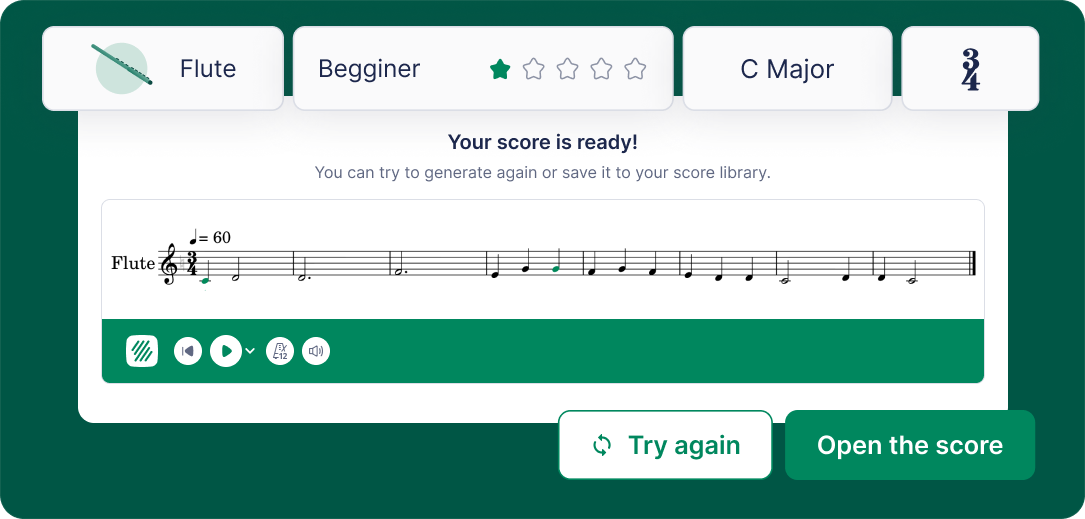
The sight-reading generator inside Flat for Education changes that entirely. Choose the instrument, the difficulty level, and the key. Press generate. Four seconds later: a unique, never-seen-before exercise, ready to assign or display. That's not a slight improvement on the old workflow. It's a completely different relationship with sight-reading practice.
What Is Sight Reading in Music?
Sight reading is the ability to perform a piece of music accurately on first encounter, without prior practice or preparation. It means turning written notation into sound in real time, reading and responding simultaneously.
For students, strong sight-reading ability means they can learn new music faster, contribute to ensembles from the first read-through, and work more independently. For a choir singer, it means being able to pick up a new anthem without weeks of rote repetition. For an orchestral player, it means surviving a professional dep job. For a piano student, it means being able to work through new pieces at home without waiting for the next lesson.
Research confirms what most teachers already sense: there is a positive correlation between time spent practicing sight reading and sight reading skill level. And crucially, once a student has completed an exercise, it is no longer a sight reading exercise for them. That's why infinite generation matters: the practice only works if the music is genuinely new every time.
Why Sight Reading Gets Skipped (And Why That Matters)
There's a particular irony in how sight reading is treated across most school music programs. Ask any music teacher whether reading fluency matters and the answer is yes, always. Ask whether their students are getting enough sight reading practice and the answer is usually quieter.
It gets squeezed to the last five minutes of a lesson. Assigned as something to "do at home sometime." Quietly dropped when concert preparation takes over the calendar. Not because teachers don't value it. Because the logistics have always been painful.
The consequences accumulate slowly and show up suddenly. Students who don't practice sight reading regularly develop a helplessness around new music that's difficult to unpick later. They become singers who can't contribute until they've listened to a recording first. Players who need every part learned by rote. Pianists who can't open a new piece independently. When those students encounter an audition, a university ensemble, or simply want to play something new, the gap in their reading is immediate and hard to close quickly.
Regular, low-stakes sight reading from early in a student's musical life is one of the most transferable things a music teacher can develop. Four seconds to generate an exercise removes the last practical excuse for not making it happen.
What Makes a Good Sight-Reading Exercise
Not all sight reading practice produces equal results. An exercise that's too easy reinforces fluency at things students already know. One that's too hard produces anxiety and guessing, which builds bad habits rather than correcting them.
The productive zone sits at what learning researchers call "desirable difficulty": challenging enough to require genuine attention, accessible enough that a focused student can succeed. For most intermediate students, that means exercises that:
- Introduce one or two rhythmic elements slightly beyond current comfort, without making the whole exercise about rhythm decoding
- Use a familiar key that the student doesn't live in constantly
- Include some melodic leaps alongside stepwise motion, but nothing that requires significant technical facility on the instrument
- Are short enough to hold in one reading, typically 8 to 16 measures
The Flat for Education generator calibrates all of these factors based on the difficulty level you select. The output is always different, but always within the parameters that make a useful exercise at that level. It's not random notation. It's pedagogically structured generation.
How to Build Sight Reading Into Your Weekly Teaching Routine
The teachers who get the best results with sight reading don't treat it as an event. They treat it as a warm-up: three to five minutes at the start of every lesson or rehearsal, before anything else. Consistent, unspectacular, every week.
That consistency matters more than duration. Short, frequent exposure to new sight reading material works better than occasional intensive drills. The skill builds through repetition across time, not through sporadic workshops.
A practical weekly structure that works across instrument teaching, choir, and ensemble:
- Start of lesson/rehearsal: Whole-group sight reading on the board or projector. Generate an exercise at the group's current level. Students read cold, once through, without stopping. Identify where things broke down. Read again.
- Mid-week or sectional: Individual or small-group exercises. Generate instrument-specific exercises for each voice or section. A soprano exercise for the sopranos; a clarinet exercise for the clarinets. Takes twenty seconds to generate, runs simultaneously across sections.
- Homework submission: Assign a generated exercise through Flat for Education as a recorded performance submission. Students record themselves reading cold on their device. The recording arrives with the score, so you hear exactly what happened and can leave feedback on specific bars.
Each live session takes three to five minutes. The homework assignment takes thirty seconds to generate and distribute. A complete weekly sight reading program on about eight minutes of planning time.
Sight Reading Across Different Teaching Contexts
The preparation problem plays out differently depending on what you teach, but the core issue is the same in every context.
Ensemble directors (band, orchestra, choir) face the transposition problem: generating exercises for a mixed instrumentation means producing multiple versions of the same exercise in different keys and clefs. The generator handles transposition automatically. Generate once, assign to each instrument section, and every player gets a correctly notated part.
General music teachers often work with students who are at wildly different reading levels within the same class. Generating differentiated exercises at three difficulty levels takes about twenty seconds. Assign them individually through Flat for Education and no student knows they received a different exercise from their classmates. That's meaningful differentiation without any visible ability grouping.
Piano and voice teachers working individually face a different version of the problem: finding genuinely fresh material for every lesson, across a range of levels, without spending more time sourcing exercises than teaching. A generated exercise at the right difficulty for that student, ready in seconds, replaces thirty minutes of hunting through books.
Choir directors face the sight singing version of this: students who can't read a new choral piece independently, meaning every piece requires intensive rote learning before rehearsal can be musically productive. Regular sight singing exercises, generated for soprano, alto, tenor, and bass voices separately, build exactly the independence that changes this.
Differentiating Sight Reading for Mixed-Ability Classes
Mixed-ability sight reading is one of the hardest problems in music teaching. An exercise that genuinely challenges your strongest reader is crushing for your weakest. An exercise pitched for your weakest reader bores everyone else. Writing multiple versions by hand takes so long that most teachers never do it.
With a generator, differentiating takes three button presses. Generate an advanced version, an intermediate version, and a foundational version of the same exercise for the same instrument. Assign through Flat for Education individually. Every student reads at their own appropriate level, at the same time, without the social dynamics that come with visible ability grouping.
For students who feel exposed reading in front of the class, the private submission model (record at home, submit the audio) often reveals a much more accurate picture of actual reading ability than in-class cold reading does. The anxiety of performing in front of peers distorts results. A private recording context mostly removes that distortion.
Using Generated Exercises for Assessment
Sight reading assessment is logistically hard in a traditional setting. Testing students one at a time while others wait is impractical. In-class cold reading in front of peers produces performance anxiety that doesn't accurately reflect reading skill. Sending exercises home without a submission mechanism produces nothing evaluable.
Flat for Education's performance assignment workflow solves all three problems. Generate an exercise, assign as a recorded performance submission, students record themselves reading cold on their own device and submit. The recording arrives displayed alongside the score. You can navigate to specific bars, leave timestamped comments, and grade against a rubric, all without the student present and without 27 students waiting for their turn.
Over a full year, those submissions constitute documented evidence of each student's sight reading development. That's useful for student self-review, parent conversations, and identifying students who need targeted support before an audition or major transition.
What the 4 Seconds Actually Changes
The honest answer: it changes the decision you make at 7:45am on a Monday when you're looking at your lesson plan and deciding whether to do sight reading or go straight to the main repertoire.
When preparing a sight reading exercise is a 45-minute task, you skip it. When it's four seconds, you don't. That's the whole argument. Not that the tool is clever, not that the exercises are well-calibrated (though they are), but that removing the friction from a valuable habit removes the reason you were avoiding it.
Sight reading goes from the thing you mean to do more of, to the thing you just do, because it stopped requiring a decision. It's on the plan. It takes thirty seconds to set up. It happens every week.
The sight reading generator is included in the Flat for Education Teacher Plan and School/District Plan, and is available immediately on the free 30-day trial. No credit card required. Set it up before your next lesson and use it as your warm-up. If it doesn't save you real preparation time and produce better practice than what you were doing before, you've lost nothing. If it does, you've found a routine that runs itself.
Related Articles
Looking for sight reading strategies specific to your instrument? Each article below covers the unique challenges of that instrument and how to build reading fluency around them.
- Sight Reading for Piano Students
- Sight Reading for Alto Saxophone Students
- Sight Reading for Trombone Students
- Sight Reading for Guitar Students
- How to Assign Sight Reading Exercises in Flat for Education
FAQ
What is a sight reading generator?
A sight reading generator is a tool that produces unique, unprepared musical exercises on demand. Unlike fixed exercise books, which students eventually memorise, a generator creates a different exercise every time, so every practice session uses genuinely new material. The Flat for Education generator creates exercises calibrated to a specific instrument and difficulty level, producing pedagogically appropriate notation rather than arbitrarily random notes.
How often should students practice sight reading?
Frequently and consistently beats occasionally and intensively. Three to five minutes of sight reading at every lesson or rehearsal produces better long-term fluency than occasional longer sessions, because the goal is to make it a routine warm-up rather than a special event. Once students stop treating it as a test, most begin to notice and take satisfaction in their own improvement.
Is sight reading the same as sight singing?
Sight singing is a type of sight reading. Sight reading is the broader term for performing any written music on first encounter without preparation, while sight singing refers specifically to performing a vocal line from notation without prior rehearsal. Both require mentally hearing pitch and rhythm before producing sound, and both benefit from regular, short sessions using genuinely new material.
What instruments does the Flat for Education sight reading generator support?
Currently piano, flute, clarinet, alto saxophone, trumpet, trombone, guitar, and voice, with more instruments being added. Each exercise is generated specifically for the chosen instrument's range and reading context, and transposition is handled automatically for transposing instruments.
How is a sight-reading generator different from Sight Reading Factory?
Sight Reading Factory is a standalone sight-reading tool, while the Flat for Education generator is built into a platform that also handles notation, composition assignments, performance assessments, auto-graded ear training worksheets, and LMS integration. If you already use Flat for Education, the generator is part of the same plan rather than a separate subscription; if you only need a standalone generator, Sight Reading Factory is a reasonable lower-cost option.