Auto-graded ear training worksheets are one of the most practical tools a music teacher can add to their classroom in 2026. Ear training is one of those things every music teacher knows students need and almost nobody has enough time to do properly. Not because it's hard to teach. Because it's hard to assess at scale. Interval identification exercises require students to hear, respond, and be corrected in sequence. In a class of 28, running that loop for every student takes a kind of time that simply doesn't exist inside a 50-minute lesson.
So ear training gets squeezed. It becomes a five-minute warm-up that never quite develops, or a worksheet sent home that comes back unmarked because the teacher doesn't have the hours. The students who need it most, the ones who can't yet hear the difference between a major third and a perfect fourth, don't get the repetition they need to close that gap.
Auto-graded ear training worksheets change the equation. They deliver the repetition, they give students immediate feedback on each answer, and they produce a completion record that tells you who is actually doing the work. The teacher's job shifts from marking to responding: you look at the results, identify which students are still struggling with minor intervals, and address that in class. That's a much better use of teaching time than correcting stacks of paper.
What Are Auto-Graded Ear Training Worksheets?
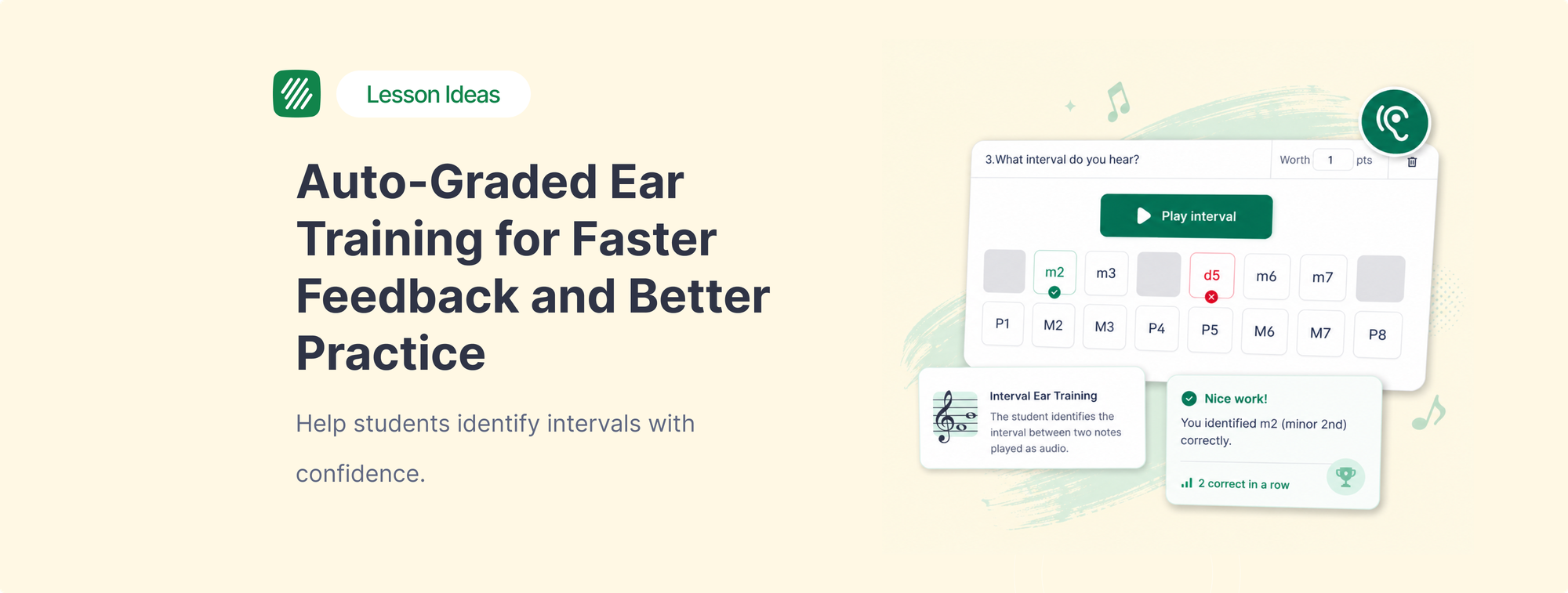
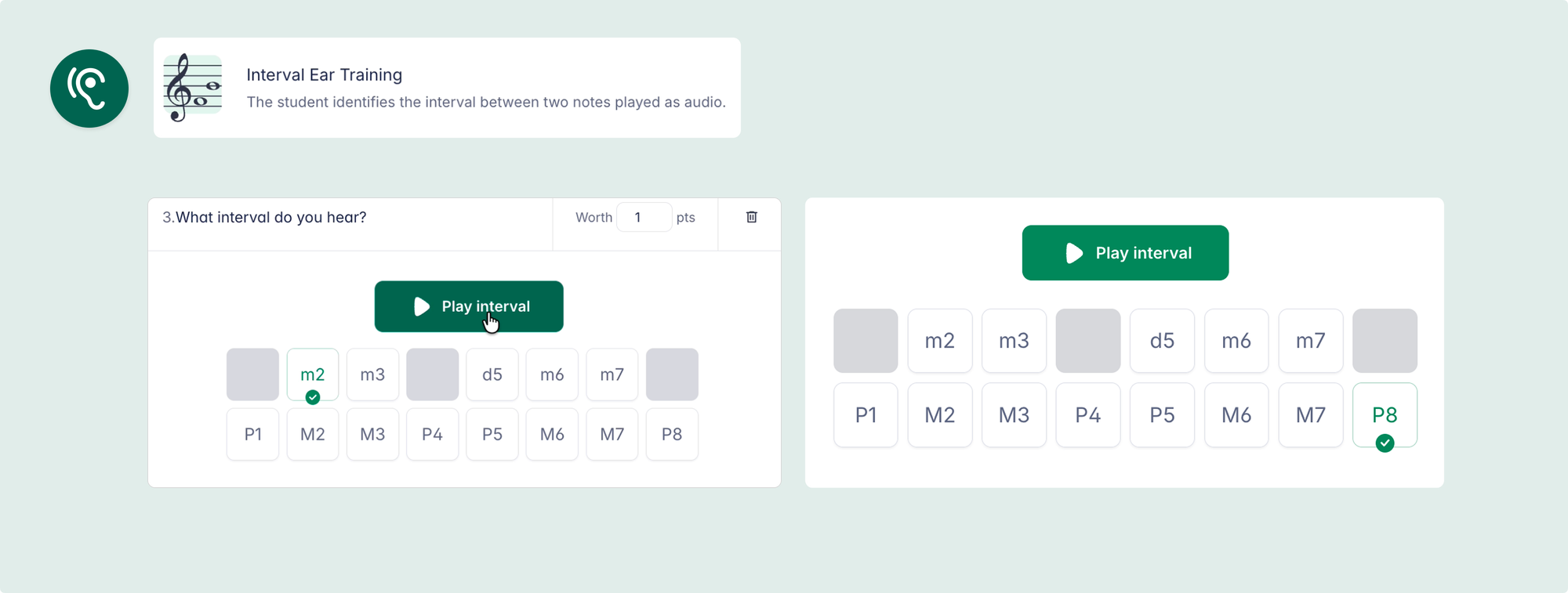
Auto-graded ear training worksheets are digital exercises in which students listen to musical examples and identify what they hear. In Flat for Education's current version, worksheets cover interval identification: students hear two notes played and select the correct interval from a list. The student submits their answer and gets immediate feedback — correct, or here's what it actually was.
No waiting for the teacher to mark it. No wondering until next week whether you got it right. No batch of identical incorrect answers that tell the teacher nothing about which specific concept each student is struggling with.
In Flat for Education, auto-graded music theory worksheets cover interval ear training and recorder fingering identification, with results feeding directly into the teacher's assignment dashboard. You can see at a glance who completed the exercise, who got it right the first time, and who submitted multiple attempts, which is a useful signal about confidence and fluency that a test score alone won't give you.
The Case for Ear Training as Regular Practice, Not Assessment
Most secondary music programs treat ear training as something that shows up on a theory exam. Students cram it for a week, do the test, and promptly forget it. That's not how aural skills develop.
Ear training works the same way as instrumental technique: through consistent, short practice sessions over a long period of time. Five minutes, three times a week, for a semester produces more measurable improvement in interval recognition than two intensive weeks before an exam. The neurons that connect a sound to its label need to be activated repeatedly and in varied contexts before the connection becomes reliable.
The practical problem with regular ear training practice in a class setting has always been the marking. If you're assigning interval identification exercises three times a week, you need a way to give feedback on three exercises per student per week without spending your evenings doing it. Auto-graded worksheets are the only scalable answer to that problem.
Interval Ear Training: Where to Start and How to Sequence It
Students who are new to interval identification almost always find the same ones hardest. Minor seconds and major sevenths sound similar in practice because they're inversions of each other. Perfect fourths and augmented fourths sound similar enough to confuse students who haven't yet developed a strong internal reference point for tritones.
A sensible progression starts with the easiest intervals to distinguish by character rather than by counting semitones:
- Week 1-2: Unison, octave, and perfect fifth. These have the most distinct characters and give students an anchor for everything else.
- Week 3-4: Major third and minor third. The major/minor distinction applied to the most common interval in tonal music.
- Week 5-6: Perfect fourth and major second. Building toward a complete set of common intervals.
- Week 7-8: Minor second, major sixth, minor sixth. The harder ones, introduced after students have reliable reference points for the easier intervals.
- Week 9+: Minor seventh, major seventh, tritone, and compound intervals.
The key thing is not to introduce intervals too quickly. A student who can reliably identify all five intervals they know is further ahead than a student who knows twelve intervals unreliably. Fluency builds on accuracy, not coverage.
How to Assign Auto-Graded Ear Training in Flat for Education
Setting up ear training worksheets in Flat for Education takes about three minutes once you know the workflow. Here's how it works:
- Go to your class and select New Assignment.
- Choose Worksheet as the assignment type.
- Select an ear training worksheet from the built-in library, or build a custom one by choosing the interval range you want to target.
- Set a due date and any attempt limits.
- Assign to the class. Students see the exercise in their assignment list, open it, listen to each example, and submit their answers.
- From your dashboard, review the results. You can see each student's score, the specific questions they missed, and how many attempts they made.
The built-in worksheet library includes exercises calibrated for different levels, so you don't need to build everything from scratch. For classes where some students are significantly ahead of others, you can assign different worksheets to different students within the same class.
Connecting Ear Training to What Students Are Already Playing
Ear training that exists in a separate universe from ensemble or composition work tends to feel abstract and irrelevant to students. The teachers who get the most out of it connect it explicitly to repertoire.
If your band is rehearsing a piece with a prominent minor sixth leap in the main theme, assign an exercise specifically on minor sixths that week. If your class is about to start working on modal melodies, run an interval worksheet focused on the characteristic intervals of those modes first. If students are composing and keep writing harmonically bland passages, working on interval recognition gives them an ear for why their choices sound the way they do.
The connection doesn't have to be elaborate. Even a brief mention, "you're going to hear that interval a lot in what we're rehearsing this week," is enough to shift ear training from abstract exercise to practical preparation.
Did you know Flat for Education also supports critical-thinking assessments?
Use them as quick follow-up activities after a lesson, formative checks between units, or short reflection tasks that help students apply what they've learned, not just recall it. Learn more by watching the video below or reading this article.
Using Results to Inform Teaching Decisions
The completion record from auto-graded worksheets is more useful than most teachers initially expect. Not just as a way to check homework, but as a genuine diagnostic tool.
If 60% of your class consistently gets perfect fourths wrong, that's a whole-class issue that needs addressing in a lesson, not individual feedback on 28 submissions. If three specific students are consistently at chance performance on minor intervals after five attempts, they need a different kind of support, maybe one-on-one time, maybe a different way of hearing the interval, maybe just more repetition than the rest of the class needs.
Auto-graded worksheets make that information visible in near real-time. You know before the next class, not after the next exam, where the gaps are. That's the kind of feedback loop that actually changes what you teach.

Flat for Education includes auto-graded ear training worksheets as part of the standard platform. If you want to try them with your class, a free 30-day trial gives you full access along with composition assignments, sight-reading exercises, performance assessments, and everything else in the platform.
Related articles:
- New Worksheets in Flat for Education: Interval Ear Training and Fingering, Now Auto-Graded
- Are You Using the Right Tools to Assess Your Music Students?
- How to Grade Music Composition Assignments (Without Losing Your Weekends)
- The Practice Tools Built Into Flat for Education: Metronome, Tuner, Tone Generator, Sound Analysis
FAQ
What is ear training in music class?
Ear training is the practice of developing the ability to identify musical elements by sound alone. In most secondary music contexts it begins with interval identification: recognising the distance between two pitches by ear. It is a foundational skill because it connects theoretical knowledge to what you actually hear. Flat for Education's ear training worksheets currently cover interval identification, auto-graded instantly on submission.
How often should students do ear training exercises?
Short and frequent beats long and occasional. Even 5 to 10 minutes three times a week, sustained over a semester, produces measurable improvement in aural skills, because the goal is consistent activation of the connection between sound and concept rather than cramming before a test. Auto-graded exercises suit this model well because they can be assigned as short homework without creating a marking burden.
Can students do ear training on a Chromebook or phone?
Yes. With browser-based tools like Flat for Education, the worksheets run in a browser and need only a speaker or headphones to hear the audio examples, with no download or specific operating system required. This matters for schools with mixed device environments where some students have smartphones rather than computers at home.
How is auto-graded ear training different from paper worksheets?
The main difference is the feedback loop. On paper, a student answers, hands it in, and finds out if they were right when the teacher returns it, often a week later, after the learning moment has passed. Auto-graded exercises give immediate feedback after each answer, so students self-correct in the moment and build accurate aural patterns faster. They also produce results data the teacher can act on, which paper worksheets do not unless scores are entered manually.