Writing your first marching band arrangement is less intimidating than it looks. The instrument ranges are the same ones you already know. The transpositions are the same. The main difference from writing a concert band piece is that the score never hits a music stand in a gymnasium; it stays on the director's podium and gets broken into individual marching charts for each section. Everything else, the harmonic structure, the voicings, the balance decisions, is the same craft.
This guide walks through the complete process of writing a marching band arrangement inside Flat for Education, from setting up your score to exporting parts. It's written for band directors who are comfortable with notation but haven't arranged for marching band specifically before.
What You Need Before You Start
Before touching the score editor, you need three things sorted.
A source melody. For first arrangements, use something you have the rights to use, or a public domain piece. A folk song, a hymn tune, or a simple theme from the standard repertoire works well. Avoid choosing something with complex harmonic rhythm in the original; it's much harder to make work convincingly when you're also dealing with marching band doublings and spacing.
Your instrumentation. Know which instruments you're writing for before you open the score editor. A typical mid-size high school marching band might include: flute/piccolo, clarinets (1st, 2nd), alto saxophone, tenor saxophone, trumpets (1st, 2nd), mellophone, trombone, baritone/euphonium, tuba, and percussion. Your school's specific roster will differ. The point is to know it in advance rather than adding instruments halfway through, which creates score cleanup headaches you don't want.
Your key decision. Marching band arrangements typically work best in flat keys for the brass (E-flat, B-flat, A-flat) and sharp keys are usually harder for most players to navigate at performance tempo outdoors. That said, your choice should be driven by what sits comfortably in the range of your most exposed voice, which is usually the first trumpet or the lead melody instrument. Pick a key where the melody sits in the sweet spot of that instrument's range before you commit.
Setting Up Your Score in Flat for Education
Flat for Education handles transposing instruments automatically, which removes one of the most error-prone parts of arranging. When you add a B-flat clarinet to the score, Flat for Education knows it's a transposing instrument and shows the written pitch while handling the concert pitch relationship internally. Your score can display in concert pitch or in transposed parts depending on what you need at any given moment.
To set up your marching band score:
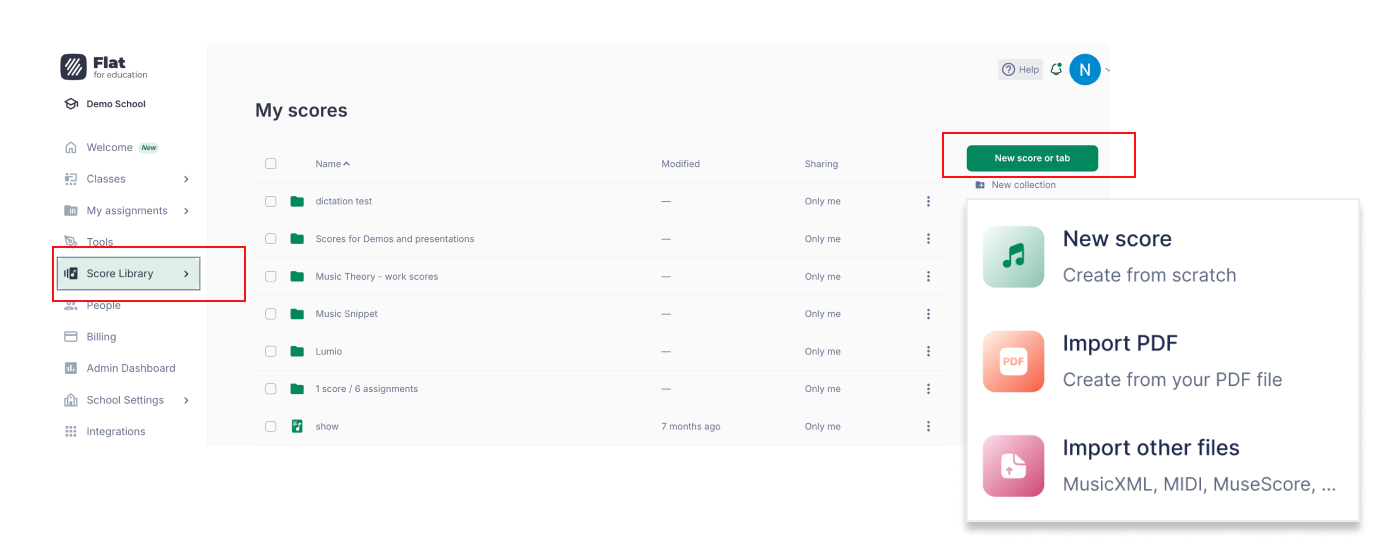
- Create a new score in Flat for Education and select the instruments in your band from the instrument picker. Group them in the standard order: woodwinds (flute, clarinet, saxophones), brass (trumpet, mellophone, trombone, baritone/euphonium, tuba), then percussion.
- Set your time signature, key signature, and tempo. For a first arrangement, 4/4 and a moderate tempo (around 120-130 BPM) gives you the most flexibility.
- Enter the melody in the top melodic voice first. Don't worry about harmonisation yet. Just get the melody in at the correct pitch, with the correct rhythms, before adding anything else. This is your reference line for everything that follows.
Instrument Ranges for Marching Band: The Essentials
These are comfortable playing ranges for outdoor performance at marching tempo. The upper limits are intentionally conservative. Players at parade tempo in the heat, wearing full uniform, performing choreography, perform at the lower end of their theoretical range ceiling. A note that works in a concert band sectional may not work reliably outdoors.
- Piccolo/Flute: D5 to D7 (concert). Piccolo is most effective in the octave above written middle C.
- B-flat Clarinet: Written E3 to G6. The break between the chalumeau and clarino registers (written B4 to C5) is a reliability risk for less experienced players. Stay in the upper register or lower register for exposed lines.
- Alto Saxophone (E-flat): Written D3 to A5. The mid-range (written G3 to E5) is most reliable outdoors.
- Tenor Saxophone (B-flat): Written D3 to G5. Rich in the lower register; use it there for effect.
- Trumpet (B-flat): Written F-sharp3 to C6. The money range for outdoor performance is written C4 to G5. First trumpets carrying the melody should sit in C4 to E5 for reliable execution.
- Mellophone (F): Written C4 to G5 is the comfortable range. Don't push mellophones into extreme high register for exposed lines.
- Trombone: Concert B-flat2 to B-flat4. The slide positions in the middle of the range (4th to 6th position) are the most reliable for fast passages.
- Baritone/Euphonium (B-flat): Written B-flat2 to B-flat4. Often doubled with trombones. Can handle melody well in the upper part of the range.
- Tuba (B-flat): Written B-flat1 to E-flat4. The bass line. Keep it largely in root positions and stay in the lower third of the range.
Flat for Education will show a range warning if you write a note outside an instrument's standard range, which catches obvious errors before you've moved on.
Voicing and Harmony for a First Arrangement
For a first marching band arrangement, keep the harmonic language simple. Four-voice chorale-style writing, with melody in the top voice and root-position or first-inversion chords in the supporting voices, works reliably and sounds full. Resist the urge to add chromatic inner voices or complex rhythmic independence in the harmony before you've confirmed the basic arrangement balances.
A practical approach for building out the harmony:
- Melody: First trumpet (doubled by piccolo/flute an octave up for outdoor projection, and possibly by first clarinet in unison).
- Counter-melody or harmony: Second trumpet and mellophone. These instruments carry inner voices well and are balanced against the lead trumpet.
- Middle harmony: Alto saxophone and tenor saxophone. Fill in the chord tones the brass aren't covering. The saxophones add warmth in the middle register.
- Bass and harmonic support: Trombone, baritone, and tuba. Trombone plays the third or fifth of the chord; baritone doubles tuba an octave up; tuba carries root movement.
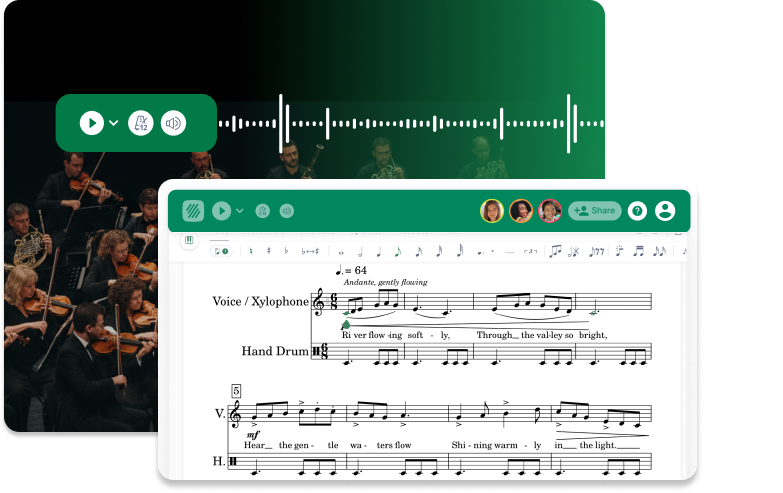
Listen to the playback in Flat for Education after each phrase to check balance. If the melody is getting buried by inner voices, reduce the dynamic on the harmony parts or simplify the voicing. The ear is the final authority here, not the theory.
Percussion Writing for the First-Time Arranger
If you're new to writing for marching percussion, keep it simple and functional. The percussion section's job in a basic arrangement is to support the pulse and articulate the phrase structure, not to independently carry interest.
A basic marching percussion part for a first arrangement:
- Snare drum: Straight time pattern or simple rudimental figure that supports the rhythmic feel. Avoid complex rhythmic unison between snare and the melodic instruments on a first arrangement.
- Bass drums: Root note articulation on strong beats. If you have a bass drum line with multiple drums, assign downbeats and simple splits; leave complex splits for when the arranger and players are both more experienced.
- Pit/front ensemble: If you have marimba or vibes available, they can double the melody or provide harmonic filler. Keep it simple.
The most common first-arranger mistake in percussion is writing too much. Percussion that's overwritten creates clutter that makes the melodic arrangement harder to hear. Write the minimum that supports the ensemble and add only if the arrangement clearly needs more.
Exporting Parts from Flat for Education
Once the arrangement is complete, exporting individual parts is straightforward in Flat for Education. From the score, you can export the full score as a PDF for the director's podium, or export individual instrument parts. Each part includes only that instrument's stave, formatted for printing.
For marching band, you'll typically want parts printed in a format that fits a flip folder, which is smaller than a standard music page. Flat for Education exports to PDF, and you can then format the page size in your PDF viewer before printing.

If you want to try writing your first arrangement, Flat for Education's free 30-day trial gives you access to the full score editor with automatic transposition, instrument range checks, and PDF export. It integrates with Google Classroom, Microsoft Teams, Canvas, Schoology, and MusicFirst, so you can share parts with students directly through the platforms your school already uses.
Related articles:
- Flat for Education as the Go-To Music Arrangement Tool for Ensemble Teachers
- The Practical Guide to Music Technology in the Secondary Classroom
- Composition Assignment Ideas for Beginning Band
FAQ
What is a marching band arrangement?
A marching band arrangement is a version of a piece adapted for performance by a marching ensemble, typically including woodwinds, brass, and percussion. Unlike a concert band arrangement, it is designed for outdoor performance at marching tempo, which affects instrument voicing, range choices, and dynamic balance, and the arranger also has to account for players moving while performing, which limits certain technical demands.
What key is best for marching band arrangements?
Flat keys generally work best: B-flat, E-flat, F, and A-flat major all sit well in the natural range of brass instruments and keep woodwind fingerings manageable at performance tempo. For a first arrangement, B-flat major is the most forgiving because it centres the first trumpet melody in its most reliable range and keeps the harmony comfortable for all sections.
How long should a marching band arrangement be?
For a first arrangement, 32 to 48 measures is a practical target, enough for an introduction, a full statement of the main melody, and a brief coda without balance and consistency becoming hard to maintain. Competitive shows run longer, but a tight, fully realized 32-measure arrangement is more useful than a longer one with unfinished sections.
Can I write a marching band arrangement if I'm not a trained composer?
Yes. Arranging is a different skill from composing: you work with existing melodic material and make decisions about instrumentation, register, and harmonic voicing rather than generating everything from scratch. Most band directors who arrange for their own ensemble learn by doing, starting with simple four-voice block harmony and adding complexity over time, and Flat for Education's immediate playback makes it easy to catch balance issues before printing parts.