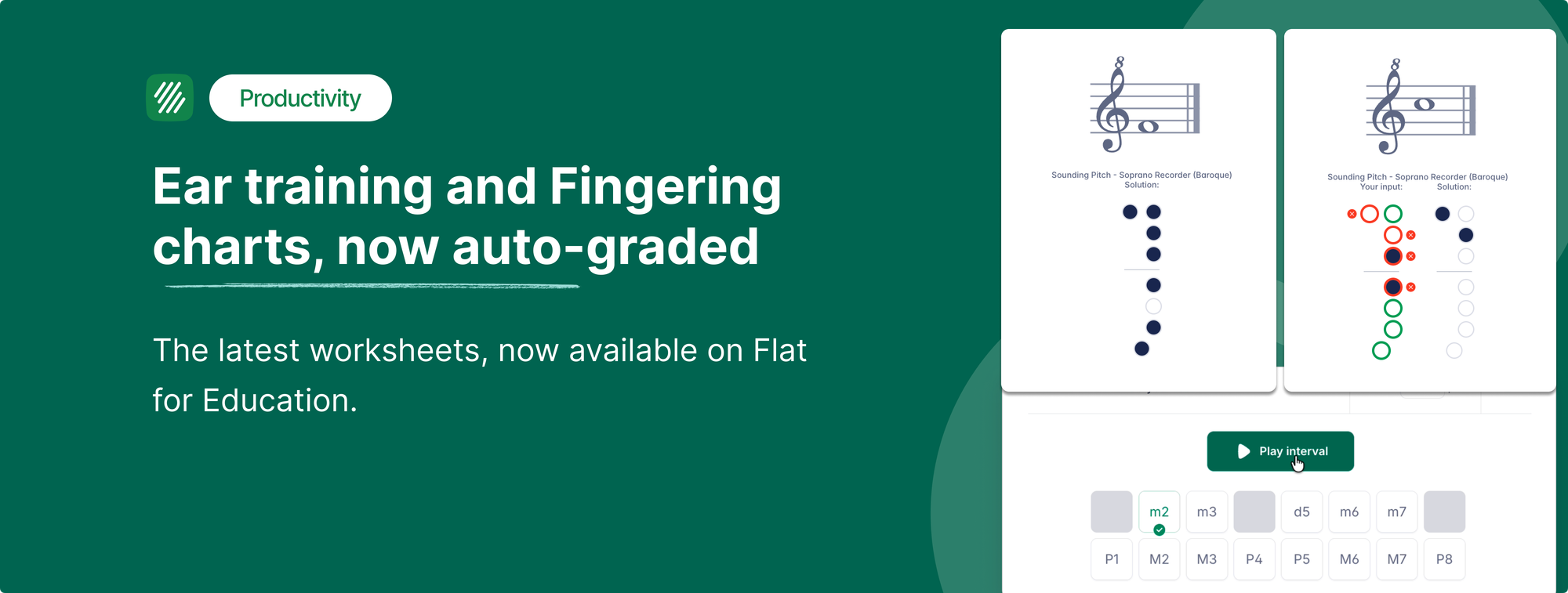
Flat for Education's worksheet family just got bigger! Let's look in detail at the latest auto-graded music theory worksheets.
Filling a gap for music teachers
Two categories of music learning share a common problem. Ear training is essential and chronically under-assessed, primarily because marking aural exercises at scale is time-consuming. Fingering mechanics are fundamental and repeatedly explained, primarily because students struggle to retain information they only encounter once during a lesson.
Flat for Education now includes two new worksheet types that address both directly. Interval ear training worksheets and fingering worksheets are built into the platform, auto-graded, and linked to your LMS gradebook. Students get immediate feedback. You see results without marking a single exercise.
cover
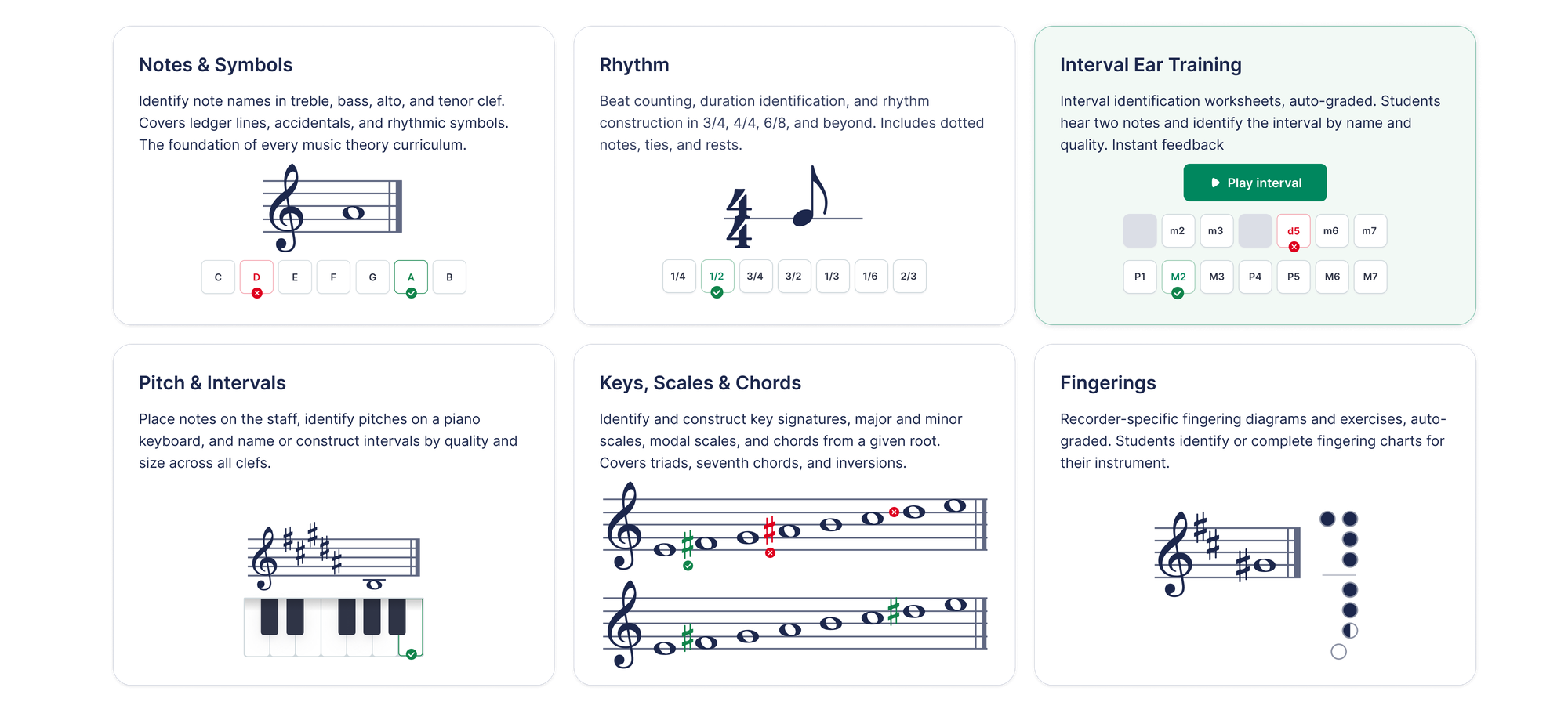
Ear training worksheets
What is ear training in music education?
Ear training is the practice of developing the ability to identify and reproduce musical elements by hearing them: intervals, chords, scales, rhythms, and melodic contours. It bridges the gap between reading notation and understanding sound. A student who can identify a major third by ear can correct their intonation in real time. A student who can hear the difference between a major and minor chord can analyse harmony in the music they listen to. Ear training is taught in virtually every serious music program but is often assessed infrequently because the assessment logistics are demanding.
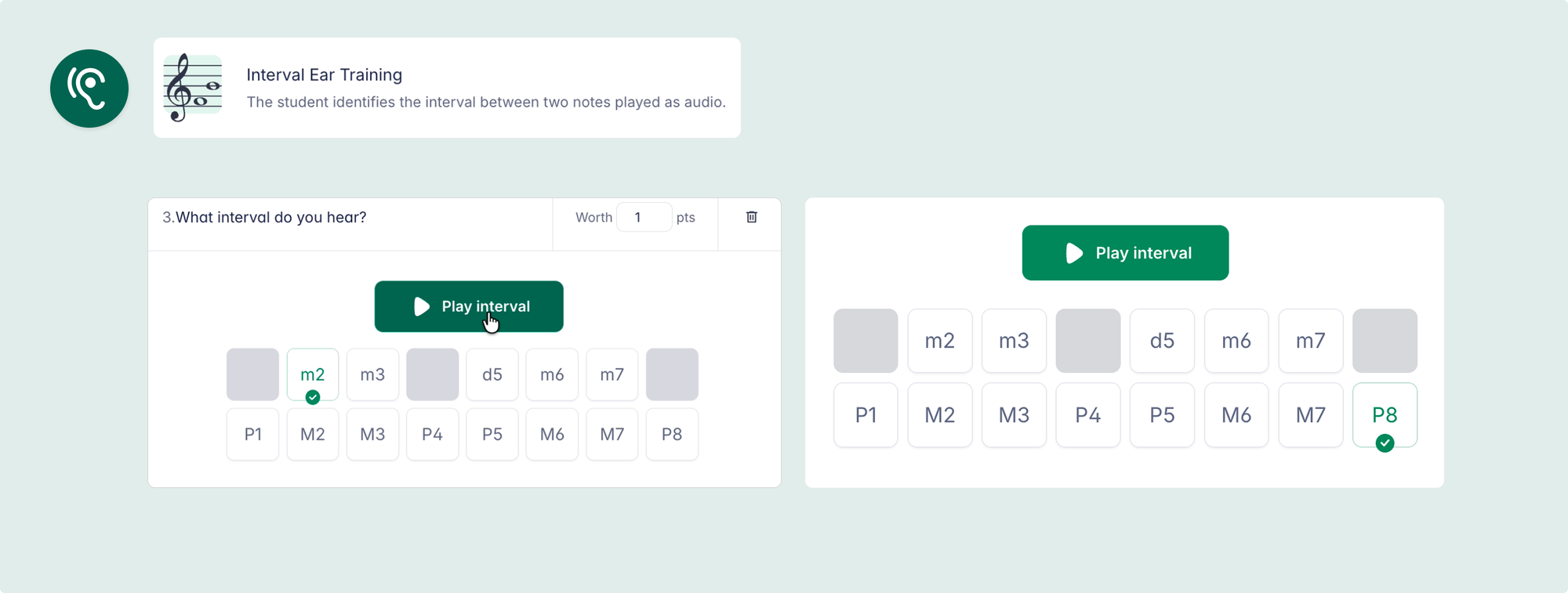
The ear training worksheets in Flat for Education cover Intervals. Students hear a played interval and identify it from a list. Covers all intervals within an octave, adjustable by the teacher based on what the class has studied.
Each exercise is auto-graded. Students submit and see their results immediately. The teacher's dashboard shows results by student and by question, so patterns are visible: if twelve students in a class missed the same interval, that's a lesson point, not thirty individual marking decisions.
Why auto-grading changes how often ear training gets assessed
The reason most music teachers assess ear training infrequently is not that they consider it unimportant. It's that aural assessment has traditionally required either live in-class performance, which is time-consuming, or recorded exercises that need individual review, which is also time-consuming. The result is that ear training gets tested at the end of a unit when time permits, rather than woven through instruction as regular formative assessment.
Auto-grading removes the marking cost. Assigning a ten-question interval identification exercise becomes as quick as assigning any other homework. Results arrive in the gradebook automatically. A teacher who assigns ear training weekly has the same workload as one who assigns it once a term, because the grading is handled by the platform.
This shifts what's possible. Weekly aural quizzes become realistic. Students get feedback while the work is still fresh. The gradebook starts to reflect aural skills alongside written theory and performance.
Auto-graded digitally. Print-ready for paper days.
Ear training worksheets can be completed digitally in Flat for Education, with audio playback built in. Students hear the intervals or chords through their device speakers or headphones and respond directly in the worksheet. Results are auto-graded and synced to the gradebook.
For classes that work on paper, worksheets can be exported as print-ready PDFs. Printed worksheets don't auto-grade because the audio component requires the platform. But the printed version works for in-class tests or classrooms where devices aren't available for every student.
Fingering worksheets
What are fingering exercises in music education?
Fingering exercises are practice activities focused on the physical mechanics of playing an instrument: which fingers go where, in what order, at what positions. For wind and brass players, this means valve and key combinations. For string players, finger placement and shifting. For woodwinds, complex key systems that take significant time to internalise. Fingering is foundational and typically taught through direct instruction and repetition, but students benefit from being able to revisit it independently, in their own time, without waiting for the next lesson.
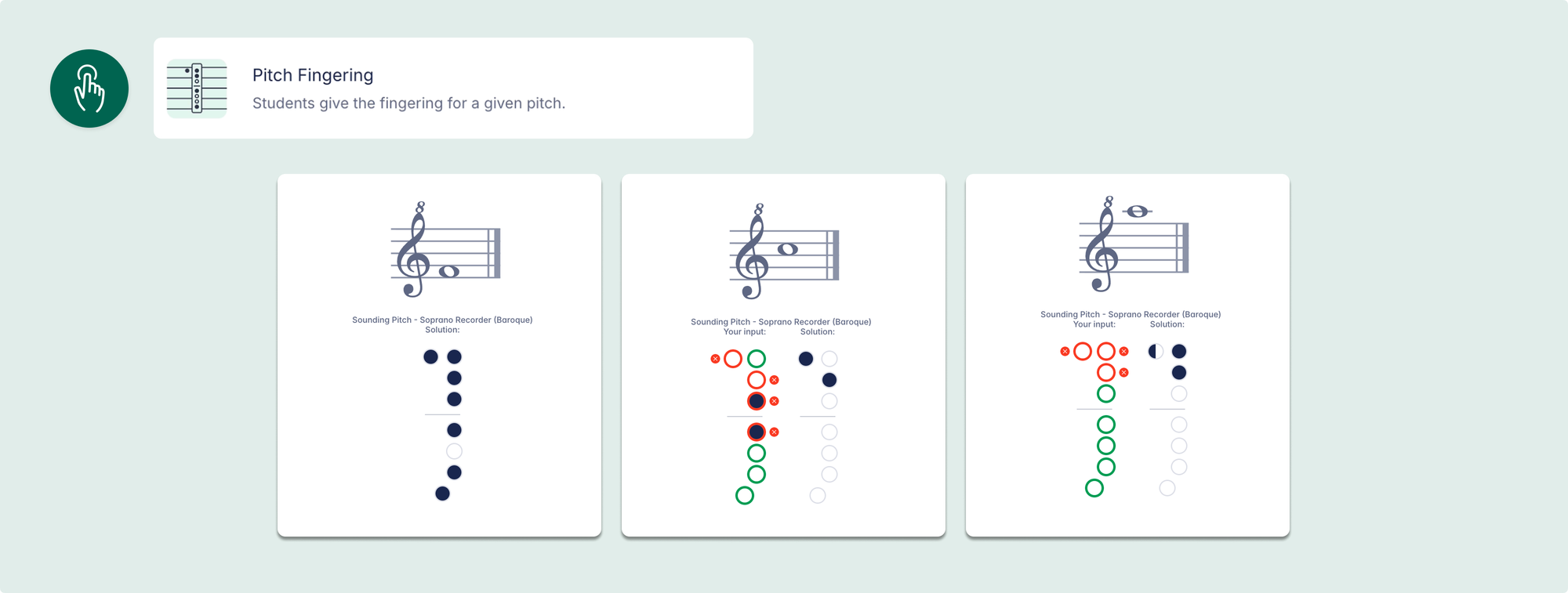
The fingering worksheets in Flat for Education are auto-graded and currently focused on recorder fingerings. More instruments will be added in future updates.
What makes instrument-specific fingering worksheets useful
A common challenge with fingering instruction is that explanations in class don't stick for every student at the same rate. The student who fully internalised the left-hand position for high D on the flute is ready to move on. The student who didn't needs to see it again. In a class of thirty, there's rarely time to revisit individual fingering questions more than once.
Instrument-specific worksheets give students a way to review fingering on their own schedule, with immediate feedback on whether their answers are correct. A student works through a worksheet on their instrument's key combinations, sees which ones they got wrong, and revisits those specifically. The teacher doesn't need to be present for that cycle.
For teachers, the worksheet results show which fingerings the class as a whole is struggling with. If a significant number of students in a clarinet class are missing the same register key fingering, that surfaces in the dashboard without any manual marking.
These worksheets and the new plans
Ear training and fingering worksheets are included in the Teacher Plan and School or District Plan. They are not available on legacy plans.
If you're on a legacy plan, you can access both worksheet types immediately by opting in. Your current pricing stays in place until your next renewal. No payment required today.
For teachers new to Flat for Education, the free 30-day trial includes the full platform and both worksheet types. No credit card required.
Frequently asked questions
What do the Flat for Education ear training worksheets cover?
The ear training worksheets cover interval identification. Students hear audio playback built directly into the worksheet and respond within the platform. Results are auto-graded and sync to the LMS gradebook immediately.
Are the fingering worksheets available for every instrument?
Fingering worksheets are instrument-specific and cover recorders. Future iterations will add more instruments! Students receive exercises in the context of their own instrument rather than generic mechanics.
Can I print the ear training and fingering worksheets?
Yes. Both worksheet types can be exported as print-ready PDFs. Auto-grading applies to digital submissions only. Printed worksheets are graded manually by the teacher.
How does auto-grading work for ear training exercises?
Audio playback is built into the worksheet. Students hear the interval directly in the platform and select their answer. When they submit, Flat for Education checks each response against the correct answer and calculates a score. The grade syncs to the LMS gradebook automatically. Teachers see individual results and class-level patterns in the same dashboard as all other assignments.
Which plan includes the ear training and fingering worksheets?
Both worksheet types are included in the Teacher Plan ($99 per teacher per year plus $6 per student) and the School or District Plan (starting at $599 per year). They are not available on legacy plans.
Flat for Education offers a free 30-day trial with no credit card required. The trial includes the ear training and fingering worksheets alongside the full platform. Start at flat.io/edu.
Other articles you might find useful: