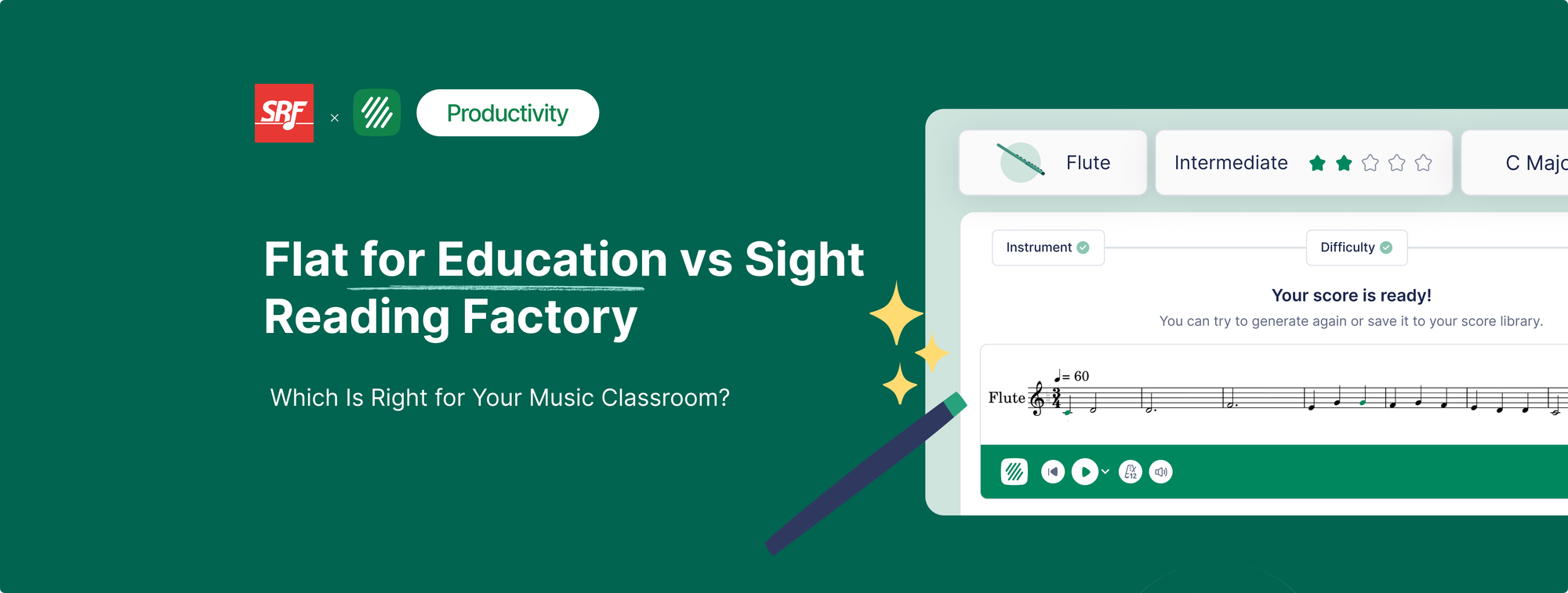
Sight Reading Factory has a well-deserved reputation. It solves a real problem; sight-reading preparation takes more time than most teachers have, and it solves it well. The generator is reliable, the exercises are musically sensible, and the instrument range is broad. Teachers who use it regularly tend to be genuinely enthusiastic about it.
So when Flat for Education launched a built-in sight-reading generator in 2026, the question a lot of teachers asked was a reasonable one: is this actually as good as Sight Reading Factory, and does it change the calculation for schools that are already paying for one or both platforms?
This post answers that honestly. Sight Reading Factory is a strong product, and it deserves to be treated as one. But there are real differences between a standalone sight-reading tool and a full music education platform that now includes sight-reading, and those differences matter for how you decide what your program actually needs.
What Sight Reading Factory does
Sight Reading Factory generates sight reading exercises on demand. You select the instrument (or ensemble), the difficulty level, and various parameters including key signature, time signature, rhythmic complexity, range, and whether to include accidentals or dynamics. Click generate and a new exercise appears. Click again and you get a different one. The exercises are musically coherent rather than random sequences of notes, which is a meaningful technical achievement and something teachers who've used the platform notice.
The platform also has an assignment and classroom management layer: teachers can create classes, assign exercises to students, and track practice sessions. Students can record their readings and submit them. There's a Live Practice feature that casts individual parts to student devices for ensemble sight reading.
Sight Reading Factory integrates with Canvas, Google Classroom, MusicFirst, and Schoology. It does not integrate with Microsoft Teams.
Pricing is approximately $45 per teacher per year plus $3 per student, though the student price decreases with volume. It's a focused tool, and for what it does, it's priced reasonably.
What Flat for Education now includes
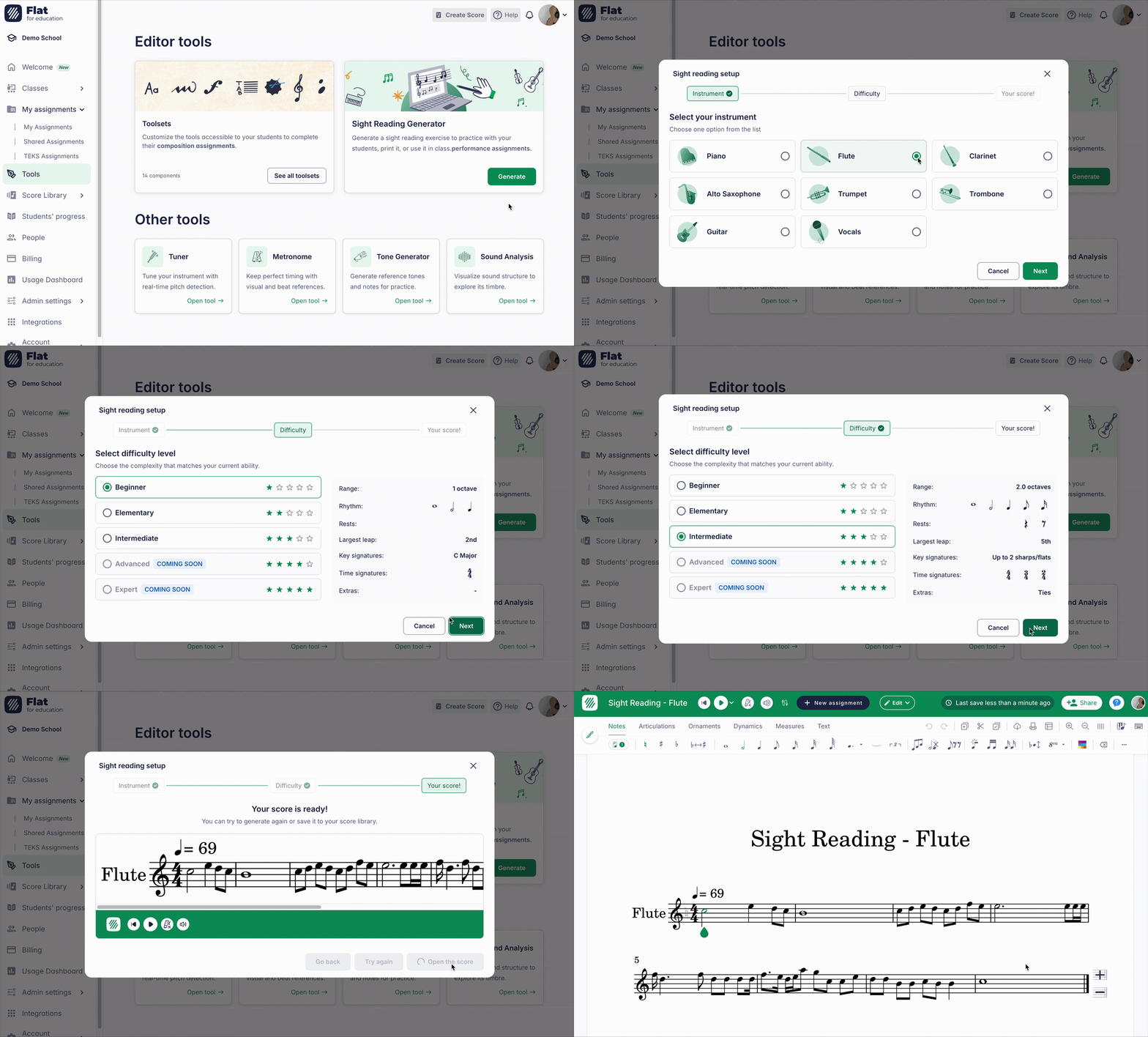
Flat for Education added a sight-reading generator in April 2026 as part of a broader update that brought seven new tools into the platform. The generator creates unique 8-measure exercises by instrument and difficulty level, and lets you set the time signature and key signature as well. You can pick one of each or select several and let it use one at random. Students can also open the generator themselves for independent practice, not only when a teacher assigns it. Supported instruments currently include Piano, Flute, Clarinet, Alto Saxophone, Trumpet, Trombone, Guitar, and Vocals, with more coming. Generated exercises save automatically to the student's score library under a dedicated Sight Reading folder.
The generator works as a class warm-up tool (project and read together) or as an individual assignment. For the assignment workflow, you attach the generated exercise to a Flat for Education performance assignment, distribute it through Google Classroom, Microsoft Teams, Canvas, Schoology, or MusicFirst, and students record their first read directly in the platform using their device microphone. The recording and the score submit together. You review them side by side and leave timestamped comments.
The generator keeps improving. Recent updates added a front-of-room Track View that opens ready to project, and one-step generate-and-assign from inside the performance assignment flow, so you can create an exercise and attach it without leaving the page. Full rundown: What's New in the Flat for Education Sight-Reading Generator.
That assignment workflow is where the two platforms diverge most clearly. More on that below.
Where Sight Reading Factory has the edge
Customisation depth. Sight Reading Factory allows teachers to configure exercises at a granular level: specific rhythmic patterns, exact pitch ranges, articulation density, accidentals by type. You can save custom parameter sets and return to them. Flat for Education has closed part of this gap: you can now set the time signature and key signature, individually or as a random pool. Sight Reading Factory still goes deeper, with configurable rhythmic patterns, articulation density, exact ranges, and saveable custom parameter sets. If that level of granularity is what you need, it remains the more configurable tool.
Ensemble sight reading. Sight Reading Factory's Live Practice feature casts individual transposed parts to student devices simultaneously, which is genuinely useful for band and orchestra directors who want to run ensemble sight reading sessions with everyone reading their own part. Flat for Education's generator produces single-instrument exercises.
Instrument range. Sight Reading Factory covers a broader instrument range including strings, percussion, and full orchestral configurations. Flat for Education's generator currently supports eight instruments. If your program is primarily strings or percussion, Sight Reading Factory's coverage is wider at the moment.
Standalone focus. If sight reading is specifically your weak area and everything else in your classroom is working, a tool built around nothing but sight reading generation and practice will feel tighter and more purpose-built than a feature inside a larger platform.
Where Flat for Education has the edge
Flat for Education also lets students open the generator themselves for independent practice, so reading reps aren't limited to what teachers assign. That keeps sight-reading in the same place where students already do their composition and performance work.
The workflow is where it matters most. In Sight Reading Factory, the student records their sight reading inside the platform. In Flat for Education, the student records their sight reading against the actual score, inside the same platform where they do their composition assignments, their theory worksheets, and their other performance work. The submission is the audio plus the score, together. You review them together. And when a performance doesn't fit a score, Free Record lets students record with none attached, so ensembles, mixed repertoire, and improvisation are covered too.
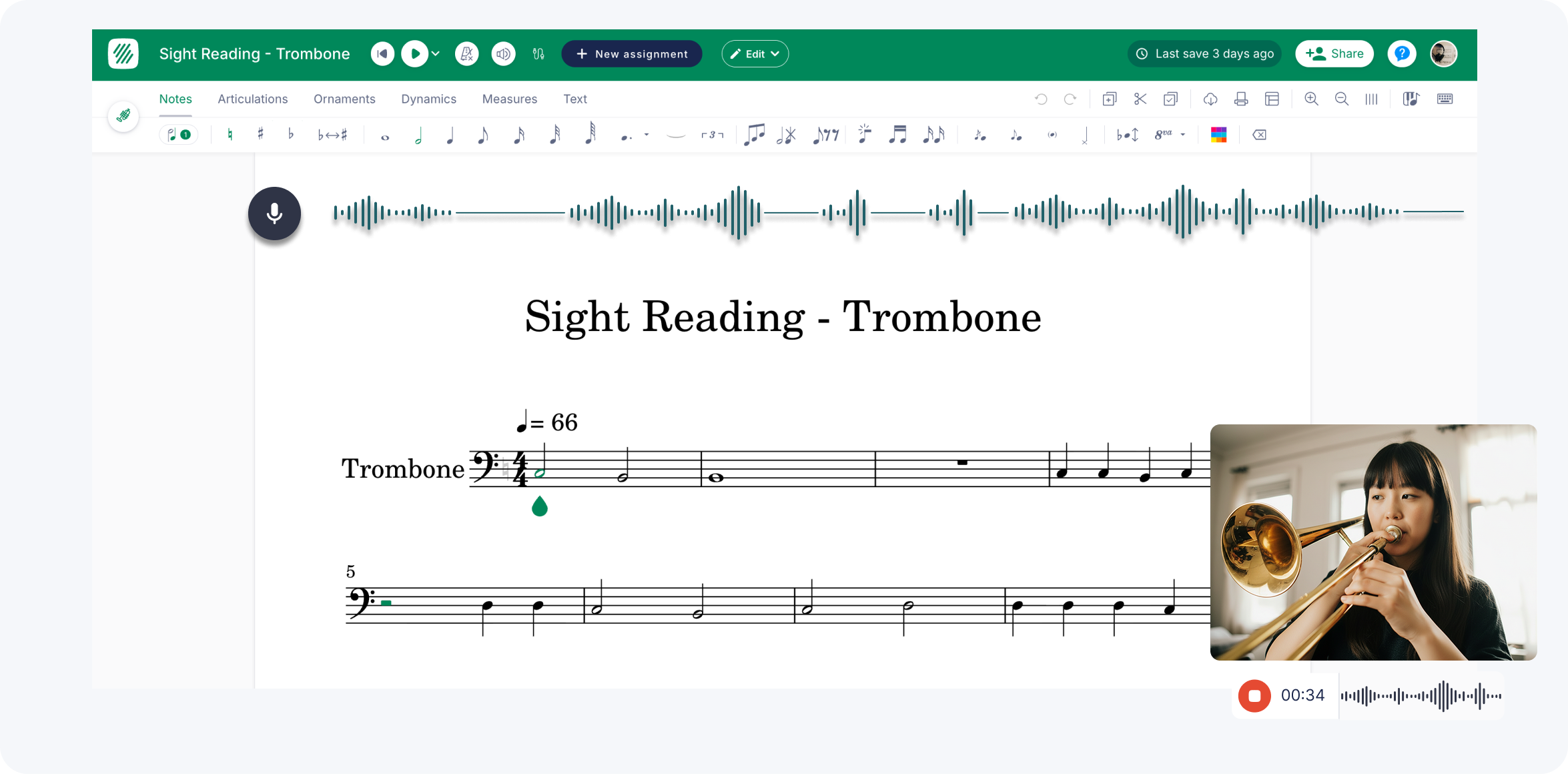
That's a different experience for both student and teacher. The teacher sees the score the student was reading while hearing the recording, which makes it much easier to identify exactly where the reading broke down and why. The student's sight-reading record is part of their overall profile in Flat for Education, alongside their compositions and other submissions, rather than sitting in a separate system.
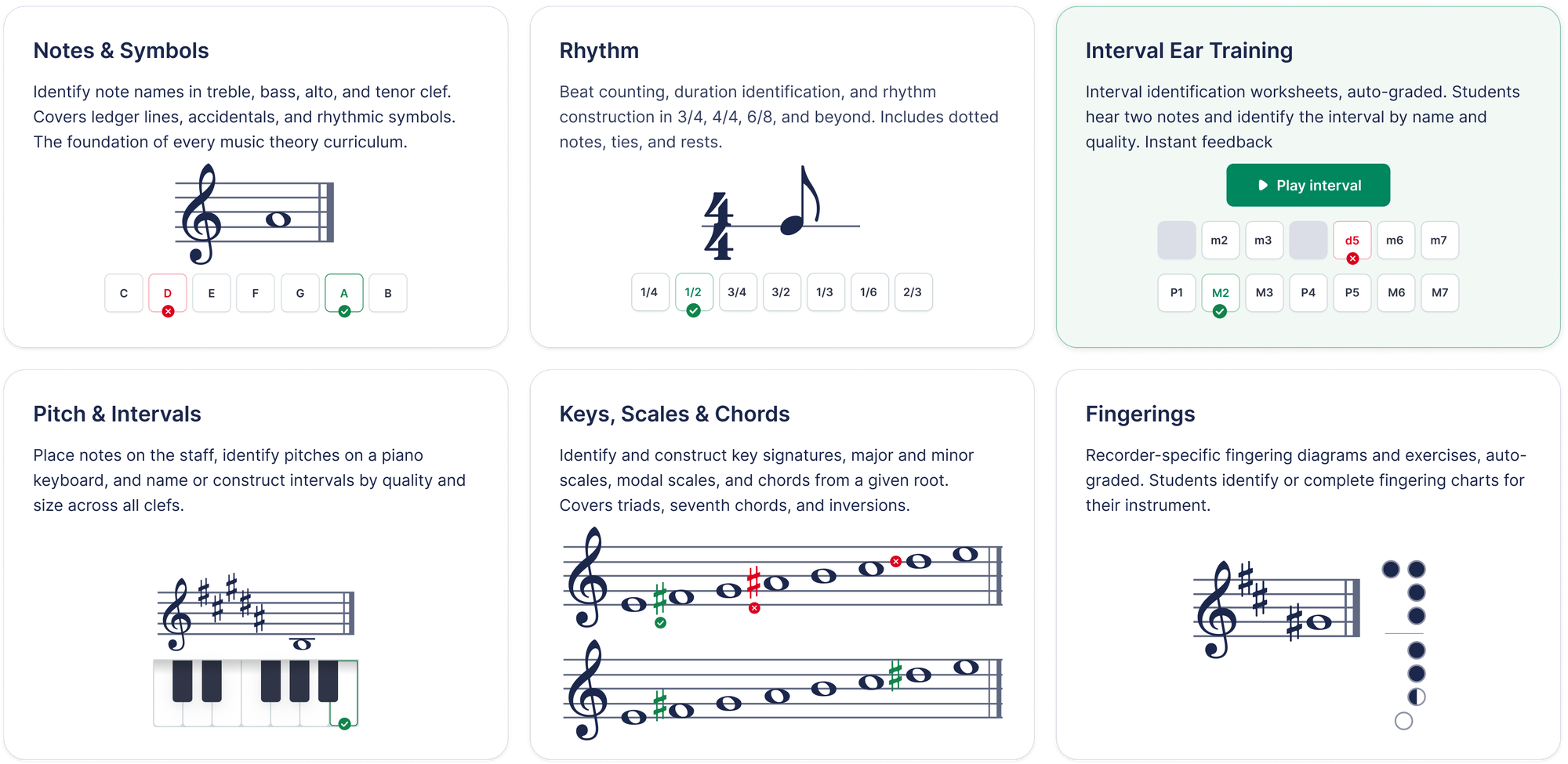
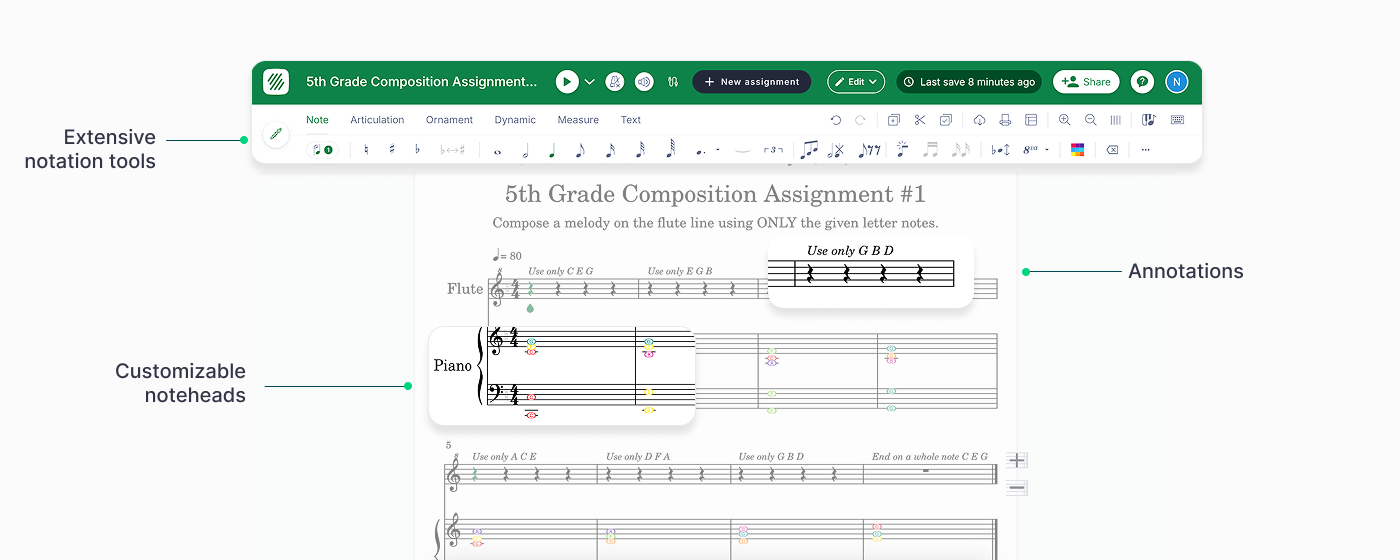
The other significant difference is what else is included. Flat for Education is a full music education platform. The sight-reading generator sits alongside the notation editor, auto-graded music theory worksheets, composition assignments, performance assignments, a tuner, a metronome, a tone generator, ear training worksheets, fingering worksheets, and LMS integration across Google Classroom, Microsoft Teams, Canvas, Schoology, and MusicFirst. If you're already using Flat for Education for composition and assessment, the sight-reading generator is already included in your plan. No additional cost, no additional login, no separate system.
Sight Reading Factory costs $45 per teacher per year plus student subscriptions. Flat for Education costs $99 per teacher per year plus $6 per student and includes the sight reading generator plus everything else. If you would otherwise pay for both platforms, the question becomes whether Sight Reading Factory's additional customisation depth justifies a separate subscription on top of what Flat for Education now provides.
For most school programs: probably not.
Feature comparison
| Feature | Sight Reading Factory | Flat for Education |
|---|---|---|
| Sight reading generator | Yes, highly customisable | Yes, pre-set difficulty levels |
| Instrument range | Very broad (strings, percussion, full ensemble) | 8 instruments currently, expanding |
| Ensemble/multi-part exercises | Yes (Live Practice) | No |
| Student recording submission | Yes, inside SRF | Yes, recording + score together |
| Timestamped feedback on recording | No | Yes |
| Notation editor | No | Yes |
| Composition assignments | No | Yes |
| Auto-graded theory worksheets | No | Yes |
| Ear training worksheets | No | Yes (intervals) |
| Fingering worksheets | No | Yes (recorder) |
| Tuner, metronome, tone generator | No | Yes |
| Google Classroom integration | Yes | Yes |
| Microsoft Teams integration | No | Yes |
| Canvas integration | Yes | Yes |
| Schoology integration | Yes | Yes |
| MusicFirst integration | Yes | Yes |
| Works on Chromebook | Yes (browser-based) | Yes (browser-based) |
| Teacher pricing | ~$45/year | $99/year |
| Student pricing | ~$3/student (volume pricing) | $6/student |
| Free trial | Yes | Yes (30 days) |
Which one should you choose?
Choose Sight Reading Factory if sight reading is the only digital tool you need, if your program is primarily strings or percussion where Flat for Education's generator doesn't yet have coverage, or if you need ensemble multi-part sight reading exercises for full band or orchestra.
Choose Flat for Education if you need a platform that handles composition, performance assessment, theory worksheets, and sight reading in one place. If you currently pay for a separate notation platform and a separate sight reading tool, Flat for Education replaces both. The sight reading generator is less configurable than Sight Reading Factory's, but it covers the core use case that most classroom teachers actually need: a fresh exercise at the right instrument and difficulty level, ready in thirty seconds, assignable through the LMS you already use.
The honest answer for most school music programs in 2026 is that maintaining two separate subscriptions for notation and sight reading no longer makes sense when a single platform covers both. Sight Reading Factory built something genuinely good. Flat for Education built something broader that now includes what Sight Reading Factory does best, alongside everything else a music classroom needs.
Comparing Flat for Education with other classroom tools? See also Flat for Education vs Noteflight and Flat for Education vs MuseScore.
Flat for Education offers a free 30-day trial with full access to the sight-reading generator and all platform tools from day one. No credit card required. Start at flat.io/edu.
Already a Flat for Education user? Access the sight-reading generator by opting in to the new tools in your account settings. If you are unable to access it, email edu@flat.io.
FAQ
Is Sight Reading Factory better than Flat for Education for sight reading specifically?
For pure sight-reading generation, Sight Reading Factory has more customisation depth: configurable rhythmic patterns, exact pitch ranges, articulation density, and ensemble multi-part exercises. Flat for Education lets you set the instrument, difficulty level, time signature, and key signature, and currently covers eight instruments rather than the full range Sight Reading Factory supports. If maximum sight reading customisation is your primary requirement, Sight Reading Factory remains the more specialised tool; if you need sight reading as part of a broader classroom platform, Flat for Education's generator covers most classroom needs and avoids an additional subscription.
Can Flat for Education replace Sight Reading Factory?
For many classroom teachers, yes. The Flat for Education sight reading generator covers the instruments used in most general music, band, and vocal programs, and it integrates directly with the performance assignment workflow so students record their reading and submit alongside the score in a single step. If you run regular ensemble sight reading sessions where every student reads their own transposed part simultaneously, Sight Reading Factory's Live Practice feature currently has no equivalent in Flat for Education.
Does Sight Reading Factory work with Microsoft Teams?
No. Sight Reading Factory integrates with Canvas, Google Classroom, MusicFirst, and Schoology, but not Microsoft Teams. Flat for Education integrates natively with all five: Google Classroom, Microsoft Teams, Canvas, Schoology, and MusicFirst. For schools on a Microsoft 365 environment where Teams is the primary LMS, this is a meaningful practical difference.
How does the Flat for Education sight reading generator work?
You select the instrument and difficulty level, then set the time signature and key signature (pick one of each, or select several and it uses one at random). The platform generates a unique 8-measure exercise instantly, opening in Track View. You can use it immediately as a class warm-up or attach it to a performance assignment for students to record and submit, and students can also open the generator themselves for independent practice.
What is the price difference between Sight Reading Factory and Flat for Education?
Sight Reading Factory costs approximately $45 per teacher per year plus around $3 per student (with volume pricing). Flat for Education costs $99 per teacher per year plus $6 per student and includes the sight reading generator alongside the full platform: notation editor, composition and performance assignments, auto-graded theory worksheets, ear training worksheets, fingering worksheets, tuner, metronome, tone generator, and LMS integration. If you currently pay for both a notation platform and Sight Reading Factory separately, consolidating to Flat for Education will likely cost less overall.