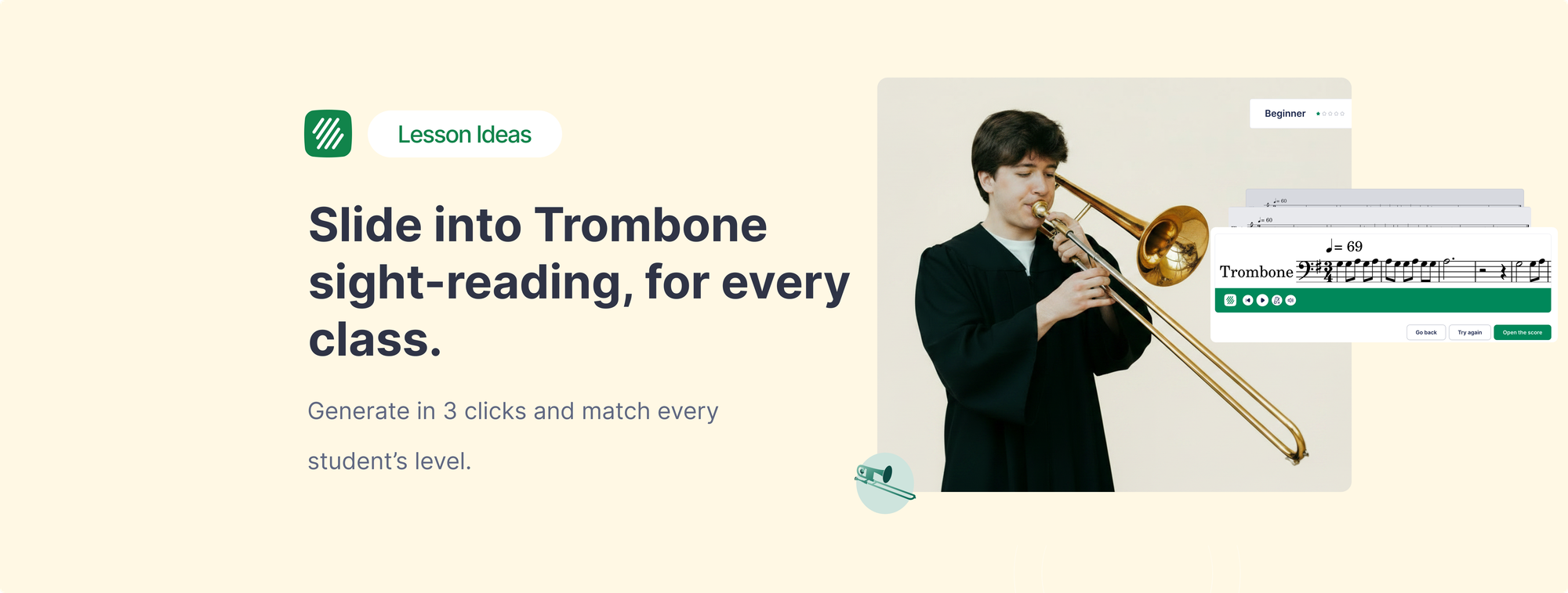
Trombone is the only instrument in a standard concert band where the student has to produce a pitch entirely by ear and physical estimation, with no fixed keys or valves to land on. There are seven slide positions and each one needs to be in exactly the right place. A trumpet player who misreads a note might play the wrong pitch, but they can correct it on the next attempt without moving anything. A trombone player who misjudges a position might produce a pitch that's not in any key at all.
This makes trombone sight reading genuinely harder than sight reading on a valved instrument, in a specific way: it requires audiation (hearing the note in your head before playing it) more urgently than almost any other band instrument. Students who don't audiate before moving the slide will always be chasing the pitch rather than landing on it.
The Flat for Education sight reading generator creates 8-measure trombone exercises that give you material to build this skill deliberately and systematically.
Audiation before moving the slide
Before reading any generated exercise, ask students to sing through it. Not necessarily in pitch, just enough to hear the melodic shape: high, low, step, leap. This 30-second activity forces audiation and dramatically improves slide accuracy in the first read.
Students who sing through an exercise before playing it land on pitches more accurately because their ear is already oriented to where the notes should be. They're not reading the note and guessing the slide position. They're reading the note, hearing it, and then confirming with the slide. That's a fundamentally different (and more accurate) process.
For students who resist singing out loud, a quiet hum is sufficient. The audiation is what matters, not the volume.
Legato reading as intonation training
Generate an exercise at a comfortable difficulty level and ask students to play it entirely legato, using a light "dah" articulation rather than a hard "tah." No stopping between notes, smooth slide movement throughout.
Legato trombone playing is harder than it sounds because the slide has to arrive at each new position exactly in time with the new pitch. Students who play legato passages cleanly have excellent slide timing. Students who play them with slides arriving a fraction after the note change produce a characteristic "smear" that bands directors know well.
Using legato sight reading exercises specifically to address slide timing is more effective than telling students to move the slide faster in general rehearsal. It isolates the coordination problem and gives students a context to practice it directly.
The pedal register as a sight reading entry point
Trombone's pedal tones (below the staff, in the low B-flat to E range) are often underused in classroom sight reading. They're physically and sonically interesting, most students enjoy producing them, and reading in that register builds familiarity with the lower part of the staff where trombone parts frequently live.
Generate a lower-difficulty exercise that stays in the middle and lower register and ask students to exaggerate the resonance on any notes below the staff. Make those notes big and full. This builds the breath support habit for the lower register, which transfers directly to ensemble playing where trombone low notes need to underpin the whole band.
Position calling before playing
Project a generated exercise on screen. Before playing, ask students to call out (or write) the slide position for each note in the first four bars. First position, sixth position, fourth position, and so on.
This is a trombone-specific equivalent of the key signature analysis that all instrument students should do before sight reading. It turns the exercise into a brief theory and technique check before the reading begins. Students who have verbally committed to the positions tend to land on them more accurately than students who navigate on instinct.
For more advanced students, do this only for notes that cross between adjacent positions and could be confused (like E-flat and D, which are in fifth and fourth position and close enough to confuse under pressure).
Assign section readings and collect recordings
Trombone sections in school bands are often small enough that individual playing tests are practical. Generate a different exercise for each student, assign as a performance submission through Flat for Education, and distribute via Google Classroom, Microsoft Teams, Canvas, Schoology, or MusicFirst. Students record at home and submit their first attempt.
Individual exercises mean no student has heard the others' version in advance. The recordings give you evidence of real sight reading development: whether students are audiating before sliding, whether intonation holds in the upper register, whether the rhythm holds across a rest.

Flat for Education's sight reading generator produces fresh trombone exercises in seconds. Assign them as class warm-ups, individual playing test submissions, or section recordings. Free 30-day trial at flat.io/edu.
FAQ
Why is trombone sight-reading harder than on valved instruments?
Trombone requires the player to physically locate each pitch on a continuous slide rather than pressing a fixed-position valve. The physical response to reading a note is therefore less automatic than on a trumpet or saxophone: the player must hear the note in advance through audiation and move the slide to approximately the right position, then fine-tune by ear. Students who have not developed audiation habits have to produce each note by estimation, which is slow and inaccurate under sight-reading conditions.
What is the best way to start trombone sight-reading in class?
Start with a brief sing-through of the exercise before playing it. Even a 30-second hum of the melodic contour activates audiation and improves slide accuracy on the first read. Use lower difficulty levels until students can read a complete exercise without stopping, then gradually increase complexity, since maintaining tempo without stopping matters more than pitch accuracy in early development.
How often should trombone students practice sight reading?
Two or three short sessions per week produce better results than one longer session. Five minutes at the start of rehearsal with a fresh exercise builds reading fluency without taking significant instructional time, and consistency over several months produces visible results. Frequent short sessions beat occasional longer ones.