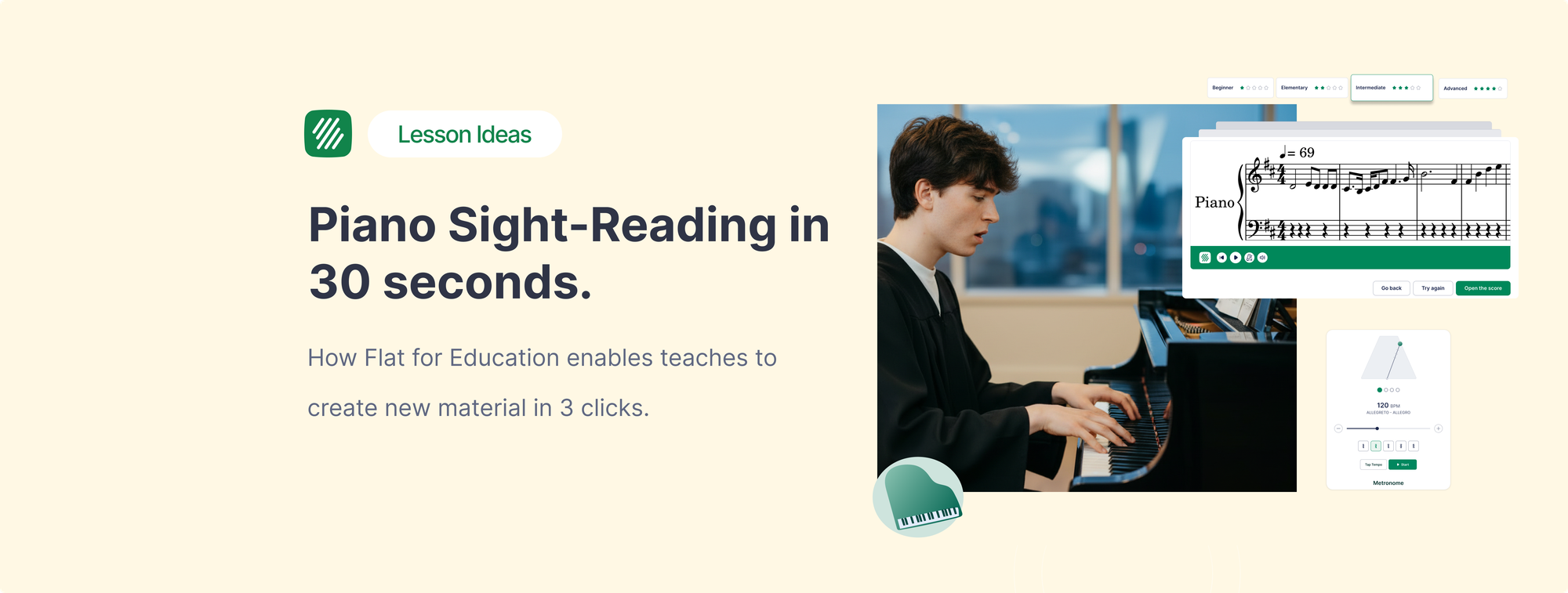
Piano is the instrument most teachers associate with sight-reading difficulty. The reason is structural: two staves, two hands, two independent rhythmic lines, often in two different clefs. A student learning trumpet reads one line. A piano student reads two simultaneously, which means there are twice as many places for things to fall apart.
That complexity is also why piano sight-reading is worth building systematically. Students who can read fluently at the piano have a musical literacy advantage that transfers everywhere: score analysis, composition, harmonisation, accompanying. The skill compounds.
The problem most classroom piano teachers face isn't motivation to teach sight reading. It's material. sight-reading ready for Monday morning, are genuinely hard to come by. Flat for Education's sight reading generator solves exactly this. Here's how to use it well for piano, and some ideas that go beyond the obvious.
What sight-reading on piano actually demands
Before getting into ideas, it's worth naming what makes piano sight-reading different from other instruments. Students need to process treble and bass clef simultaneously, coordinate two independent rhythmic streams, and make real-time fingering decisions without prior practice. That's three cognitive tasks happening at once.
Most sight-reading breakdowns on piano are rhythm failures, not pitch failures. A student who stumbles on a dotted quarter note pattern in bar 3 usually knows what the note is. They're not sure how long to hold it while the other hand does something different. This matters for how you design exercises and what you ask students to focus on when they read.
Use the generator for right-hand-only warm-ups
Start each class with a single-line exercise in the treble clef and ask students to play it with the right hand only, at a tempo where they never stop. The rule is simple: keep going regardless of wrong notes. Stopping is the habit that kills sight reading development, because stopping to fix a mistake is exactly what sight reading doesn't allow in performance.
Running this as a five-minute opening routine two or three times a week produces visible results within a half-term. Students stop stopping. Their eyes start moving ahead of their fingers. That's the whole skill.
The generator gives you a fresh exercise every time. Same difficulty setting, different notes. Students never see the same exercise twice, which removes the memorisation shortcut entirely.

The rhythm-clap-before-you-play approach
Generate an exercise and project it on screen. Before anyone plays a single note, the class claps the rhythm together. Both hands of the piano exercise, if it's a two-staff piece, or just the treble line for beginners. Count it in, clap it through, identify where it gets complicated.
Then play it.
This separates the two hardest parts of piano sight reading (rhythm and pitch) into two manageable steps. Students who understand the rhythmic shape before their fingers touch the keys make fewer stops. The clap-through is also an excellent diagnostic: if the class stumbles on bar 4 during the clap, you know exactly where the teaching needs to happen.
Hands together, but one note apart
Here's an exercise that works surprisingly well for intermediate piano students who can handle single-hand reading but freeze when both hands come in. Take a generated exercise that has two staves. Ask students to play only the top note of the right hand and only the bottom note of the left hand. One note per hand, two hands together.
This strips the exercise down to its rhythmic skeleton. The coordination challenge remains. The harmonic complexity disappears. Students who consistently lock up when reading two full staves often find this version manageable, and manageable is where fluency starts.
Once they can do the stripped version without stopping, add one note back to the right hand. Then one to the left. The full texture becomes a gradual accumulation rather than an all-at-once demand.
Generate matching exercises for different levels
A piano class almost always has a wide ability range. A student in their third year of lessons and a student in their first term are not going to benefit from the same sight reading exercise. The generator lets you produce exercises at different difficulty levels from the same session.
Generate three versions: beginner, intermediate, and one step above where your most advanced students currently sit. Use them in the same class, assigned to different students. Nobody reads the same exercise as anyone else, so there's no comparison pressure. Everyone reads something that's slightly uncomfortable, which is where sight reading development actually happens.
Assign each version as a performance assignment through Flat for Education, send through Google Classroom, Microsoft Teams, Canvas, Schoology, or MusicFirst, and students record their reading at home between classes. You review the recordings, see exactly where each student is struggling, and adjust the level for next time.
Sight reading as a composition analysis tool
This is the one that tends to surprise piano teachers. Generate an exercise at a difficulty level slightly below where the class currently sits. Before playing it, ask students to analyse it for thirty seconds: what key is it in, what's the time signature, where are the phrase boundaries, what's the highest note in the right hand.
Then play it.
The analysis step builds the pre-reading habit that experienced sight readers do automatically. Most students, when handed a piece of music, play the first note as quickly as possible. Fluent sight readers scan the score first. Teaching the scan explicitly, with a generated exercise where the music is unfamiliar and there's nothing to memorise, builds this habit faster than using repertoire students already know.

Flat for Education's sight reading generator produces fresh piano exercises in seconds, at whatever difficulty level you need. Assign them as in-class warm-ups, home practice, or recorded performance submissions. The 30-day free trial gives you full access to the generator and all assignment tools from day one. Start at flat.io/edu.
Related Articles
👉 How to generate and assign sight-reading assignments
👉 How to run individual music performance assessments for a full class
FAQ
How often should piano students practice sight reading?
For classroom piano programs, two or three short sight reading sessions per week produce better results than one longer session. Five minutes at the start of each lesson, with a fresh exercise each time, builds the reading habit without eating into other instructional time. The key is consistency and fresh material, not duration.
Should students practice sight reading at home?
Yes, but the material needs to be accessible without a teacher present. An exercise slightly below the student's current playing level works well: the reading challenge is there but the student can complete it independently. Flat for Education's performance assignment tool lets students record their home sight reading and submit it, giving you evidence of independent reading without a formal assessment session.
What makes piano sight-reading different from other instruments?
Piano requires reading two staves simultaneously and coordinating two independent hands, which creates a higher cognitive load than single-line reading. Most breakdowns on piano come from rhythm coordination failures rather than pitch errors, so exercises that isolate the rhythmic challenge, like clap-throughs before playing, help students address the actual source of their difficulty.
What is an appropriate sight-reading level for a piano student?
A useful rule of thumb is that sight-reading material should sit roughly two grade levels below a student's performance level, so a student who performs Grade 4 repertoire comfortably should be sight-reading at Grade 2. The gap narrows as students become more fluent, but starting with material that feels easy builds confidence and keeps students from stopping.