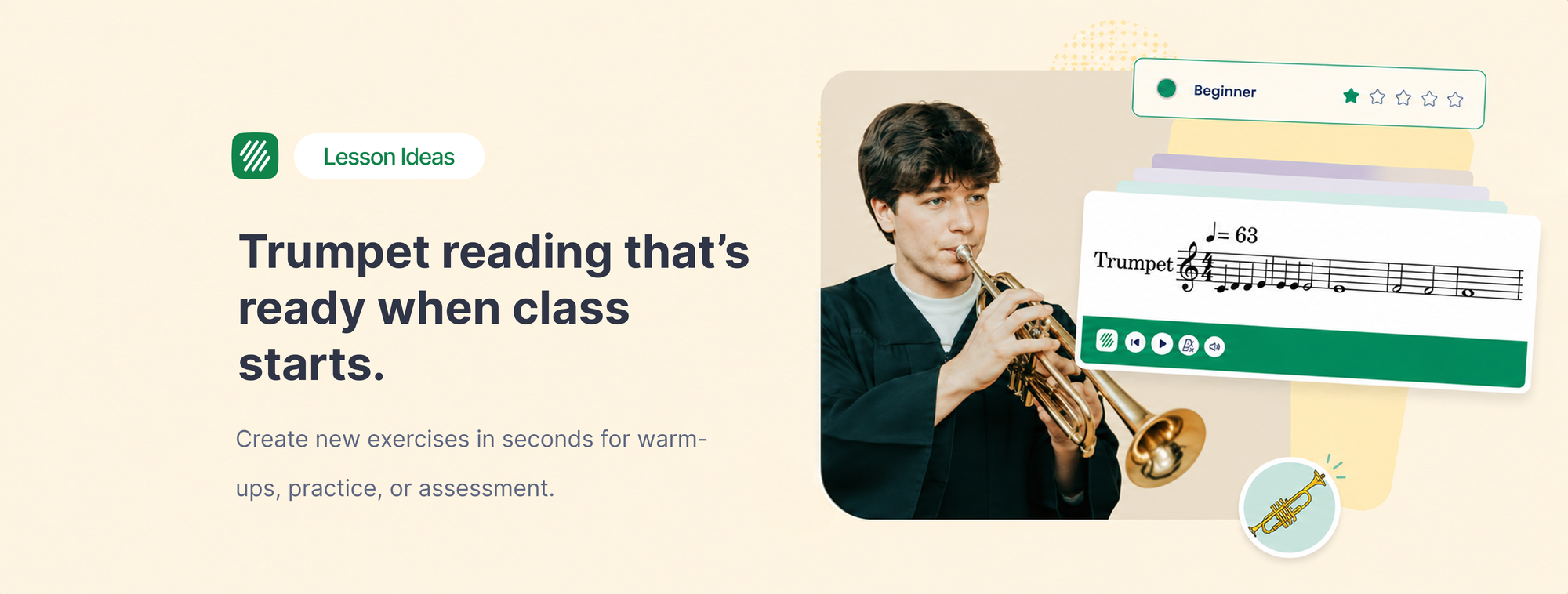
Trumpet players stop. It's almost a defining characteristic of trumpet sight reading at the intermediate level. A note doesn't speak cleanly, or the tonguing feels uncertain, and the student stops. Backs up. Tries again. The exercise is technically not a sight read at that point. It's a slow sightread interrupted by micro-rehearsals.
The stop-and-fix habit is deeply embedded in most trumpet students because it works in practice. They stop, they fix, they improve. The problem is that this exact behaviour is counterproductive for sight reading development. Reading fluency requires keeping a tempo regardless of imperfection. Building that habit is the primary goal of trumpet sight reading practice.
The Flat for Education sight reading generator gives you unlimited fresh exercises to do exactly that. Here's how to use them in ways that address the specific challenges of the trumpet.

The upper register and why it matters for sight reading
Trumpet's range expands significantly as students develop, but sight-reading ability in the upper register lags behind performance ability. A student who can play a high C reliably in a piece they've practised may miss it completely when reading it cold, because the preparation for a high note on trumpet (breath support, embouchure tension, air speed) has to happen in advance of the note, and the sight reader can't always see far enough ahead to prepare in time.
This makes look-ahead practice especially valuable for trumpet. When using the generator, build a specific exercise into your routine: before playing, ask students to identify every note above the staff. High notes first. The score analysis step that fluent readers do automatically, but beginners skip.
Slur versus tongue sight reading
Generate the same exercise twice. First read: tongue every note, no slurs regardless of what the score says. Second read: slur everything. Keep the beat in both versions.
This is deliberately artificial, but it produces something useful. The all-tongued version forces students to articulate cleanly through passages they might slur over to avoid committing. The all-slurred version forces breath connection and removes the tonguing as a performance safety net. Students who have done both versions understand the musical meaning of the actual articulation markings much more clearly when they read the exercise correctly on a third pass.
Rhythm before pitches for trumpet
Trumpet sight reading tends to break down first at rhythmically complex passages rather than at difficult pitch passages, because the embouchure recovery from a missed high note is slower than correcting a pitch on a woodwind. When a rhythmically complex passage is also in the upper register, the combination is genuinely hard.
Build the habit of rhythm-first reading: project the generated exercise and ask students to buzz the exercise on the mouthpiece alone, tracking the rhythm exactly but without producing pitched notes. No instrument, just mouthpiece. This is a real warm-up technique used in brass methodology, and it maps directly onto sight reading preparation. Students who buzz through a passage before playing it produce more accurate first reads.
Individual playing tests using sight reading exercises
The trumpet is one of the instruments where individual playing tests are genuinely assessable in a group context because the sound cuts through. Use the generator to create a unique exercise for each student, assign it as a performance assignment through Flat for Education, and have students record at home. They submit via Google Classroom, Microsoft Teams, Canvas, Schoology, or MusicFirst before the next class.
The individual exercise ensures no student has heard anyone else's version. The home recording means you're hearing a real first attempt rather than a class performance. Review the recordings for specific feedback: where did they stop, where did the rhythm break down, did the high notes speak. That evidence is useful for a private conversation with a student about where their practice should focus.
Trumpet section competition reading
Generate an exercise that's moderately challenging for the section. Everyone reads simultaneously. The rule: the moment you stop, your hand goes up. Last person playing with both hands on the instrument wins.
This is ridiculous enough to be funny and effective enough to be worth doing regularly. The competitive frame removes the social safety of stopping, which is the exact habit you're trying to change. Students who find this stressful are exactly the students who need it most. Keep the exercises at a level where most students can get at least halfway through, so the exercise feels fair.

Flat for Education's sight reading generator produces fresh trumpet exercises in seconds. Assign individual exercises to every student in your section, collect recorded submissions, and track reading development over time. Free 30-day trial at flat.io/edu.
FAQ
Why do trumpet students stop when sight reading?
Stopping and correcting is a productive practice habit that students transfer inappropriately to sight reading. In practice, stopping to fix a mistake makes the music better, but in sight reading it breaks the rhythmic continuity and defeats the purpose of the exercise. The habit needs to be addressed explicitly: tell students clearly that in sight reading, wrong notes are fine but stopping is not.
How do I handle upper register in trumpet sight reading?
Match the difficulty setting to the student's reliable upper register, not their maximum range. If a student can play high C in rehearsed music but misses it under pressure, exercises that include high C in sight reading will produce frustration rather than development. Work in the range where the student produces notes consistently, then gradually introduce upper-register material as confidence grows.
Can I use sight reading as a playing test for trumpet?
Yes, and it is one of the most authentic assessments available, because a student who sight reads an unseen exercise demonstrates real musical literacy rather than prepared performance. Using Flat for Education's performance assignment tool, you can assign a unique generated exercise to each student and collect their recordings as evidence, and the assessment stays fair because every student receives an equivalent but different exercise.