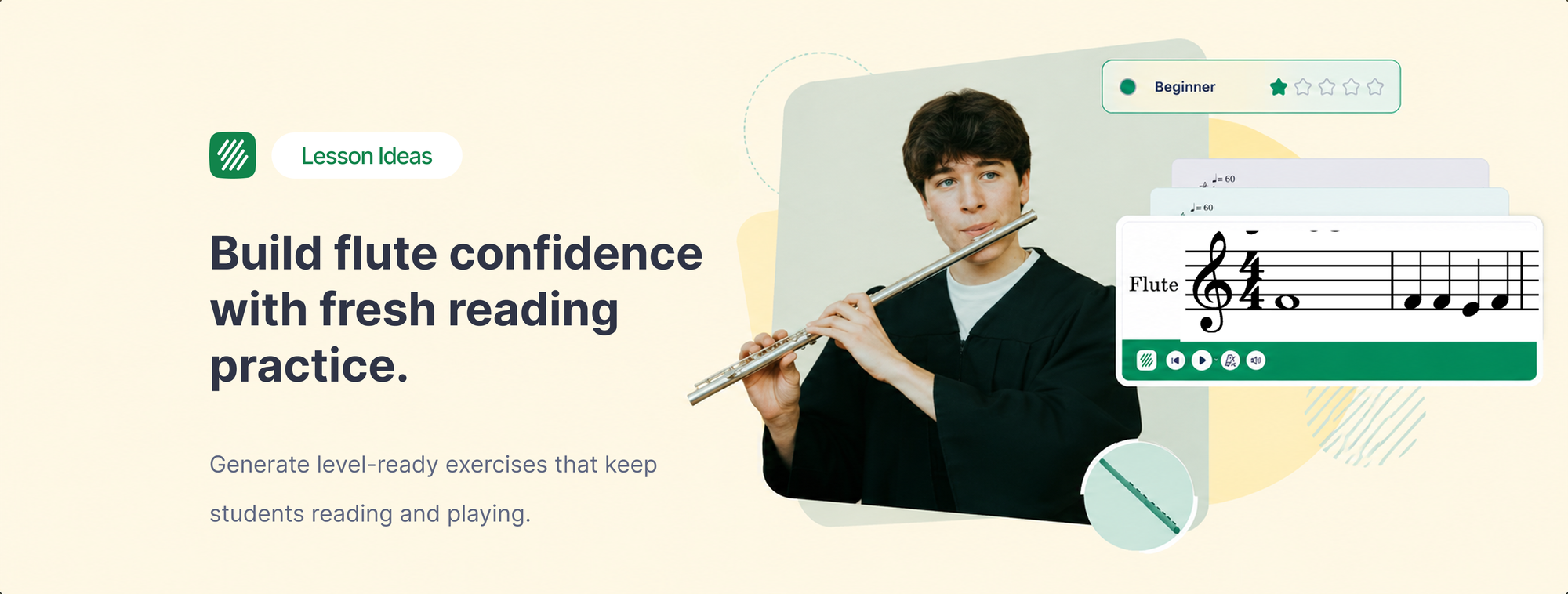
Flute players can have a curious sight-reading problem. Their instrument is intuitive in the middle register, and most beginners get there fairly quickly. But the moment an exercise crosses into the third octave, or drops into the lower register where the tone changes, reading fluency drops. The notes aren't harder to read on the page. The physical response to crossing the break is what interrupts the flow.
The practical consequence for flute teachers: sight reading exercises need to account for register, not just difficulty. An exercise that looks like a Level 2 in terms of rhythmic complexity might function like a Level 4 for a student whose high D is unreliable. The Flat for Education sight reading generator lets you use difficulty levels to control this exposure thoughtfully.

What register actually means for flute sight reading
The flute's first octave sits below the treble staff. Most beginners learn to read those notes early and can sight-read them fairly fluently within a few months. The second octave, from middle C to C above the staff, is where most intermediate flute students live. The third octave, anything above the staff, requires a different embouchure and more air support, and is where sight-reading typically breaks down.
When you're using the generator, use lower difficulty levels specifically to work in the second octave range where students are secure. Use higher difficulty levels to introduce third octave reading deliberately, when students are warmed up and focused, not as the opening exercise on a cold Monday.
Interval skips: the flute-specific sight reading challenge
Large interval skips are technically demanding on flute because the embouchure adjustment between registers is larger than on most other woodwinds. A skip of an octave or a tenth requires not just reading the correct note, but making a rapid physical adjustment that beginners haven't yet automated.
Use the generator to produce exercises at a difficulty level that includes some skips but stays within a manageable range. Then ask students to scan the exercise before playing and circle every interval larger than a fifth. This isn't cheating. It's the preparation that experienced flautists do automatically. Teaching the scan explicitly produces students who do it habitually, which is the actual goal.
The long tone sight-reading connection
Here's one that band directors don't always connect explicitly: students with inconsistent tone quality sight-read worse than students with consistent tone quality at the same technical level. The reason is cognitive load. A student who has to think about producing the note has less mental bandwidth to read the next one. A student whose tone production is automatic can redirect that attention to reading ahead.
Try this: run a two-minute-long tone warm-up before the sight-reading exercise, specifically targeting the register where today's exercise sits. If you're working in the upper register, long tones from A above the staff down. If you're in the middle register, long tones from middle C up to G. Then go straight to the sight reading. Students who are warmed up in the right register read more fluently.
Sight-reading duets for flute section
Generate two exercises at slightly different difficulty levels and have two students read simultaneously, one on each part. This is not ensemble sight reading in the traditional sense. The two lines don't have to fit together harmonically. The point is that each student is reading independently while hearing another flautist next to them.
The social dynamic helps. Students who would stop and correct themselves when reading alone often push through when someone is reading alongside them. Stopping feels more disruptive. The momentum of the other player carries them forward. It's a useful habit-training context.
Assign home practice exercises as performance submissions
Generate a sight reading exercise at a level slightly below where students are currently working. Assign it through Flat for Education as a performance assignment via Google Classroom, Microsoft Teams, Canvas, Schoology, or MusicFirst. Students record themselves reading it at home and submit the audio alongside the score.
You get two useful things from this. First, genuine sight-reading evidence: students who haven't seen the exercise before produce a real first read. Second, home practice confirmation. A student who played the exercise five times before recording sounds noticeably different from a student reading it cold. You can hear the fluency or the hesitation in the recording. The exercise goes into the gradebook like any other assignment.
Using dynamics as a sight-reading focus
Most students, when sight-reading, ignore dynamics entirely. They're managing pitch and rhythm and there's nothing left for expression. This is normal, but it's worth addressing periodically because ignoring dynamics becomes a habit that carries into performance.
Pick a generated exercise that's well within the student's technical comfort zone, slightly easier than their current working level. Ask them to read it with attention only to the dynamics: play the fortes, follow the hairpins, land the piano markings. Pitch and rhythm are secondary for this one exercise.
What happens is interesting. Students who are freed from the pressure of getting every note right often produce more musical sight-reading. And reading dynamics requires seeing further ahead in the score, which is exactly the reading habit you want to build.

Flat for Education's sight reading generator creates fresh flute exercises at any difficulty level, instantly. Assign them as class warm-ups, section exercises, or recorded performance submissions through Google Classroom, Microsoft Teams, Canvas, Schoology, and MusicFirst. Start your free 30-day trial at flat.io/edu.
FAQ
What makes flute sight-reading hard for students?
The main challenges are register breaks, where crossing into the upper or lower octave requires an embouchure adjustment students have not yet automated, and large interval skips that demand a quick physical response. Rhythmic complexity is usually secondary. Exercises that work within a student's secure register first, then gradually introduce upper-register material, produce better development than exercises that ignore the physical reality of the instrument.
How do I use sight reading in a flute section warm-up?
Generate an exercise at a level appropriate for your weakest readers, not your strongest, so the whole section can get through it without stopping. Success builds the habit of reading forward rather than stopping to fix mistakes. Use a harder exercise later in the rehearsal when students are warm and focused.
Should sight-reading exercises for flute include third octave notes?
Yes, but deliberately rather than accidentally. Higher difficulty settings introduce upper-register notes, so use them when students are specifically working on upper-register fluency, not as the default for all sight reading. For most beginners and intermediate students, the second octave is where fluency development should focus.