Your school probably has Prop 28 money it hasn't spent. You may not know who controls it, what it's allowed to buy, or how to ask for a piece of it. Most music teachers don't, and that's not a failure on your part: the money arrives at the district, gets split by school, and lands in a spending plan your principal writes. Nobody sends the music room a memo.
This guide covers how to use Prop 28 funds for music technology: what qualifies, how much of the money can go to software and materials, when it has to be spent, and exactly what to send your principal or arts coordinator. If you only read one section, read the request template near the end.
What is Prop 28?
Proposition 28, the Arts and Music in Schools (AMS) Funding Guarantee and Accountability Act, is a 2022 California law that gives every public TK–12 school and charter school dedicated money for arts and music education every year. For 2026–27 the total is about $1.06 billion statewide, shared out by enrollment, with extra weight for schools serving economically disadvantaged students. The money must add to what your school already spends on the arts. It can't replace existing funding.
Two details matter for you. First, there's no application. The money is already allocated to your school. Second, each school site gets its own share and its own expenditure plan, written by the principal. That plan is where your request needs to land.
Can Prop 28 funds pay for music software?
Yes. The law defines an arts education program as including instruction and training, supplies, materials and arts educational partnership programs, and it names music composition and ensembles among the disciplines it covers. A notation, composition and assessment platform your students use every week fits squarely under supplies and materials. From January 1, 2027, a new state law (AB 2440) also adds curriculum, instructional materials and professional development to the definition, which makes the case even clearer.
What Prop 28 won't do is pay for something unrelated to arts instruction, or replace a purchase your school already funds from its general budget. If your district bought your current software out of the general fund last year, moving that same line item to Prop 28 is the kind of backfilling the law forbids. A new tool, an expansion to more classes, or a program you couldn't afford before is a different story.
How much Prop 28 money can go to software and materials?
This is the part most people get wrong. In districts with 500 or more students, at least 80% of the Prop 28 money spent each year must pay for arts staff: certificated or classified employees who teach arts. Up to 20% can go to everything else, including training, supplies, materials and partnerships. Software lives in that 20% share.
So the realistic pitch isn't "spend the arts budget on software." It's "use part of the materials share on something every student in the music program uses." For most schools that share is plenty: a site license for a music class costs a small fraction of a single staff position.
Districts with fewer than 500 students don't have to follow the 80% rule, so they can put more of their allocation toward materials and technology. Every district also has to keep administrative costs to 1% or less of what it receives.
For the full breakdown, see Prop 28 allowable expenses: what the 80/20 rule means for music programs.
When do Prop 28 funds have to be spent?
Each year's allocation can be spent over three school years. Whatever is left after that goes back to the state and is shared out again. In practice:
- The 2024–25 allocation must be spent by June 30, 2027.
- The 2025–26 allocation must be spent by June 30, 2028.
- The 2026–27 allocation must be spent by June 30, 2029.
That first date is the one to mention in your request. A principal sitting on 2024–25 money has a real reason to commit it this school year. More detail on reporting and what happens to unspent money is in Prop 28 deadlines: when your funds expire.
How to ask for Prop 28 funds for music technology
Teachers don't apply for Prop 28. You ask the person who writes your school's plan, and you make it easy for them to say yes.
- Find out who writes your school's plan. It's usually the principal. In larger districts, the visual and performing arts (VAPA) coordinator often shapes the plans for every school. Ask whether your school still has 2024–25 Prop 28 money to spend, and when the plan for next year gets written.
- Pick what you're asking for, and why. Name the tool, the number of students and classes, and the problem it solves. "Sixty students in two composition classes who currently can't hear what they write" beats "music technology."
- Get a written quote. Principals can't add a line to a plan without a number. Ask the vendor for a quote addressed to your school.
- Connect it to standards and to growth. Mention the California Arts Standards your lessons address, and whether the tool adds something new, like composition for every student or recorded performance assessments. New is what Prop 28 is for.
- Send a short written request. Use the template below. Short beats thorough here: your principal is reading forty of these.
A Prop 28 request you can copy
Adjust the details in braces and attach the quote.
Subject: Prop 28 request: music software for {school}
Hi {name},
I'd like to use part of our Prop 28 arts and music funds for Flat for Education, the music notation and assignment platform I use with my classes.
It would let {number} students write, play back and share music on our school devices, and lets me assign and grade composition, theory and performance work in {Google Classroom / Canvas / Schoology}.
It fits Prop 28 as supplies and materials for music education, adding to what we already spend on the arts. The quote is attached: {amount} for one year.
Could we add it to our spending plan? Our 2024–25 allocation has to be spent by June 30, 2027.
Thank you,
{your name}
Need a version for a district coordinator, or justification language for the plan itself? We've collected several in Prop 28 request templates for music teachers.
What to look for in music technology bought with Prop 28
Prop 28 money is reported publicly. Each school's plan and an annual report get posted, so whatever you buy should be easy to justify a year later. A few practical filters:
- Every student uses it, not just the strongest ones. A tool that only your advanced composers touch is a harder sell than one the whole general music class uses weekly.
- It runs on what you have. If it needs new hardware or installs IT has to approve, the purchase stalls. Browser-based tools that run on Chromebooks avoid that.
- It shows its work. Assignments, grades and recorded performances give you evidence for the annual report, and for your own program review.
- It fits your LMS. If grades don't flow back to Google Classroom, Canvas or Schoology, you'll stop using it by October.
How Flat for Education fits a Prop 28 plan
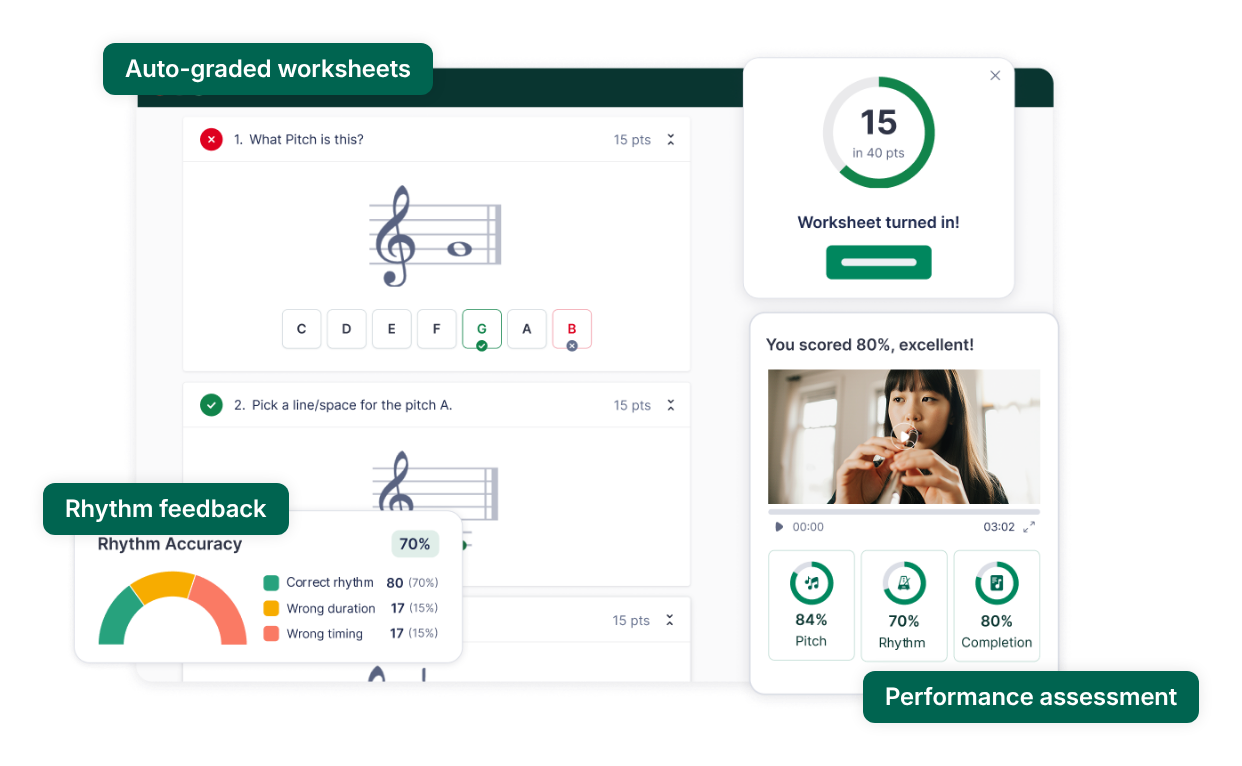
Flat for Education is a browser-based music notation and assignment platform built for schools. Students compose and hear their work instantly on Chromebooks, laptops or tablets, with nothing to install. You can import a PDF and turn it into an editable score, assign composition and performance work, and use auto-graded theory and ear training worksheets, a sight-reading generator, a tuner and a metronome in the same place. It integrates with Google Classroom, Microsoft Teams, Canvas, Schoology and ClassLink, plus other LMSs through LTI 1.3.
For a Prop 28 plan, that means one line item covering composition, theory, practice and assessment for the whole program. If you're new to it, here's how to set up a music class in 30 minutes.
Prop 28 for California music programs, in short
The money exists, it's already assigned to your school, and the oldest allocation expires on June 30, 2027. The teachers who get a share are the ones who walk in with a specific request, a quote and a reason it helps every student. Get a Flat for Education quote for your Prop 28 request, or start a free 30-day trial and try it with one class first.

This guide reflects California Department of Education guidance and AB 2440 (Chapter 606, Statutes of 2026) as of November 2026. Rules can change, so confirm details with your district's arts coordinator or business office. Sources: CDE Prop 28 FAQ, CDE 2026–27 funding profile.
FAQ
Can Prop 28 funds be used for music software?
Yes. Prop 28 can pay for supplies, materials and training that support arts education, and music composition is named as an arts discipline. From January 1, 2027, AB 2440 also adds instructional materials and curriculum to the definition. The school or district decides in its own spending plan.
How much of Prop 28 can be spent on technology?
In districts with 500 or more students, at least 80% of Prop 28 spending must pay arts staff, so up to 20% can go to supplies, materials, training and partnerships, which is where software belongs. Districts with fewer than 500 students are not bound by the 80% rule.
Do teachers apply for Prop 28 funds?
No. Prop 28 money is allocated to every public TK-12 school and charter school automatically. Teachers ask their principal or district arts coordinator to include a purchase in the school's Prop 28 expenditure plan.
When do Prop 28 funds expire?
Each allocation can be spent over three school years. The 2024-25 allocation must be spent by June 30, 2027, and unspent money goes back to the state to be redistributed.
Is there an approved vendor list for Prop 28?
No. California does not publish an approved vendor list for Prop 28. Schools choose what to buy and document it in their expenditure plan and annual report.