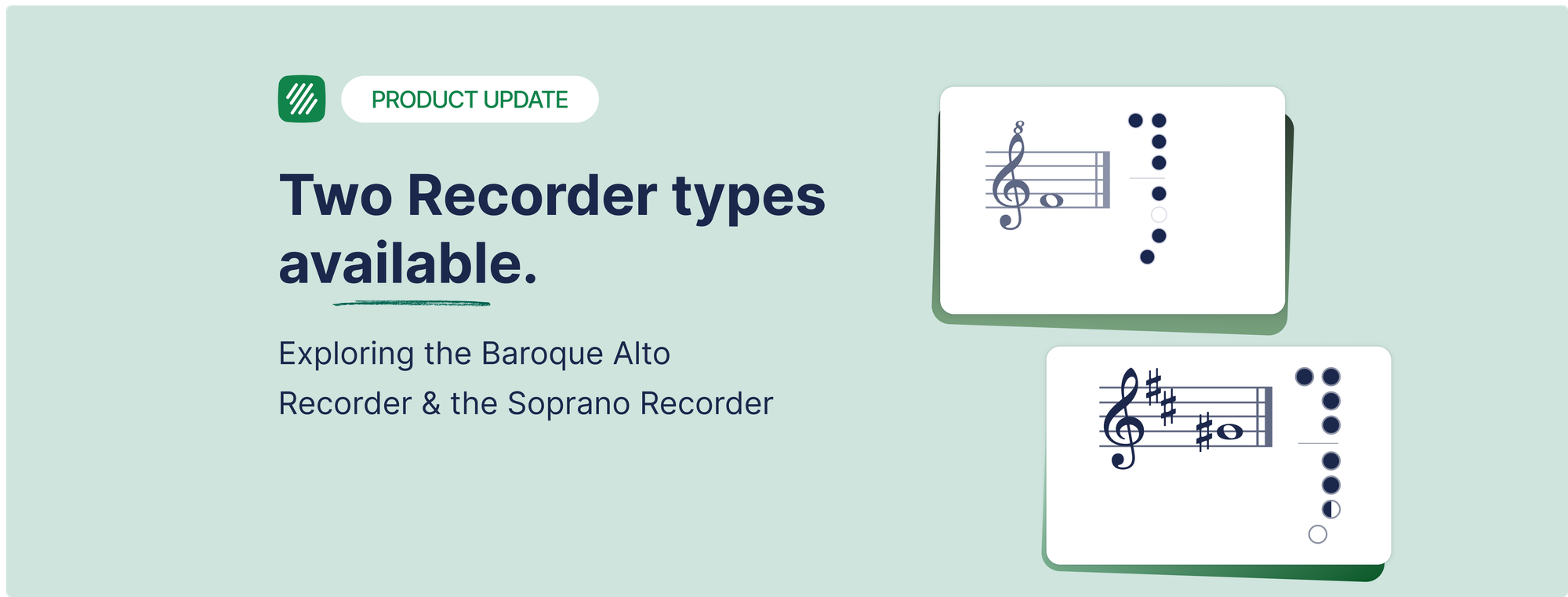
If you've opened Flat for Education's new fingering worksheet tool and seen two options in the instrument dropdown, Soprano Recorder (Baroque) and Alto Recorder (Baroque), and wondered which one to pick: this post explains exactly what the difference is, why it matters, and which one your students almost certainly need.

The short answer for most elementary and general music teachers: Soprano Recorder (Baroque). That's the standard classroom recorder in the US, UK, and most other markets. But the distinction is worth understanding properly, because choosing the wrong one produces exercises with the wrong fingerings for the instruments your students are actually holding.

What is a recorder fingering worksheet in Flat for Education?

The fingering worksheet in Flat for Education is an auto-graded assignment. Students are shown a note on the staff and asked to identify the correct fingering. They complete the worksheet digitally, submit, and get immediate feedback on which answers were correct.

The grade goes back to your LMS gradebook automatically. Google Classroom, Microsoft Teams, Canvas, Schoology, and MusicFirst all supported. You don't grade it manually. You see the results.
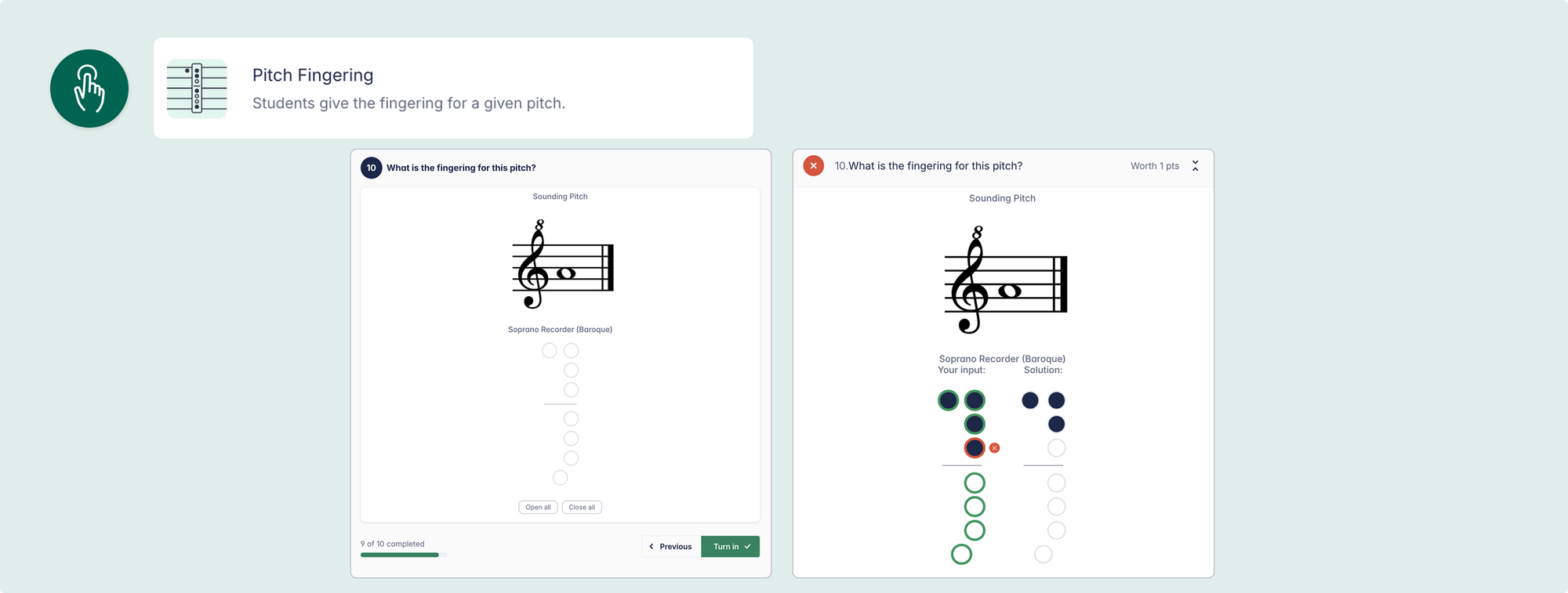
Soprano Recorder (Baroque): what it is and who needs it

The soprano recorder is pitched in C. It's the smallest and highest of the common recorder sizes, and it's the instrument used in the vast majority of elementary school music programs worldwide. When a teacher says "recorder unit," they almost always mean soprano recorder.

The Baroque fingering system (also called English fingering) is one of two fingering systems available on soprano recorders. The other is the German system. On most notes, the two systems produce identical fingerings. The difference shows up on F and a few other notes, where the Baroque and German fingerings diverge.

Baroque fingering is the professional standard and the system used in most published method books, including Essential Elements Recorder and Recorder Karate. If your students are using instruments bought from a reputable music supplier for classroom use, they almost certainly have Baroque-system recorders. The fingering diagram on the box will confirm this.

If you're not sure: check the F fingering. On a Baroque recorder, F uses a forked fingering (holes 1, 2, 4 covered; hole 3 open). On a German recorder, F is a straight fingering (holes 1, 2, 3, 4 all covered). The Flat for Education worksheet uses Baroque fingerings. If your students have Baroque recorders, the exercises match. If they have German recorders, the F exercises will not match.

For most classroom teachers: choose Soprano Recorder (Baroque).

Alto Recorder (Baroque): what it is and who needs it

The alto recorder is pitched in F, which makes it a transposing instrument. A student reading a C on the treble staff and playing it on an alto recorder produces an F in concert pitch, a fifth lower than written. This is different from the soprano, which is a concert pitch instrument: written C sounds as C.

Alto recorders are larger than sopranos, require a bigger hand span, and produce a warmer, lower sound. They're used in recorder consort programs, in secondary school music, and by students who have progressed beyond the soprano. They're significantly less common in elementary classroom programs than the soprano.

The alto recorder also uses Baroque fingering, and the fingering patterns are similar to the soprano, but the instrument is larger and the transposition means students need to understand the relationship between written pitch and sounding pitch. This is a more advanced context than the typical elementary recorder unit.

Choose Alto Recorder (Baroque) if your students are playing alto recorders specifically. Don't use it for soprano students, even if the instrument looks similar. The exercises will have the correct fingering patterns for the alto, which differ in range and context from the soprano.

Why Baroque and not German?

Flat for Education supports the Baroque fingering system for both recorder types. German system recorders are not currently supported.

This is the right choice for most classroom contexts. Baroque fingering is the international standard, used in professional performance, in music education programs, and in the majority of published method books. German fingering was developed to make the F fingering easier for beginners, but the trade-off is compromised intonation on several notes. Most music educators and instrument manufacturers have moved away from German-system instruments as a result.

If your students have German-system recorders, the F fingering exercises in the worksheet will not match their instrument. Check the instrument packaging before assigning. If you're unsure which system your school's recorders use, the forked F test above is the quickest way to find out.

How to use the fingering worksheet in practice

A few practical uses that work well in elementary and general music programs:

After introducing a new note. Teach the fingering for B-flat in class. Assign a fingering worksheet that includes B-flat before the next lesson. Students confirm the fingering independently, get immediate feedback, and arrive at the next class with the note more securely in their hands. The worksheet result also tells you who needs a reminder at the start of class.

Before a performance or assessment. In the week before a recorder performance, assign a review worksheet covering all the notes in the piece. Students work through it at home. You see who is confident and who isn't before they stand up to play, which gives you a chance to offer targeted support rather than discovering gaps during the performance.

As independent practice during class. In a class where students are at different stages, a fingering worksheet gives students who have already learned the current note something musically relevant to do while you work with students who haven't. The auto-grading means you're not creating extra marking for yourself.

As printed revision. The worksheet is also available as a print-ready PDF. For students who prefer paper, or for homework in settings where devices aren't available at home, print the worksheet and collect it manually. Note that printed versions are not auto-graded.

Frequently asked questions

Which recorder option should I choose for elementary students?

Almost certainly Soprano Recorder (Baroque). This is the standard classroom recorder for elementary programs in the US, UK, Australia, and most other markets. It's pitched in C, it's the smallest and most common recorder size, and Baroque fingering is the system used in the vast majority of classroom method books. If your students are using instruments from a school supplier, they will almost certainly have Baroque-system soprano recorders.

How do I know if my students have Baroque or German recorders?

The easiest test is the F fingering. Play (or ask a student to demonstrate) the note F just below middle C. On a Baroque recorder, F uses a forked fingering: hole 1 covered, hole 2 covered, hole 3 open, hole 4 covered. On a German recorder, F uses a straight fingering: holes 1, 2, 3, and 4 all covered. The instrument packaging will also specify Baroque or German. Most instruments sold for classroom use by major suppliers are Baroque system.

What is the difference between soprano and alto recorder?

The soprano recorder is pitched in C: written C sounds as C. It's the smaller, higher-pitched instrument used in most elementary programs. The alto recorder is pitched in F: written C sounds as F (a fifth lower than written), making it a transposing instrument. The alto is larger, has a warmer lower sound, and is typically used by more advanced students or in recorder consort settings. The fingering patterns are similar between the two instruments but not identical, and the transposition on the alto requires understanding the relationship between written and sounding pitch.

Are the fingering worksheets auto-graded?

Yes, when completed digitally inside Flat for Education. Students submit the worksheet and get immediate feedback on each answer. Results sync to your LMS gradebook automatically, whether you're using Google Classroom, Microsoft Teams, Canvas, Schoology, or MusicFirst. Printed versions of the worksheet are not auto-graded and require manual collection and marking.

Will more instruments be added to the fingering worksheets?

The current version supports Soprano Recorder (Baroque) and Alto Recorder (Baroque). More instruments are planned for future updates. If you have a specific instrument you'd like to see added, the team welcomes feedback at edu@flat.io.


Flat for Education's fingering worksheets are available on the Teacher Plan and School or District Plan. If you're already a Flat for Education user, you can access the worksheets by opting in to the new tools now, with your current pricing unchanged until your next renewal. New to Flat for Education? Start a free 30-day trial at flat.io/edu.