Sight reading is one of the most consistently under-practiced skills in school music programs. Not because teachers don't know it matters. Because preparing a usable sight-reading exercise takes time that most teachers don't have spare.
Finding appropriate repertoire means checking the difficulty, the clef, the range, and the key against what the class is currently working on. Formatting it for distribution means printing, scanning, or building an assignment around an existing score. For a teacher with three sections at different levels, that's three separate exercises, three times the prep work.
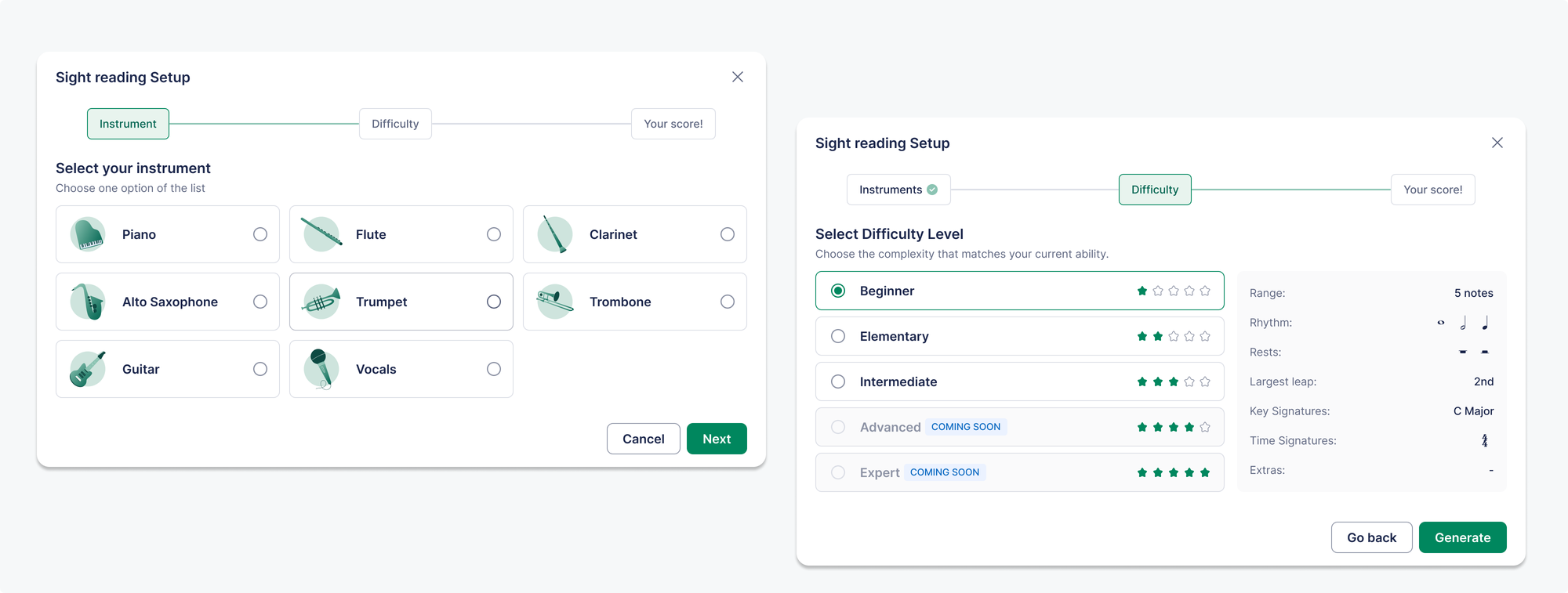
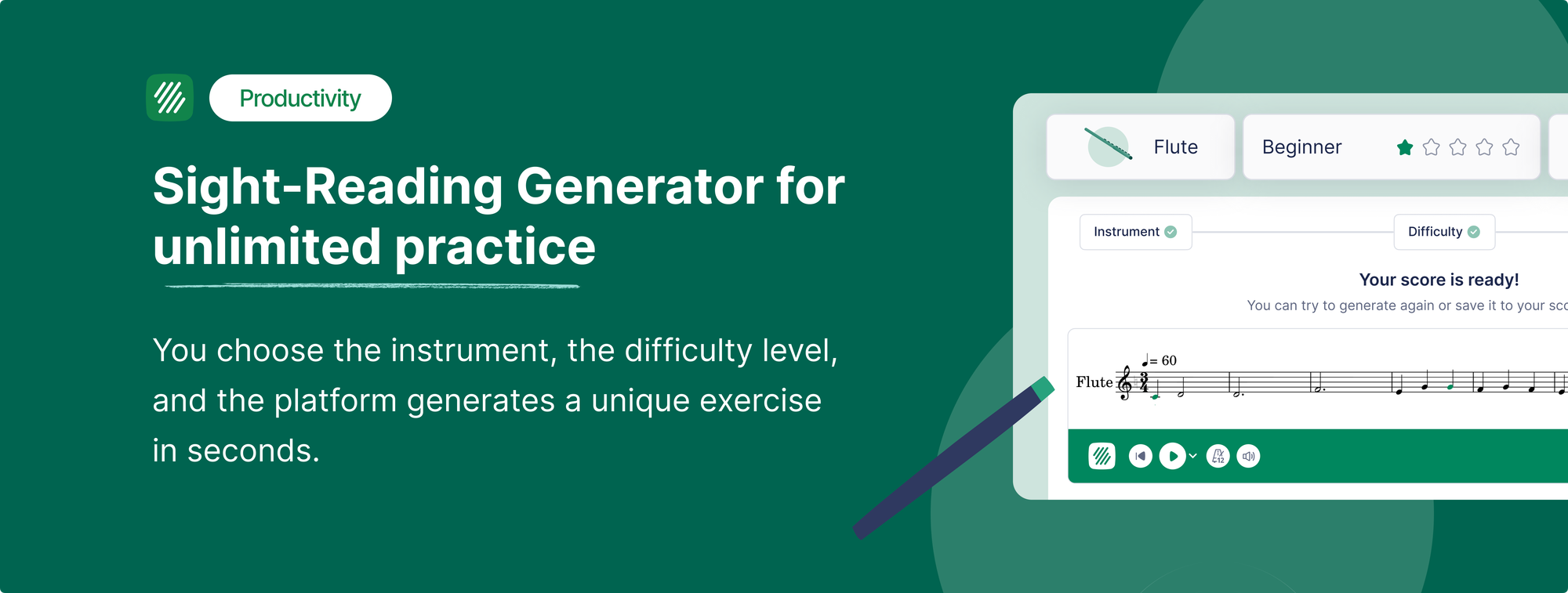
Flat for Education now includes a sight-reading generator built directly into the platform. You choose the instrument, the difficulty level, and the platform generates a unique exercise in seconds. You assign it, print it, or use it in class immediately.
What is sight reading in music?
Sight reading is the ability to perform a piece of music on first encounter, without prior practice or preparation. The performer reads from the notated score and plays or sings in real time, interpreting pitch, rhythm, dynamics, and articulation simultaneously. It is a distinct skill from performance accuracy or musicianship more broadly: a student can be highly competent on their instrument but weak at sight reading if they have rarely practiced it.
For most school music students, sight reading is practiced infrequently because preparing appropriate exercises is labour-intensive. The sight-reading generator addresses this specific bottleneck: it removes the preparation step entirely.
How the generator works
The generator creates a notated musical excerpt based on parameters you choose. The settings include:
- Instrument. The exercise is written for the range and reading context of the student's instrument.
- Difficulty level. Controls rhythmic complexity, interval size, chromaticism, and other factors that affect how challenging the exercise is.

The generated exercise is a standard music score. Students read it the same way they would read any notated piece. There's nothing unfamiliar about the format.
Each generated exercise is unique. Running the generator twice with the same settings produces two different excerpts, which matters for assignment contexts where you want each student working from a different score.
Using it for warm-ups
The most immediate use for most teachers is class warm-ups. Before rehearsal or at the start of a theory lesson, a sight-reading exercise does several things at once: it settles the class, it activates reading skills, and it gives you a quick read on where students are before you start the planned lesson.
Generating a warm-up exercise on the day of class takes about thirty seconds. It's available immediately without any pre-planning. For teachers who currently use the same few pieces on rotation for warm-ups, or who skip sight-reading entirely because the prep isn't worth the time, this changes the calculation.
The exercise can be displayed for the class to read together or used individually on student devices. Both approaches work within Flat for Education without additional setup.
Assigning sight reading as homework
The generator also works as an assignment tool. You create an exercise through Flat for Education's performance assignment tool and assign it through Google Classroom, Microsoft Teams, Canvas, or Schoology. Students record their performance directly in Flat for Education using their device microphone, and submit the recording alongside the score.
This is the workflow that makes regular sight-reading practice possible at scale. A teacher who assigns one sight-reading exercise per week to three sections of thirty students each is running ninety individual performance submissions per week. With Flat for Education's performance assignment workflow, those ninety submissions arrive organised by class and student name, with audio attached to the score. The teacher reviews each recording in the same dashboard as every other assignment.
Using it for in-class assessment
Sight reading assessment that requires calling students up one at a time to play for the class is one of the most logistically painful assessment activities in music education. It consumes class time, creates performance anxiety, and limits how often teachers can actually assess it.
Assigning sight reading as a recorded submission changes the logistics. Students complete the exercise at home, during a practice session, or on a device at school. The recording arrives with the score. The teacher hears exactly what the student did and gives specific feedback. Full-class sight-reading assessment becomes something that happens regularly rather than once a semester.
For a full guide to running performance assessments at scale, see how to run individual music performance assessments for a full class.
This tool and the new plans
The sight-reading generator is included in the Teacher Plan and School or District Plan. It's not available on legacy plans.
Teacher Plan: $99 per teacher per year plus $6 per student. Supports up to two teachers, fully self-serve.
School or District Plan: starting at $599 per year. Includes Canvas, Schoology, shared assignment libraries, and training.
If you're on an existing plan, you can access the sight-reading generator immediately by opting in. Your current pricing stays in place until your next renewal. No payment is required today.
Frequently asked questions
Can I control what key the sight-reading exercise is in?
The first version has pre-set difficulty levels, but as we iterate, it will be possible to customize these even futher.
Does the sight-reading generator work for all instruments?
The sight-reading generator currently works for: piano, Flute, Clarinet, Alto Saxophone, Trumpet, Trombone, Guitar and Vocals. More instruments will come soon.
Can I use the same exercise for multiple students?
Yes. One generated exercise can be assigned to the entire class. If you want each student to have a unique exercise, you can generate multiple versions using the same settings. Each generation produces a different excerpt.
Is the sight-reading generator available on the free trial?
Yes. The free 30-day trial includes the full Teacher Plan experience, which includes the sight-reading generator. No credit card required.
How is this different from Sight Reading Factory?
Sight Reading Factory is a standalone sight-reading tool at $45 per teacher per year plus $3 per student. The Flat for Education sight-reading generator is included as part of the Teacher Plan ($99 per teacher plus $6 per student), alongside notation, assignments, performance assessment, auto-graded theory worksheets, metronome, tuner, and the rest of the platform. If you're already paying for Flat for Education for notation and assignments, the sight-reading generator is part of the same plan rather than a separate cost.

Start a free 30-day trial at flat.io/edu and use the sight-reading generator from day one!
Other articles you might find useful: