At the end of a semester, teachers often ask themselves what really worked. One general music teacher in Shizuoka Prefecture, Japan, decided to ask the people who had experienced the lessons firsthand: his students.
Between October 13 and 15, 2026, 137 sixth graders across five classes reflected on their first semester of music. They were asked which of the classroom tools they had used were helpful, and they could select as many as they wanted.
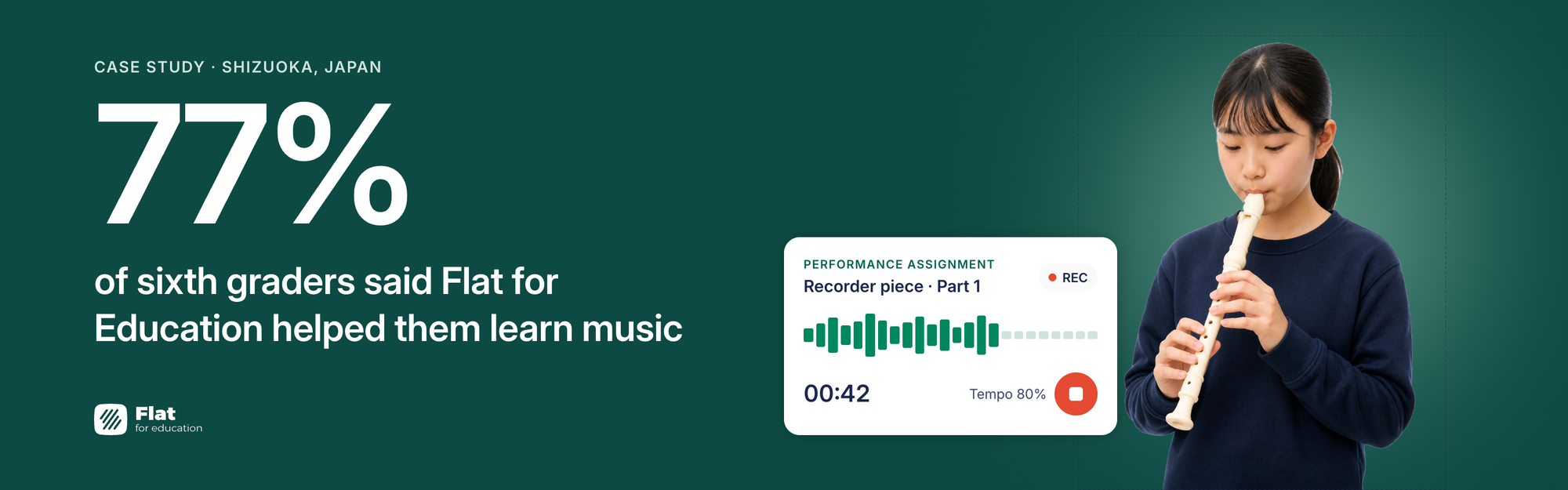
106 students, 77% of the group, selected Flat for Education.
Flat for Education was one option among several. Students weren't asked to rate it specifically, and the most revealing evidence came from their own explanations of when and how the tools had helped them.
At a glance
- Location: Shizuoka Prefecture, Japan
- Students: 137 sixth graders across five classes
- School level: final year of elementary school in Japan
- Period: April to September 2026
- Activities: recorder, singing, score reading and composition
- Result: 106 of 137 students selected Flat for Education as a helpful classroom tool
One score, several ways to learn
Students used Chromebooks and tablets in their music lessons, and recorder playing and singing were an important part of the semester.
The teacher created scores in Flat for Education, and students opened those scores on their own devices. The same musical material could also be used with separate apps for recorder fingering and singing practice. Students used Flat for Education directly to follow scores, practice with playback and write songs of their own.
So the score wasn't just something to read. It could be a model to hear, an accompaniment to practice with and a space where students could create and revise music.
What did students find most helpful?
Flat for Education was the most frequently selected tool in the survey. 106 students (77%) chose it, compared with 72 students (53%) for the next most frequently chosen tool. Only four students said none of the tools had been particularly helpful.
The follow-up question asked students when their chosen tools had helped them. Of the 106 students who selected Flat for Education, 57 referred to it clearly enough in their written answer for their reasons to be categorized.
Some students described more than one benefit, so the numbers below are mentions and may overlap.
| How students said Flat for Education helped | Mentions |
|---|---|
| Practicing with score playback | 27 |
| Creating songs and scores | 18 |
| Viewing and reading scores | 18 |
| Using it at home or during breaks | 3 |
Four additional answers expressed a general or unclear benefit and weren't counted as a separate theme.
Students could hear, slow down and practice the music
Practicing with playback was the most common theme.
Students described listening to the score, changing its tempo and using the accompaniment to practice on their own. This was especially useful for recorder, when students needed to work out an unfamiliar rhythm or connect written notes with the pitches they heard.
"I can look at it at home too, and I can change the speed, so practicing was easier."
"It helped when I practiced playing at the real tempo."
"With [Flat for Education], it's easy to tell whether a note is high or low."
"When I actually play, at first I don't know the intervals or the rhythm, but [Flat for Education] teaches me the intervals and rhythm."
For one student, playback meant practicing without waiting for someone else to accompany them:
"I could practice on my own along with the accompaniment on the Chromebook."
Another described moving between two complementary tools: first learning recorder fingerings in a dedicated practice app, then using the complete score in Flat for Education.
"Once I could play well enough with [the fingering practice app], using [Flat for Education] made me able to play really well."
What matters here is what playback let students do for themselves: slow the music down, check what they were hearing and build toward the real tempo.
Students could compose and immediately hear their ideas
Eighteen students mentioned creating songs or writing scores.
What stood out was the short distance between having an idea, writing it down and hearing the result. Playback gave students immediate feedback they could use to revise their work.
"I could listen to my score as soon as I finished it and fix it right away. That was great."
"I can type in a melody that pops into my head. Sharps and flats are easy to use, too."
"It was fun because I could make my own songs."
One student said they could create scores "even of songs I like." That's a step beyond completing a required exercise: the student was using notation to explore music that mattered to them personally.
We've written before about how instant playback helps older students connect music theory with what they hear and how teachers can support songwriting with Flat for Education. These sixth graders are starting to make the same connection between notation, sound and revision.
Digital scores made music easier to read
Another 18 students described how Flat for Education helped them view or read music.
Some benefits were very practical. Digital scores didn't flap around or get lost, and students could resize the music on their screen.
"Paper sheet music flaps around and is hard to see when I play, but on the tablet I could look at the score properly while playing."
"I can make the score bigger or smaller, and I can see it all the way to the end without it moving."
"As sheet music, it's better than paper because I can't lose it."
For some students, though, the difference went beyond convenience.
"Thanks to [Flat for Education], I can now mostly read sheet music, which I couldn't read before."
"With the score, even if I couldn't play very well at first, I was able to play it by the end."
For some students, learning continued beyond the lesson
Only three students explicitly mentioned using Flat for Education at home, during breaks or in self-study time. It was a small group, but their comments show what becomes possible when classroom scores stay available on a student's device.
"I hardly knew anything about sheet music before using [Flat for Education], but during breaks and self-study time I learned a little about it."
Another student said they could keep practicing even without their music textbook.
What can elementary music teachers take from this?
This survey represents one school and was run by the classroom teacher. It isn't a controlled research study, and it doesn't measure learning outcomes. What it does provide is a direct account of the moments students themselves found helpful.
They didn't describe software features. They described what those features let them do: hear a passage before playing it, slow it down, practice with an accompaniment, compose and correct their own work.
The common thread is student independence. Flat for Education gave students ways to answer some of their own musical questions, like what a passage should sound like or whether their melody sounded the way they imagined.
It also gave the teacher a flexible base for the wider classroom workflow. A score created once could be opened on different devices and used in other practice tools.
About the survey
The classroom teacher ran the survey through Google Forms between October 13 and 15, 2026, with 137 sixth-grade students across five classes. Students answered two questions: "Which tools were helpful?" (multiple answers allowed) and "When did that tool help you?" (open text).
To analyze the written responses, the survey summary included 46 students who selected only Flat for Education and 11 who selected several tools but explicitly named Flat for Education in their answer. The remaining 49 students who selected Flat for Education alongside other tools didn't specify which tool they were describing, so their written answers weren't categorized.
Student responses were originally written in Japanese and translated into English by Tutteo Japan. Some longer responses were shortened. The school, teacher, classes and students are not identified to protect their privacy.
What would your students say?
With Flat for Education, students can listen to scores, slow them down, practice on their own and hear their compositions right away. Teachers can share musical materials with an entire class without printing another copy, and Flat for Education works with Google Classroom, Microsoft Teams, Canvas, Schoology and MusicFirst.
Start your free 30-day trial and ask your students at the end of the semester.