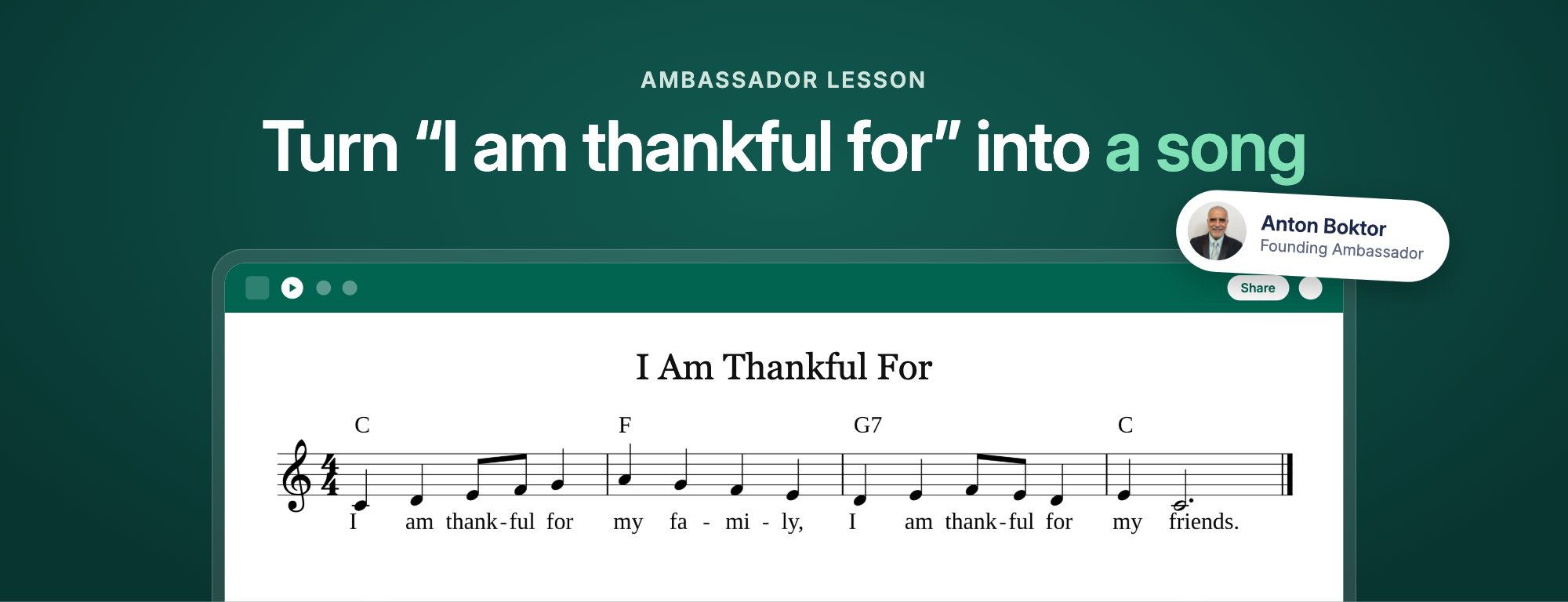
Clap this out loud: I am thankful for.
Quarter, quarter, two eighths, quarter. That's four beats. Congratulations, you just wrote measure one of a song.
That's exactly how Anton Boktor opened his Thanksgiving music lesson this year. Anton is a Flat for Education Founding Ambassador and has been Music Director at Thomas Starr King Middle School in Los Angeles since 1998. Every one of his piano students left the unit with an original song called "I Am Thankful For," complete with melody, chords, vocals and a music video. These are kids who started music three months ago.
Here's how the lesson works, step by step, plus a second Thanksgiving activity for younger classes that you can assign before the week is out.
Watch three of the finished songs
Before the how, the why. Press play.
"I ran their scores through AI tools to add vocals and full orchestration and sent the finished songs back to them. The pride on their faces was the best part of my week."
Anton Boktor, Flat for Education Founding Ambassador
What is the "I Am Thankful For" songwriting activity?
"I Am Thankful For" is a Thanksgiving music lesson where students turn three sentences about gratitude into a complete song. They write the words, give each syllable a rhythm, shape that rhythm into a melody in C major, then harmonize it with I, IV and V7 chords. It fits grades 5 to 8 and works for beginners, because every step builds on something the student already made.
Step 1: Write three sentences before any notes
Each sentence starts the same way: "I am thankful for…" What comes next is up to the student. My dog. My grandma's tamales. The fact that it's Friday.
This is the part kids think is the easy bit, and it secretly does the most work. A song about something real gets finished. A song about nothing in particular doesn't.
Step 2: Give the words a rhythm
Now students say their sentences out loud and listen for the beat. The opening line is already solved for them:
| Word | I | am | thank-ful | for |
|---|---|---|---|---|
| Rhythm | quarter | quarter | two eighths | quarter |
| Beats | 1 | 2 | 3 & | 4 |
The rest of each line is theirs to figure out. "My dog" might be two quarters. "Pumpkin pie" might be two eighths and a half note. Students enter the rhythm on a single pitch first, like a rap, and type the words under the notes with the lyrics tool. If a syllable lands in a weird spot, they hear it straight away on playback.
Step 3: Turn the rap into a melody
Same rhythm, new pitches. Anton kept the rules short: stay in C major, start on C, end on C, and move mostly by step. That's it.
"Plenty of them ignored that last one," he says about ending on C. Fair enough. It's their song.
The way students got the notes in was up to them. Some used the on-screen keyboard in Flat for Education, some plugged in a MIDI keyboard, and some just dragged notes around and hit play until it sounded right. All three are legitimate composing. The last one is how plenty of professional songwriters work too, for the record.
Step 4: Add I, IV and V7 chords
Last musical step: chords in the left hand. Students only need three, C, F and G7, and a simple rule for picking one. Look at the melody notes on the strong beats of each measure. If they belong to C-E-G, use C. If they fit F-A-C, use F. If they sit in G-B-D-F, use G7. When two chords work, let the ear decide.
If your students already know their primary chords, this goes fast. If they don't, this is where they learn them, and they'll remember them better than any chart. Our post on teaching I, IV and V chords through songwriting has Anton's full sequence if you want to build up to it.
The fun part: vocals, orchestra and a music video
Once the scores were done, Anton took them outside Flat for Education and ran them through AI tools to add sung vocals and full orchestration. Then he sent the finished tracks back to his students. Hearing your own melody sung back to you, with strings behind it, is a very different feeling from hearing it on a piano sound.
Students wrapped up by building music videos in Canva, with pictures that tell their own "thankful for" stories. That's the video above. It's optional, but if you have a spare class period before break, it's the part they'll talk about at the dinner table.
How to run this Thanksgiving music lesson in Flat for Education
Anton built a sister activity, O Halloween, O Halloween, that runs on the exact same three parts: rap it, melodize it, harmonize it. It already tells students they can swap in other words, so it's the fastest way to set this up.
- Open O Halloween, O Halloween and add it to your assignments. New to Flat for Education? The 30-day free trial gets you in.
- Change the opening line in the instructions to "I am thankful for," and replace the sample verses with a couple of your own.
- Keep the template score locked, so students build on your setup (4/4, C major) without breaking it.
- Assign it through your LMS. Flat for Education integrates with Google Classroom, Microsoft Teams, Canvas, Schoology, and MusicFirst.
- Comment while they compose. Catch the melody that ends on a B before it gets saved that way (or don't, see above).
- Play a few back to the whole class at the end. Ask who can guess what each song is thankful for.
Running short on time this week? Do steps 1 and 2 only. A rhythm with lyrics is already a finished piece, and you can come back for melody and chords after the break.
A Thanksgiving music activity for younger students
For a grade 5 class, or anyone not ready to write their own lyrics, there's a gentler option in the Public Assignments library inside Flat for Education: Compose your own Thanksgiving song!
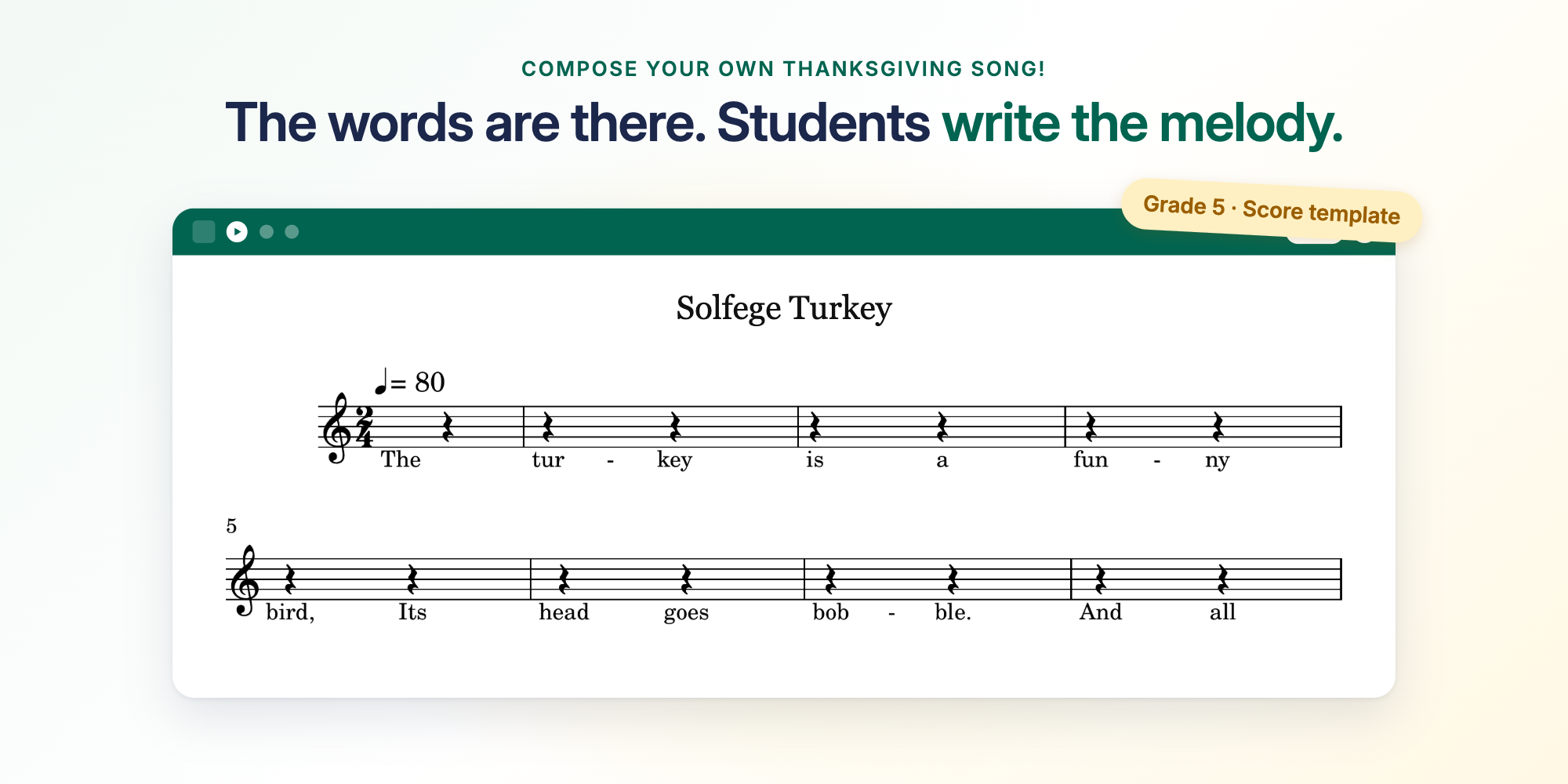
Here the words come first and they're already done. Students open a short score in 2/4, set for xylophone in C major, with the lyrics of a classic silly turkey rhyme already in place. Every syllable sits on a quarter rest, so the rhythm is decided for them. Their only job is to choose pitches that fit the mood of the words. The rhyme ends on a double "gobble," so expect some very dramatic final measures.
Here's how the two activities compare:
| Compose your own Thanksgiving song! | I Am Thankful For (via O Halloween template) | |
|---|---|---|
| Grades | 5 | 5 to 8 |
| Lyrics | Given (turkey rhyme) | Written by each student |
| Rhythm | Given (one quarter note per syllable) | Written by each student |
| Students write | The pitches | Rhythm, melody and I, IV, V7 chords |
| Where to find it | Public Assignments library | Anton's activity page |
They also chain nicely. Turkey song first to warm up, "I Am Thankful For" next once students have the hang of fitting notes to words.
Not everyone celebrates Thanksgiving. The lesson still works.
Gratitude isn't tied to a date on the calendar. "I am thankful for" works in a classroom where half the kids have never eaten turkey, and it works just as well in December, at the end of the year, or as a thank-you song for a retiring teacher. Anton's Halloween activity even includes autumn and harvest moon verses for students who'd rather skip the holiday.
For band or orchestra, have students write the melody for their own instrument and keep the chords in a keyboard part. It turns into a great first arranging project, and it's a lot more personal than another warm-up.
Try it before the break
Anton's students wrote real songs three months into learning music. Yours can too. Open Anton's activity, swap in "I am thankful for," and see what your class comes up with. Flat for Education offers a free 30-day trial, so you can run the whole lesson before you commit to anything.

Looking for more?
Browse the Flat for Education activity library, try the elementary songwriting lesson plan for 4th graders, or read why we started the Ambassador Program in the first place. The NAfME standards call this kind of work Creating: imagine, plan and make, evaluate and refine, present. Your students just call it their song.
FAQ
What is a good Thanksgiving music lesson for middle school?
A songwriting lesson works well: students write three sentences starting with "I am thankful for," give the words a rhythm, turn that rhythm into a melody in C major, then add C, F and G7 chords. Each step builds on the last, so even students in their first months of music can finish a complete song.
How do you turn words into rhythm in a music lesson?
Have students say each sentence out loud and assign one note value per syllable, such as a quarter note or two eighth notes. For example, "I am thankful for" becomes quarter, quarter, two eighths, quarter, which fills one measure of 4/4.
What Thanksgiving music activities work for elementary students?
Giving students lyrics with the rhythm already set lets them focus on choosing pitches. The "Compose your own Thanksgiving song!" activity in the Flat for Education Public Assignments library does this with a short turkey rhyme in 2/4 for grade 5.
Can students who don't celebrate Thanksgiving do this activity?
Yes. Gratitude songs aren't tied to the holiday, so students can write about anything they are thankful for, at any time of year. Teachers can also offer autumn or harvest themes instead.