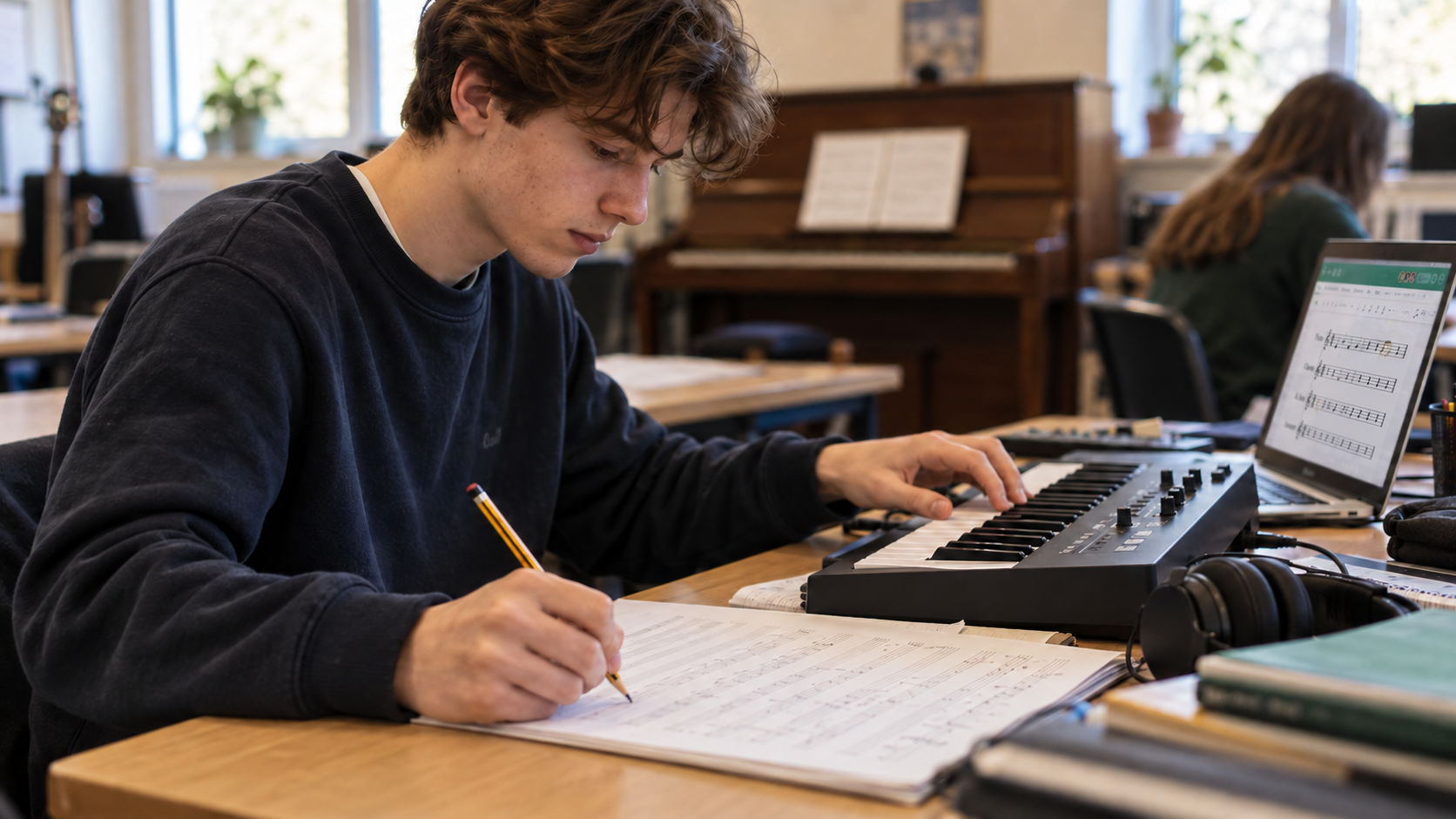
One pupil can play you a melody but struggles to put it on the stave. Another has written eight bars and keeps repeating them. A third is waiting for an idea worth starting.
They are all composing, but they need different next steps.
Useful GCSE/IGCSE music composition ideas give pupils something small enough to try and interesting enough to develop using Flat for Education. These four starters include specific material, support for less confident writers and extensions for A-level students. Use them as short teaching exercises before pupils tackle independent assessed work.
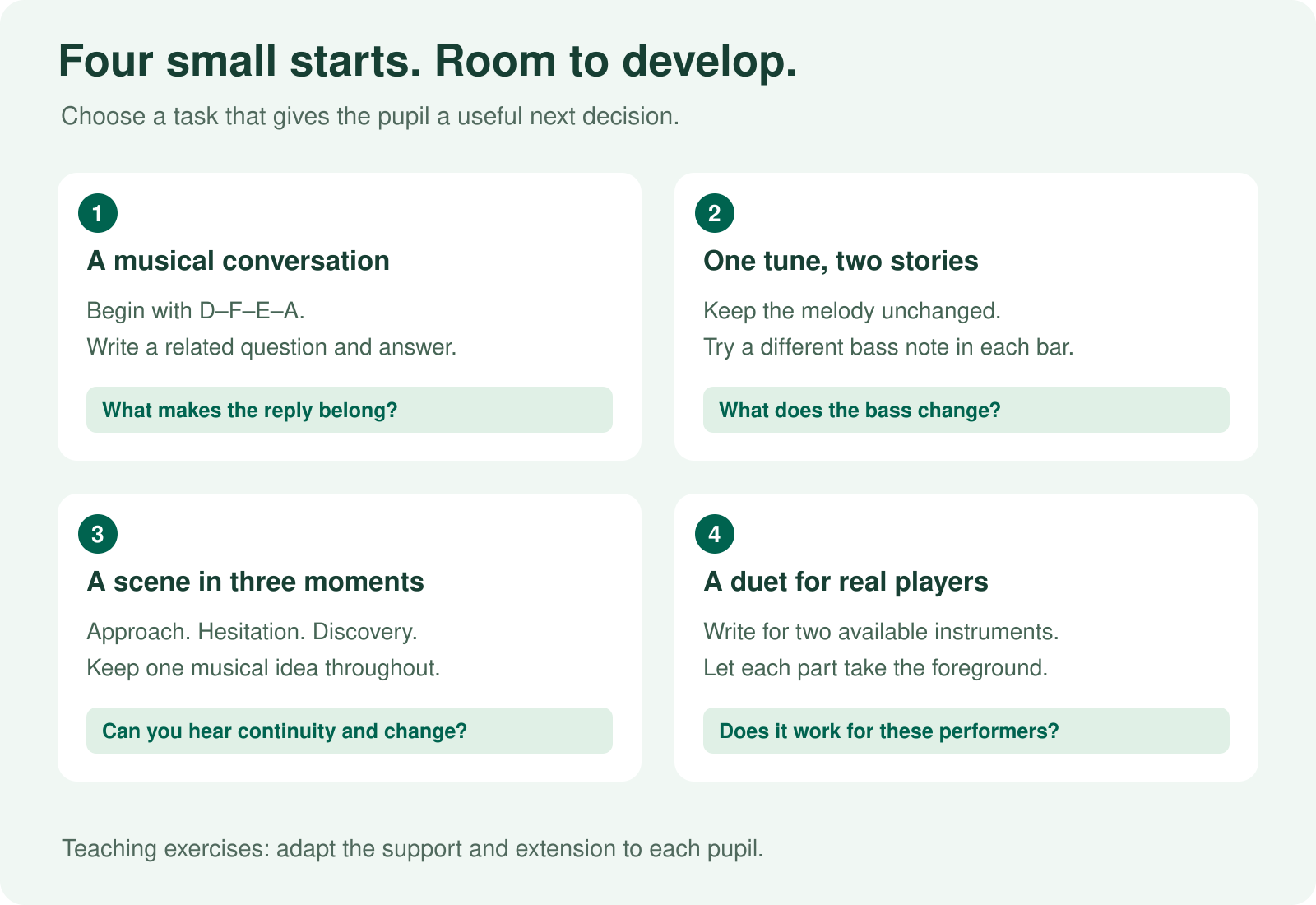
1 Turn four notes into a musical conversation
Start in D minor, in 4/4. Write D4, F4, E4 and A4 as four crotchets, where C4 is middle C. Play the bar twice. Ask pupils what makes it recognisable: the rhythm, the rising third, the step down or the final leap?
The task: turn the motif into a four-bar question and answer. Keep bar one, vary it in bar two, then write a two-bar reply. The reply should have an audible connection to the opening.
For pupils who need a narrower starting point, use only D, E, F, G and A, with crotchets and minims. Ask them to finish once on A and once on D, then compare the effect. They can sing or play a reply before notating it.
A-level extension: carry the motif into an eight-bar passage. Change its harmonic setting or place it in a second voice. Ask students which feature they preserved so the listener can still recognise it.
Listen for: does the answering phrase belong to the same piece, and does it sound like an answer?
2 Make the same melody tell two stories
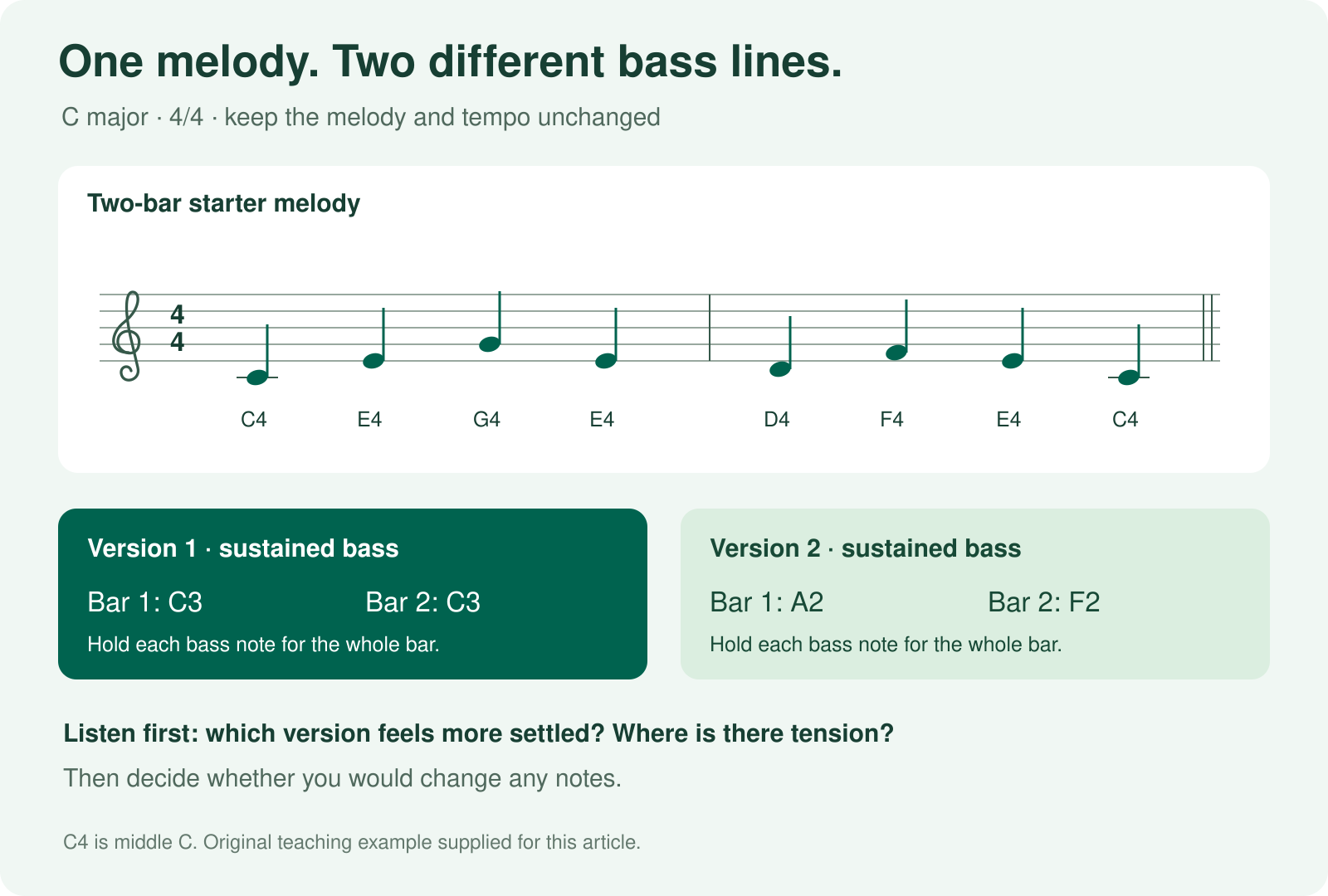
Use a short two-bar melody in C major, in 4/4.
The task: make two versions by adding one sustained bass note per bar. For the first, try C3 then C3. For the second, try A2 then F2. Keep the melody and tempo unchanged so pupils can hear what the bass changes.
Ask them to describe the difference before giving it a theoretical label. Which version feels more settled? Where do melody and bass create tension? Would they change any notes?
For support, begin with just the first bar and compare the two bass notes. Pupils who are ready can turn the sustained notes into an accompaniment pattern.
A-level extension: develop an alternative harmonisation using fuller chords, voice leading and a planned point of arrival. Explain how the harmony changes the phrase's direction.
Listen for: what changes when the tune stays the same?
3 Compose a scene using one recurring idea
Give the class this scene: someone approaches a closed door, hesitates, then opens it.
The task: write three short sections for approach, hesitation and discovery. Use one recurring musical idea across all three. A repeated note, a two-note figure or a rhythm is enough.
Let pupils choose what is behind the door. That decision gives them a reason to change the music. A discovery might feel welcoming, comic or unsettling; pupils should be able to explain how their choices support that interpretation.
For support, supply a three-part planning sheet with space to choose tempo, register and texture for each section. Demonstrate one change and ask pupils to propose another.
A-level extension: transform the recurring idea across the sections and manage the transitions. Explore how harmony, pacing and orchestration can change its meaning.
Listen for: can you hear both continuity and a change in the scene?
4 Write something classmates can actually play
Choose two available instruments, or voice and an instrument, and agree a comfortable range with the performers.
The task: write an eight-bar duet in which each part has a moment in the foreground. Begin with a melody and a simple accompaniment, then exchange their roles.
For support, restrict the pitch range, use a familiar metre and leave room for breathing or movement between phrases. Pupils can work in pairs on shared devices, alternating between composing and checking the parts.
A-level extension: use imitation or a countermelody while keeping the parts idiomatic. Ask the performers what they would change and decide which suggestions serve the piece.
Listen for: does the arrangement work for these players? Use playback to explore the texture, then test the parts with the musicians. A convincing playback is a starting point for that conversation.
Help pupils hear the next decision
In Flat for Education, pupils can enter these examples in the notation editor and use playback to compare their ideas. For a demonstration, prepare the opening and two different continuations, then ask the class which continuation works better and why.
When you are ready to collect individual work, a composition assignment can start from a score template. You can retain supplied notes with the template lock and choose the notation tools available to pupils.
At GCSE/IGCSE, focus on a coherent idea and a purposeful change. At A level, ask for more sustained development and greater control of the relationship between melody, harmony and texture. Adapt the challenge to the pupil's musical starting point as well as the qualification.
Try the four-note starter in Flat for Education
Start with one bar: D, F, E, A. Create an answering phrase, play both back and change one thing. You can prepare and demonstrate the activity using your own teacher account before adding pupil accounts.
Start your free 30-day trial and use the first starter as your first score.
Continue with How to teach GCSE and A-level composition beyond the first eight bars, the next article in this series.
FAQ
Can these starters be used for assessed compositions?
They are teaching exercises using supplied material. For assessed work, follow the current specification and rules on originality, permitted support and authentication. Pupils need to develop their own musical ideas under the conditions required by their exam board.
Do pupils need strong notation skills to begin?
They can first sing, play or describe an idea, then work on representing it accurately. A restricted pitch set and a short rhythmic pattern can make that translation more manageable.
More in the UK GCSE and A-level series
- How to teach GCSE and A-level composition beyond the first eight bars
- GCSE music theory and aural practice that shows you what to teach next
- Recording GCSE and A-level music practice so feedback leads somewhere
- Best music notation software for UK schools in 2026
- Using Flat for Education and Music Snippet for GCSE and A-level music