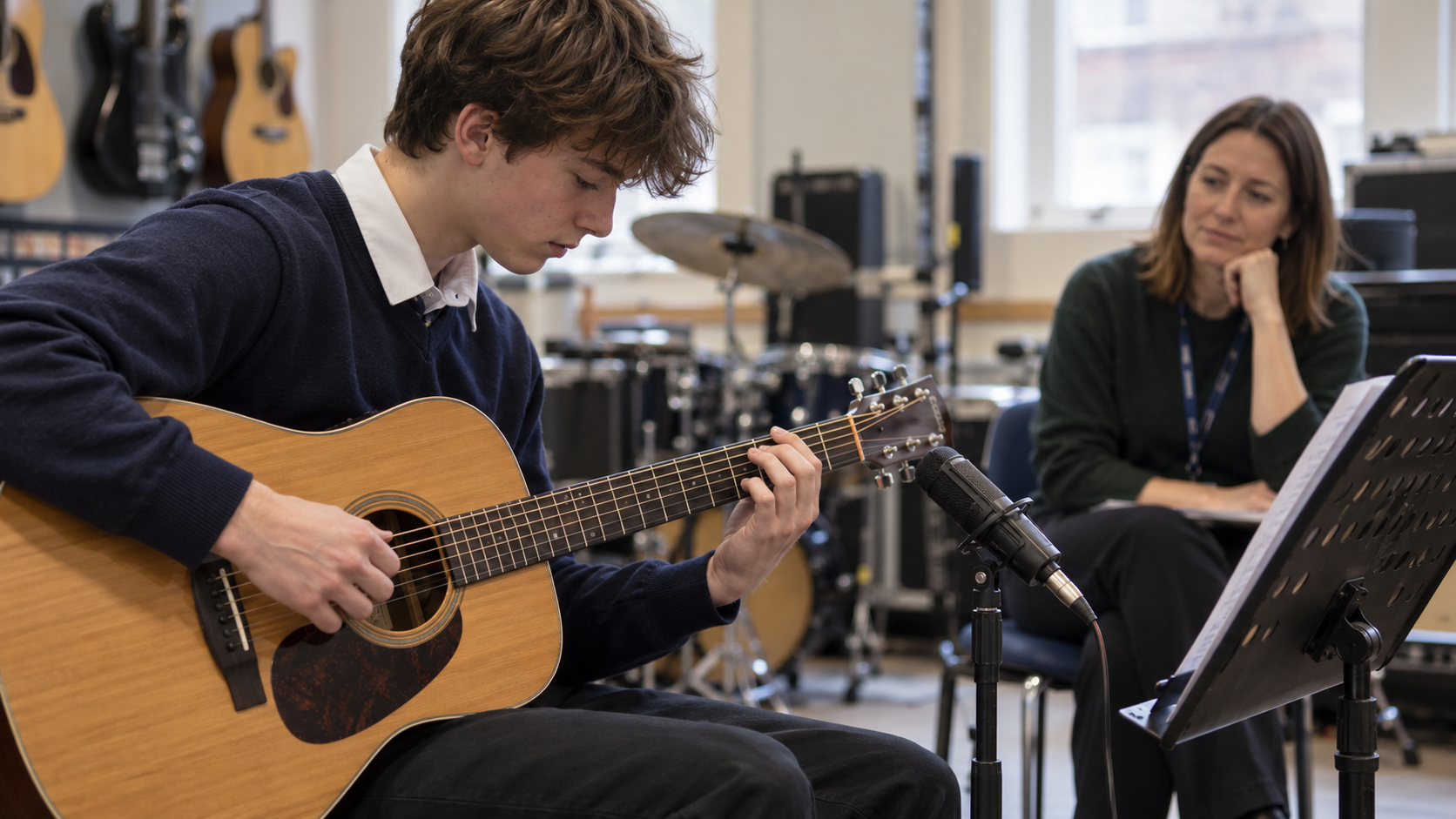
"It was better when I practised it."
A pupil may be right. The difficult passage went well yesterday, but today's performance gives you little sense of what changed, how they practised or where the problem begins.
A short practice recording gives you something specific to discuss. It also gives the pupil a chance to hear the performance from the listener's side and decide what to work on next.
For GCSE/IGCSE and A-level music, the useful routine is simple: choose a passage, record it, identify one improvement and return to it. A clear collection process helps you spend the review time on the music.
Give each recording one purpose
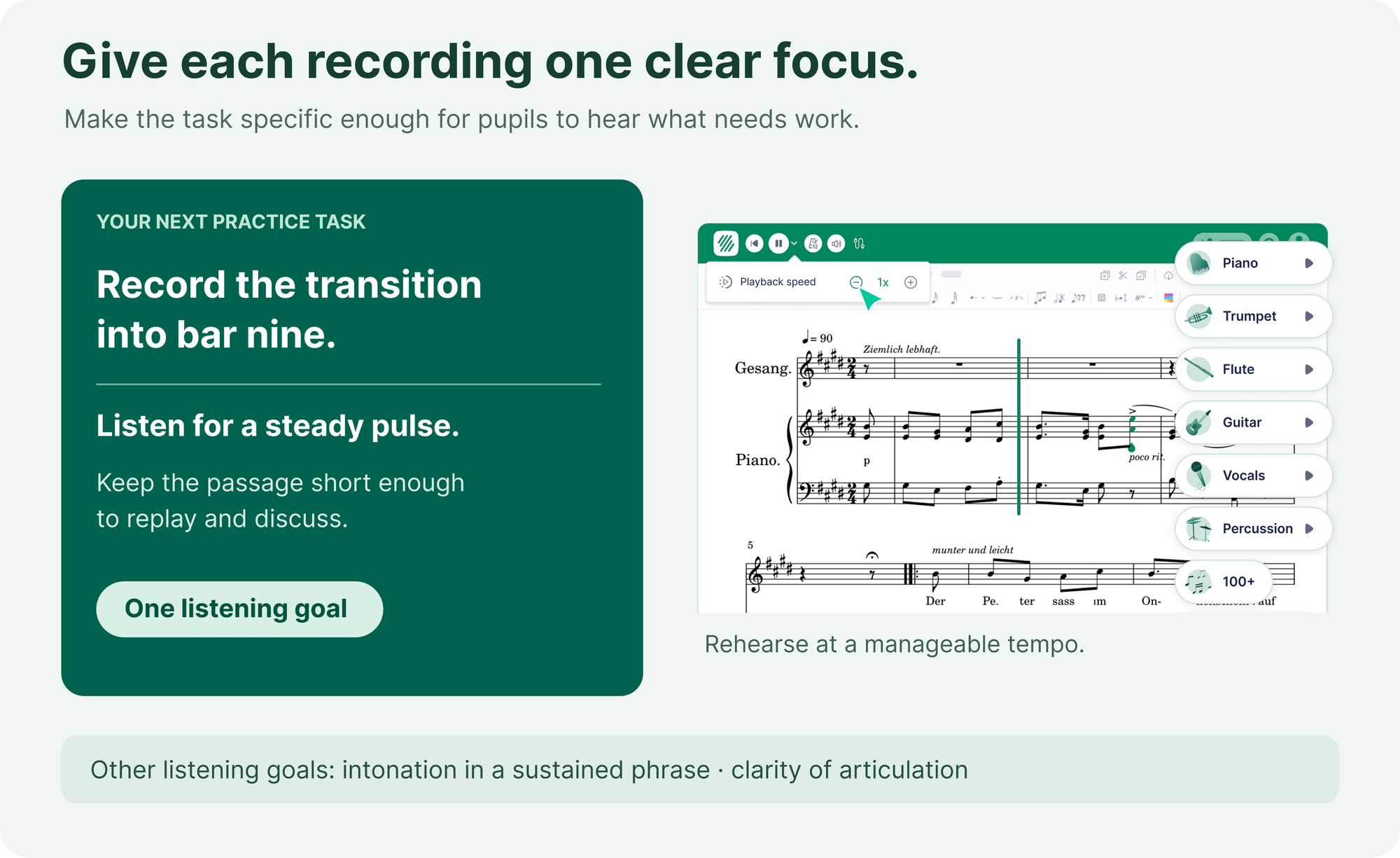
"Record your piece" is a large task with an uncertain outcome. "Record the transition into bar nine and listen for a steady pulse" gives the pupil a more useful focus.
Choose a passage short enough to replay attentively. Agree one listening criterion, such as the pulse through a transition, intonation in a sustained phrase or clarity of articulation.
For a Year 10 practice task, supply the criterion and model what to listen for. At A level, ask students to identify a priority themselves and explain how it relates to their interpretation.
A short recording can then become evidence for a musical decision, rather than another file submitted to meet a deadline.
Try a two-recording practice cycle
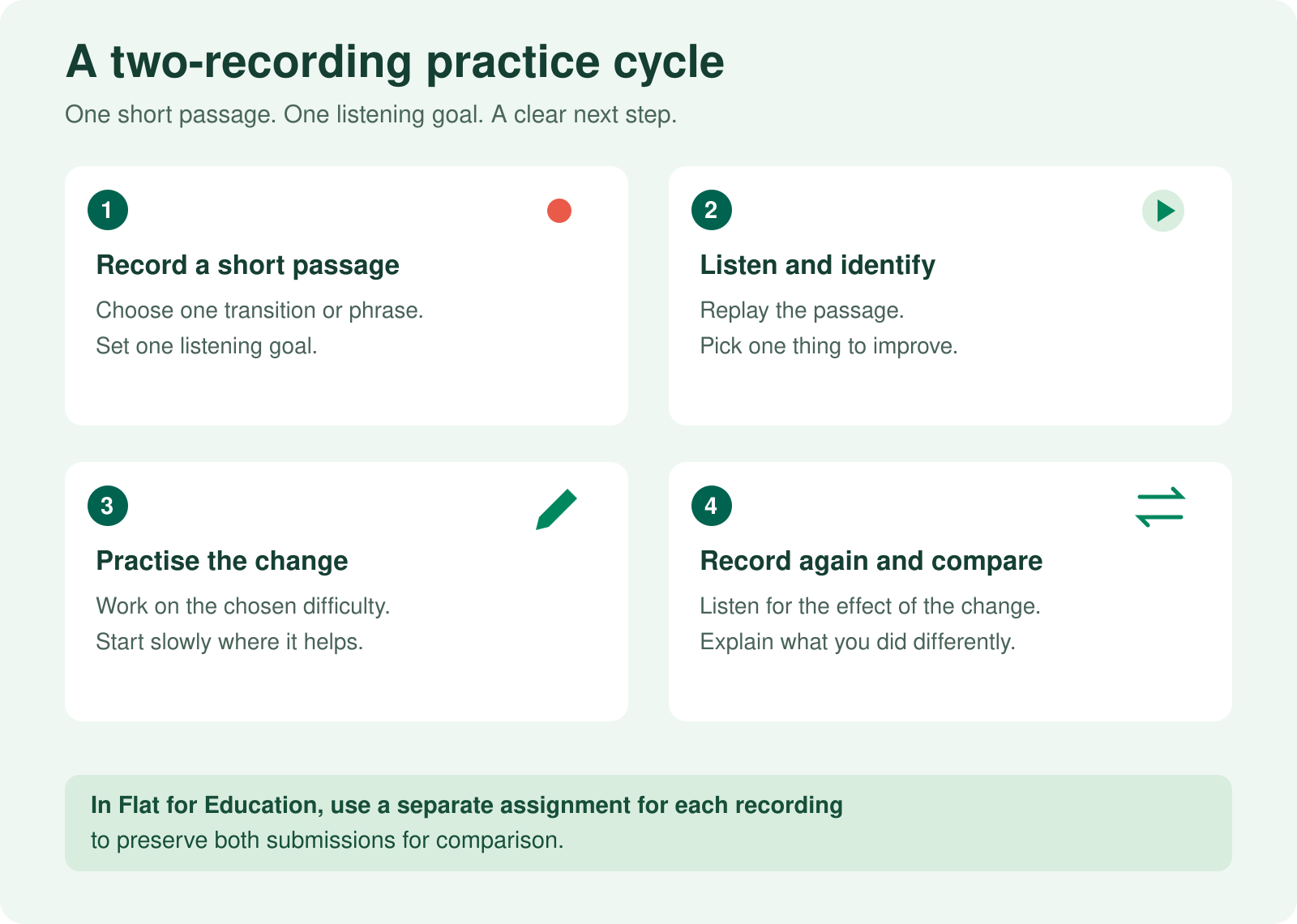
Here is an illustrative task for a pupil who rushes a transition:
- Choose the final two bars of one phrase and the first two of the next.
- Record the passage at a manageable tempo.
- Listen back and identify where the pulse changes.
- Practise the join slowly, then work towards the intended tempo.
- Make a later recording and compare the transition.
Ask for one short reflection: "What did you change in your practice, and where can we hear the effect?"
If the second take is still uneven, that is useful information too. The next conversation can focus on whether the difficulty lies in fingering, breath, coordination or the pupil's sense of the pulse.
Keep the recordings and feedback together
With performance assignments in Flat for Education, pupils can record audio or video and submit it for teacher review. Choose a score-based assignment when the activity uses a particular score, or Free Record for a performance without an attached score.
For the two-recording cycle, create separate assignments, such as "Transition practice 1" and "Transition practice 2". This preserves two submissions to revisit; the recording workflow itself saves one take at a time.
Free Record has a 10-minute limit per submission. Score-dependent controls are not available in that mode, so choose a score-based task if you want the relevant playback or practice controls during recording.
Begin with one pupil submission on a school device before rolling the activity out to the class. Check microphone access and choose a recording location where the sound is clear enough for the listening goal. A short audio take may be sufficient; video is useful when seeing technique serves the feedback.
Give feedback the pupil can test
"Keep practising the transition" leaves the pupil to solve the same problem alone.
A more actionable response identifies the moment and gives a next step: "The pulse speeds up as you change position. Practise the join at a slower tempo, then record those four bars again."
Keep the response proportionate to the task. One passage and one priority make the follow-up manageable for both of you. Where possible, ask the pupil to listen and comment before reading your feedback, so they practise recognising the issue themselves.
Flat's metronome and tuner can support preparation where relevant. Introduce a tool because it helps with the chosen goal, such as using a slower pulse to rehearse the join.
Make the routine possible at school
Do not make a home recording the only way to complete the task. Some pupils will need access to a school instrument, a suitable device or a quieter space.
Plan a recording opportunity during a lesson, rehearsal or supervised practice time. Start with a small group if that is more workable than recording everyone in one session.
The routine can sit alongside live feedback. It gives you and the pupil another way to revisit a passage when hearing it once was not enough.
Keep formal assessment requirements in view
This is a classroom practice workflow. For the final assessed performance, follow the current exam-board requirements for supervision, recording, permitted support and submission. Collecting work in Flat does not itself complete the board's submission process.
Try one passage with one clear goal
Choose a transition or phrase you are already teaching. Create a performance assignment, set one listening criterion and plan a second assignment for the follow-up take.
Start your free 30-day trial and test the workflow before introducing it to your class.
For a wider department evaluation, read Best music notation software for UK schools in 2026 in this series.
FAQ
Are performances marked automatically?
In this workflow, you listen and provide the feedback. Flat's automatic worksheet marking does not assess these performance recordings.
Do pupils need a notated score to submit a practice recording?
No. Free Record allows a recording without an attached score. Use a score-based assignment when the score and its supported controls are part of the activity.
More in the UK GCSE and A-level series
- GCSE music composition ideas pupils can build on
- How to teach GCSE and A-level composition beyond the first eight bars
- GCSE music theory and aural practice that shows you what to teach next
- Best music notation software for UK schools in 2026
- Using Flat for Education and Music Snippet for GCSE and A-level music