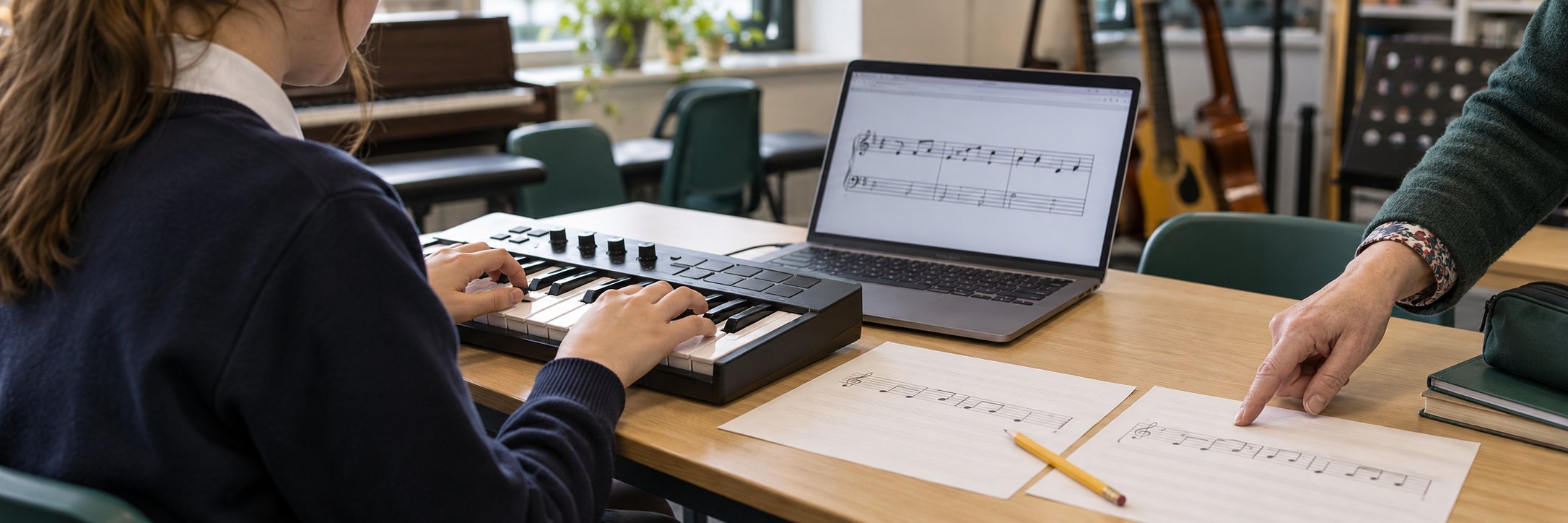
The opening sounds promising. Then it happens again. And again.
Ask the pupil what comes next, and they may add a new instrument, change the sound, or start a completely unrelated section. Plenty is happening on the screen, but the musical idea is standing still.
This is a useful moment to teach composition. The pupil has material worth working with. The next lesson can help them hear what development sounds like and choose a direction for their own music.
The sequence below follows one short idea from its first variation to a revised passage. Use it for classroom practice at GCSE/IGCSE Music, with a more demanding version for A-level students.
Begin with a decision the class can hear
Take a one-bar motif in D minor: D4, F4, E4, A4, all crotchets in 4/4. Repeat it once without changing anything.
Now change only the rhythm of the repeat. Keep the four pitches, but use a dotted crotchet, a quaver and two crotchets. The bar still contains four beats, yet the phrase has a different sense of movement.
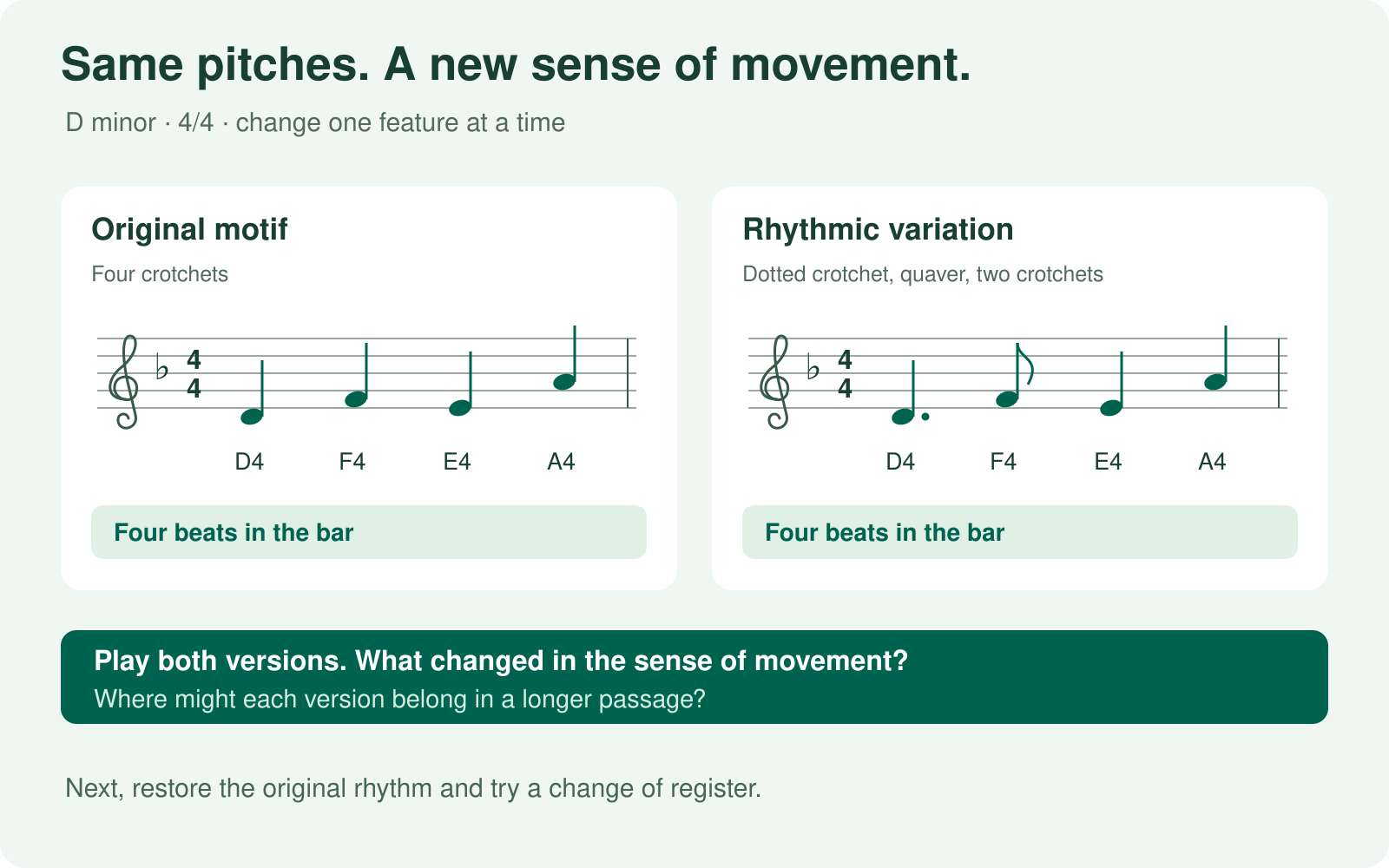
Play the versions in succession. Ask: does the second version feel more urgent, less balanced or simply different? Where might it belong in a longer passage?
Next, return to the original rhythm and try a change of register. Compare again. Changing one feature at a time helps pupils connect what they wrote with what they heard.
In Flat for Education, you can prepare the alternatives as short scores and demonstrate them through playback. Keep the examples small enough that the class can identify the decision.
Give each stage a musical purpose
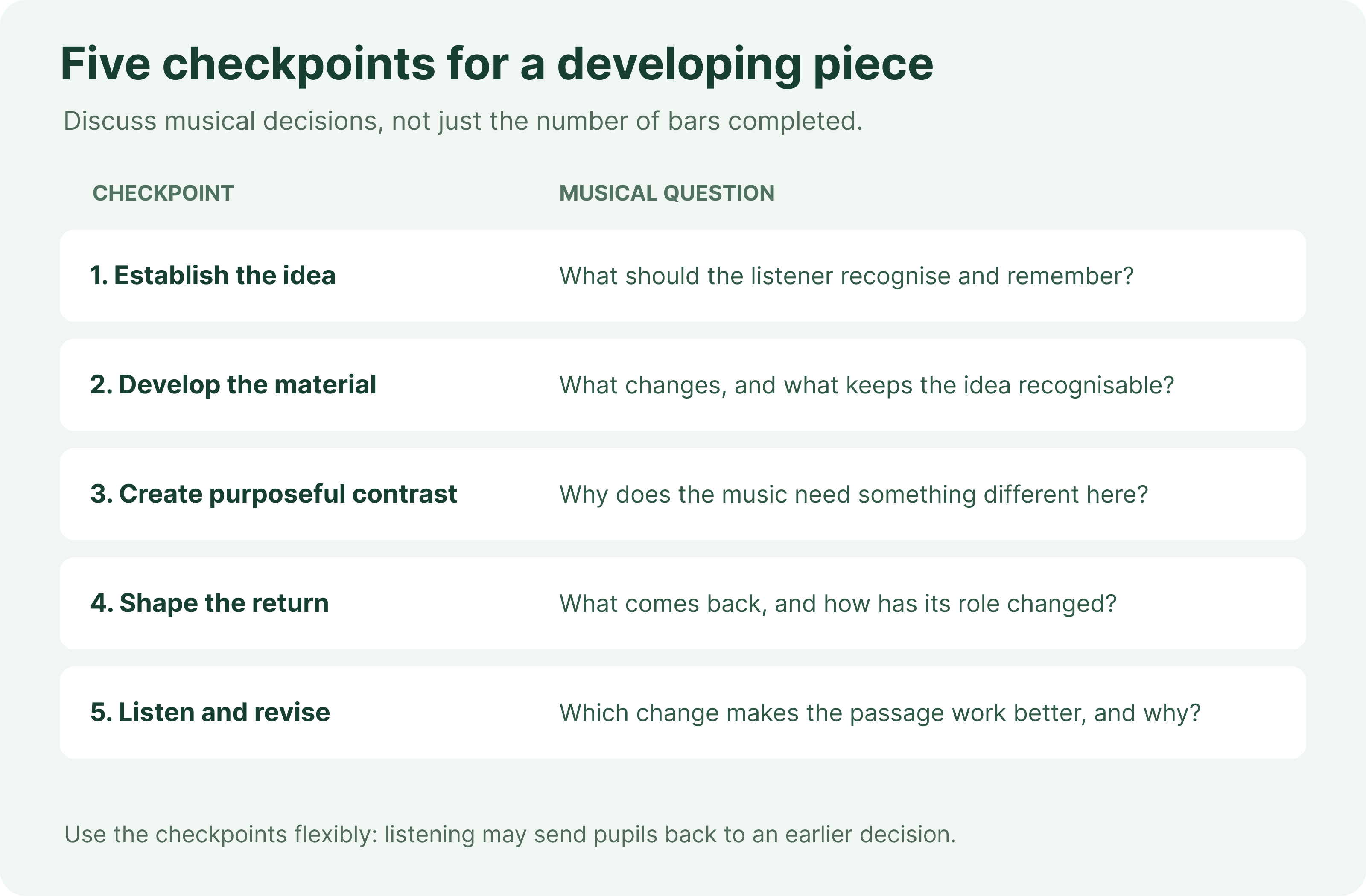
Use five checkpoints to make progress visible.
These checkpoints give you a way to discuss progress without measuring it only in bars completed. A pupil who removes an ineffective section may have made a stronger musical decision than one who adds another page.
Teach structure through what the listener needs
Before asking for a new section, ask what the current one has established. Does the listener know the main idea? Has it developed? Is there a reason for contrast now?
For a GCSE practice task, a short returning structure can make this manageable: establish an idea, contrast it, then bring something recognisable back. Pupils should still decide the proportions, musical content and treatment of the return.
At A level, explore how the return can be changed by what happened in between. A different harmonic setting, a thinner texture or a delayed arrival can give familiar material a new function. The extension is greater control of the whole passage, rather than simply more bars.
Make feedback lead to a pupil decision
Compare these two comments:
"Add more variety."
"You described this section as building tension. Where can we hear that increase between bars five and eight?"
The second gives the pupil a musical question to investigate. They might change the bass, narrow the spacing, increase rhythmic activity or decide the original intention no longer fits.
With Flat for Education's review tools, you can open work in progress and respond before submission. Focus a review on one decision the pupil can hear and act on. There is no need to comment on every bar.
For a manageable routine, ask pupils to identify the passage they want feedback on and explain the problem first. That gives your response a purpose and encourages them to listen before asking for help.
Build independence across the course
Use short shared exercises to introduce techniques, then ask pupils to apply them to fresh material of their own. Gradually reduce the prompts as they become more confident in selecting, testing and revising ideas.
Flat for Education's published Finham Park teacher story offers a UK example of this longer view. Head of Music Jo Sharkey describes a sequence of projects connecting theory and composition before GCSE. It is a useful illustration of building familiarity over time, rather than expecting one software lesson to create independent composers.
For live assessed work, use your board's current rules on feedback, supervision and authentication. The AQA GCSE guidance, for example, requires teachers to review how work develops and record support received.
Build one worked example before your next lesson
Create an opening motif and a rhythmic variation in Flat for Education. Play them to the class, discuss the difference, then ask pupils to make and justify their own change.
Start your free 30-day trial and prepare the demonstration first. Add a class when you are ready to follow pupils' drafts and give feedback.
For more starting material, read GCSE music composition ideas pupils can build on in this series.
FAQ
How can I help pupils who keep repeating their opening?
Ask them to preserve one recognisable feature and change another. Compare the result with the original, then discuss where each version could belong. Begin with a short passage so the effect is easy to hear.
Does Flat for Education assess the quality of a composition automatically?
You provide the musical judgement and feedback. Automatic marking is available for supported theory and ear-training worksheet exercises; it does not replace your evaluation of a pupil's creative choices.
More in the UK GCSE and A-level series
- GCSE music composition ideas pupils can build on
- GCSE music theory and aural practice that shows you what to teach next
- Recording GCSE and A-level music practice so feedback leads somewhere
- Best music notation software for UK schools in 2026
- Using Flat for Education and Music Snippet for GCSE and A-level music